 Omar Haddad
Two days in Yerevan splits into one city day and one valley day, and the order matters: day one walks the pink tuff centre, Republic Square, Northern Avenue, the Cascade and the Matenadaran manuscripts, while day two drives east to the pagan temple at Garni and the rock cut monastery of Geghard, the classic half to full day trip that every first visit should include. Yerevan, one of the world’s oldest continuously inhabited cities, founded as Erebuni in 782 BC, is compact at its centre and built from rose pink volcanic tuff that glows at both ends of the day. The Garni and Geghard run is about 30 kilometres to the temple and a further 10 or so to the monastery, and it is timed and costed below in the way travellers actually do it: by hired car or tour for ease, by minibus for economy. Keep Monday for the day trip, because Yerevan’s major museums, the Matenadaran included, close on Mondays.
Quick Facts
- Where: Yerevan, capital of Armenia, at about 1,000 metres elevation in the Ararat plain foothills
- Founded: As the Urartian fortress of Erebuni in 782 BC, making the city older than Rome
- The stone: Pink and rose tuff, the volcanic stone that faces the centre and gives Yerevan its Pink City nickname
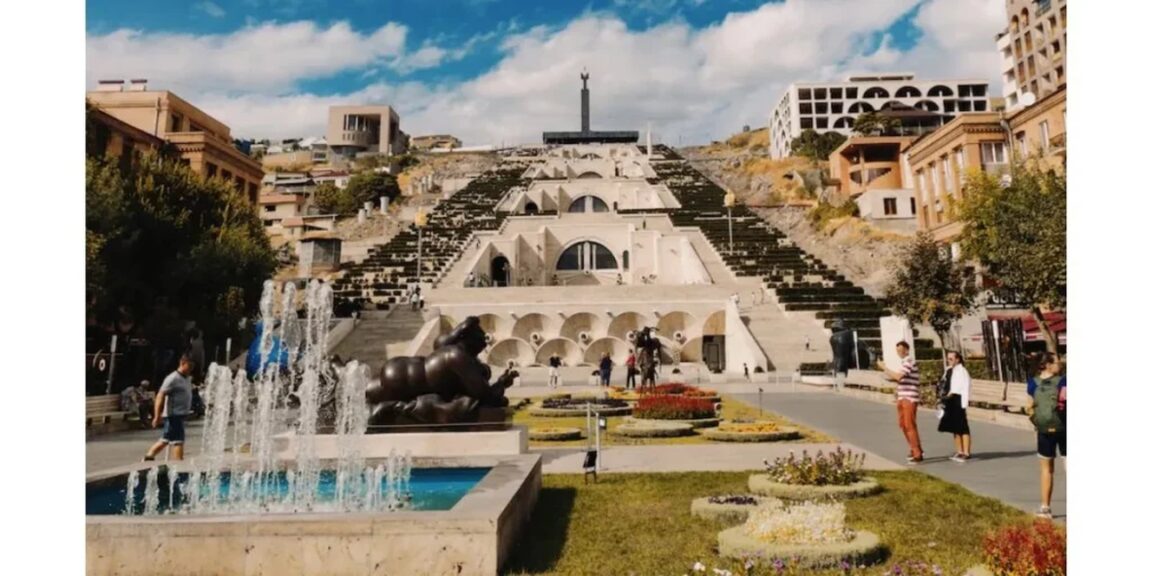
- The Cascade: A monumental stairway of 572 steps linking the centre to the Monument district, housing the Cafesjian Center for the Arts, with internal escalators running daily in recent schedules
- The manuscripts: The Matenadaran, Mesrop Mashtots Institute of Ancient Manuscripts, holding one of the world’s richest collections of medieval manuscripts; museum generally open Tuesday to Saturday, closed Sundays, Mondays and holidays
- Day trip: Garni Temple, about 30 kilometres east, the only standing Greco Roman colonnaded temple in the former Soviet region, built in the 1st century AD; Geghard Monastery about 10 kilometres further, partly carved from the cliff, UNESCO listed with the Upper Azat Valley in 2000
- Money: Armenian dram (AMD); cards widely accepted in the centre, cash useful for minibuses, rural sites and small cafes
Day 1 morning: Republic Square and the pink centre
Begin at Republic Square, the oval heart of the city laid out under the architect Alexander Tamanyan’s master plan, ringed by five pink tuff buildings in a neo Armenian classical style: the History Museum of Armenia and the National Gallery share the great curved block on the square’s north side, flanked by ministries, the post office and the Marriott hotel building. The square’s singing and dancing fountains perform in the evenings in the warmer months, roughly from 9 pm, and are worth returning for after dinner. The History Museum is the right first museum if you only take one on day one: its collections run from Bronze Age carts to medieval khachkar crosses, and they frame everything you will see at Garni and Geghard tomorrow. Recent schedules list it closed on Mondays, like most Armenian state museums.
Walk north up Northern Avenue, the pedestrian boulevard of cafes and shops cut through the centre in the 2000s, to the Opera House and Freedom Square, the cultural centre of gravity, with Swan Lake pond beside it and the cafe terraces of the surrounding streets doing brisk business at every hour. This central loop, square, avenue, opera, is flat, pink and photogenic, and it orients you for everything else: the Cascade rises to the northeast, the Matenadaran stands at the top of Mashtots Avenue to the northwest, and the gorge of the Hrazdan River cuts along the west.
Day 1 afternoon: the Cascade and the Matenadaran
The Cascade is Yerevan’s signature structure, a giant limestone and tuff stairway of 572 steps and five terraced levels climbing from Tamanyan Street toward the Monument district and Victory Park. Conceived in Tamanyan’s plans, built from the 1970s and completed in its current form under the Cafesjian Center for the Arts, it works three ways at once: as a staircase, as an open air sculpture garden, with works by Fernando Botero, Barry Flanagan and others on the terraces and in the park at its base, and as a museum, since the arts centre’s galleries occupy the levels inside. The internal escalators run daily, about 8 am to 8 pm in recent schedules, with the exhibition galleries keeping shorter hours, typically Friday to Sunday, so ride up inside, walk down outside, and time the top for late afternoon, when the view across the pink rooftops to Mount Ararat, across the border in Turkey and visible on clear days, is at its most likely and most golden. Ararat is the emotional centre of Armenian geography, and the Cascade top is the city’s best free seat for it; go on your clearest morning or evening, because haze hides the mountain for days at a time.
Pair the Cascade with the Matenadaran, a short walk northwest at the head of Mashtots Avenue, beneath the statue of Mesrop Mashtots, creator of the Armenian alphabet in 405 AD. The institute guards one of the world’s great manuscript collections, tens of thousands of manuscripts and fragments in Armenian and many other languages, and its museum displays illuminated gospels, medical and astronomical treatises and the largest Armenian manuscript of all, alongside one of the smallest. Guided tours in several languages run through the day and transform what would otherwise be a room of beautiful but unreadable books. The museum generally opens Tuesday to Saturday, about 10 am to 5:50 pm, and closes on Sundays, Mondays and public holidays, so on a two day visit that starts on a Sunday or Monday, the Matenadaran must anchor day one accordingly, or be swapped with the History Museum. Finish the day at the Vernissage open air market near Republic Square for crafts, paintings and carved wood, strongest at weekends, and with dinner on Saryan Street, the centre’s wine bar row, where Armenian wines from Areni and other regions are poured by the glass.
Day 2: Garni and Geghard, timed and costed
The Garni and Geghard trip is the essential Yerevan excursion, and it sequences in one direction only: out through the Charents Arch viewpoint, where the road frames Mount Ararat, to Garni first, then up the Azat gorge to Geghard, then home. Garni Temple stands on a cliff edged plateau above the gorge, a colonnaded temple of the 1st century AD dedicated to the sun god Mihr, the only pagan temple to survive Armenia’s Christianisation in any complete form, collapsed in the earthquake of 1679 and rebuilt in the 1970s from its original stones. The site also holds a Roman era bathhouse with a mosaic floor and the ruins of the royal palace and church. Entry to the Garni site is ticketed, with a modest fee for foreign visitors listed by the site administration; carry dram in cash. Below the temple, the gorge holds the Symphony of Stones, a cliff of hexagonal basalt columns reached by a walk down from the village, which adds 45 minutes and is worth it for walkers.
Geghard, about 10 kilometres further up the valley, is the greater wonder. The monastery, whose name means spear, for the Holy Lance once kept here, was founded in the early centuries of Armenian Christianity and built mainly in the 12th and 13th centuries, with chapels and chambers carved directly into the living cliff, extraordinary acoustics in the rock cut halls, and khachkars carved into the rock face outside. It has been a UNESCO World Heritage Site with the Upper Azat Valley since 2000. There is no entrance fee to the monastery itself, though a small parking charge may apply, and modest dress and covered shoulders are expected in the working church. Allow 60 to 90 minutes, and buy gata, the sweet bread baked by village women at the gate, for the drive home.
Now the timing and costing, stated as ranges because operators adjust them seasonally. By private car with a driver, or on a small group tour, the round trip takes about 4 to 5 hours for both sites without rushing, and group tours from Yerevan are among the best value in the Caucasus, typically priced in the low tens of US dollars per person including transport and a guide, with private cars costing several times that for the vehicle. By public transport, minibus 266 and connecting services run from Yerevan’s Gai station area toward Garni roughly every 30 minutes in daytime for a very small fare, but onward transport from Garni to Geghard is irregular, so the minibus version works only with a negotiated taxi for the Garni to Geghard leg and back to Garni, arranged with the driver before you set off. The honest recommendation for a two day visit is the tour or driver: the saving from the full minibus version is real but small, and the time it risks is the scarcest thing you have. Travellers building a Caucasus and Central Asia loop will find the same Soviet and Silk Road layers handled in our Almaty guide, and the Baltic old town pacing of our Vilnius two day plan is the closest European cousin to this itinerary’s shape.
Frequently Asked Questions
How do you do Garni and Geghard in one day?
Easily, because they share one road east of Yerevan: Garni at about 30 kilometres, Geghard about 10 kilometres beyond. A tour or hired car covers both in 4 to 5 hours with proper time at each. Visit Garni first, then Geghard, and stop at the Charents Arch for the Ararat view on the way out if the morning is clear.
What does the Garni and Geghard trip cost?
Group tours from Yerevan typically run in the low tens of US dollars per person, private cars with drivers cost several times that per vehicle, and the minibus to Garni costs a very small fare but leaves the Garni to Geghard leg to a negotiated taxi. Garni charges a modest site entry fee; Geghard monastery itself is free, with a possible small parking charge. Confirm current prices when booking, as operators adjust them seasonally.
When is the Matenadaran open?
The Matenadaran museum generally opens Tuesday to Saturday, about 10 am to 5:50 pm, and closes on Sundays, Mondays and public holidays. That closure pattern is why this itinerary keeps Monday for the Garni and Geghard trip. Take a guided tour inside if one fits your timing; the manuscripts reward explanation.
Can you climb the Cascade, or is there an easier way up?
Both. The Cascade has 572 steps for those who want them, and a system of escalators inside the complex, running daily in recent schedules, that carries you between levels past the arts centre galleries. Many visitors ride up and walk down. The exhibition galleries inside keep shorter hours than the escalators, typically Friday to Sunday.
Will you see Mount Ararat from Yerevan?
On clear days, yes, and the top of the Cascade is the classic viewpoint, with the Charents Arch on the Garni road the classic framed shot. Early morning offers the best odds before haze builds. Ararat sits across the closed border in Turkey and cannot be visited from Armenia, which is part of its emotional weight in the city.
When is the best time to visit Yerevan?
Spring, roughly April to June, and autumn, September to November, bring the most comfortable walking weather and the clearest Ararat views. Summer is hot at midday, though the elevation takes the edge off evenings, and winter is cold with short days but atmospheric snow. The museum Monday closure rule applies in every season.