 River Callahan
Bokor Hill Station is a day trip with no ticket desk, no fixed opening ceremony and no single gate price to memorise: the historic plateau inside Preah Monivong Bokor National Park, about 37 kilometres west of Kampot in southern Cambodia, is reached by one winding mountain road, current visitor reports put entry to the park itself at free, and the only charge most travellers meet is a small fee of around 2,000 riel at Popokvil Waterfall. What the trip does demand is timing. The plateau sits at about 1,080 metres, cloud can erase the view by late morning, and the sights string out along the summit roads in an order that rewards a plan: the Lok Yeay Mao statue and the Black Palace on the way up, the old Catholic church and the Bokor Palace at the top, Wat Sampov Pram for the coast view, and Popokvil Waterfall last, when it is running. Go early, go on a clear day if you can choose, and treat the modern casino resort that now shares the plateau as scenery, not as the point. This guide runs the drive in order, and it pairs with the Borobudur sunrise visit guide for travellers building a Southeast Asia heritage route.
Quick Facts
- What: A French colonial hill station built in the early 1920s on Bokor Mountain in Preah Monivong Bokor National Park, Kampot Province, Cambodia, centred on the Bokor Palace Hotel, inaugurated in 1925
- Base: Kampot, about 37 kilometres away. The park turn off is on Highway 3, roughly 8 to 11 kilometres from town, then about 32 kilometres of mountain road to the plateau
- Height and climate: About 1,080 metres above sea level. Noticeably cooler than the coast, and frequently in cloud. Clear views are most likely early in the day and in the dry season, roughly November to March
- Entry: Current visitor reports put entry to the national park and the historic public landmarks at free. Popokvil Waterfall charges a small separate fee, reported at around 2,000 riel, about 0.50 US dollars, with a bottle of water included. Gate practice has varied over the years, so carry small cash and confirm on the day
- Time needed: A full day trip from Kampot, about 1 to 1.5 hours of driving each way without stops
- Key sights in road order: Lok Yeay Mao statue, Black Palace, Bokor Palace, the old Catholic church, Wat Sampov Pram, Popokvil Waterfall
What is Bokor Hill Station, and what state is it in now?
The French built Bokor in the early 1920s as a temperate escape from the heat of the plains: a small resort town with a post office, shops, a Catholic church, royal apartments and, as its centrepiece, the grand Bokor Palace Hotel and Casino, inaugurated in 1925. The station was abandoned in the late 1940s during the First Indochina War, revived in the 1950s and 1960s as a glamorous Cambodian retreat, then abandoned again in 1972 as the Khmer Rouge took the area, and the palace and the church were fought over in the years that followed. That layered history is exactly what you see now, but one common description is out of date. The palace is no longer a hollow ruin you can wander through. It was restored and reopened in December 2017 as Le Bokor Palace, a luxury hotel, so today visitors admire its facade and its cliff edge setting from outside, while the genuinely abandoned buildings are the old Catholic church, the Black Palace and the smaller ruins scattered across the plateau. A large modern casino resort, the Thansur Sokha, opened on the plateau in 2012, which gives the summit an odd double character: half ghost station, half new development. Knowing that in advance stops the place from disappointing anyone who arrives expecting an untouched ruin field.
The mountain itself is protected as Preah Monivong Bokor National Park, established in 1993 and covering a large area of the Damrei, or Elephant, Mountains. The forest on the drive up is part of the experience, with viewpoints over the Kampot plain and the Gulf of Thailand on clear stretches.
How does the drive up work?
From Kampot, take Highway 3 toward Sihanoukville for roughly 8 to 11 kilometres to the signed turn off for the park, pass the entrance arch, and climb about 32 kilometres of paved, sweeping mountain road to the plateau. Most visitors go by rented motorbike, by tuk tuk or car hired in Kampot, or on a day tour booked in town; there is no public bus up the mountain. Fuel up in Kampot, because services on top are limited to the resorts. The road itself is good, but it is a mountain road: mist, rain and monkeys near the verges all argue for a steady pace, and the descent in wet cloud is the part of the day to leave the most time and light for. Near the top the road passes the huge Lok Yeay Mao statue, a revered figure for travellers in Cambodia, where Cambodian visitors stop to make offerings; treat it as a working shrine, not a photo prop, and dress accordingly if you go close.
The Black Palace: the first ruin
About 10 kilometres before the hill station proper, the road passes the Black Palace, Damnak Sla Khmao, a small summer palace built for King Sihanouk in 1936 and named for its dark brick and timber. It is a shell now, open to the weather and the graffiti writers, and it takes ten minutes to look around. It sets the tone for the plateau: beautiful bones of buildings, no interpretation panels to speak of, and an atmosphere that does the work.
What should you see at the top, and in what order?
The Bokor Palace and the old Catholic church
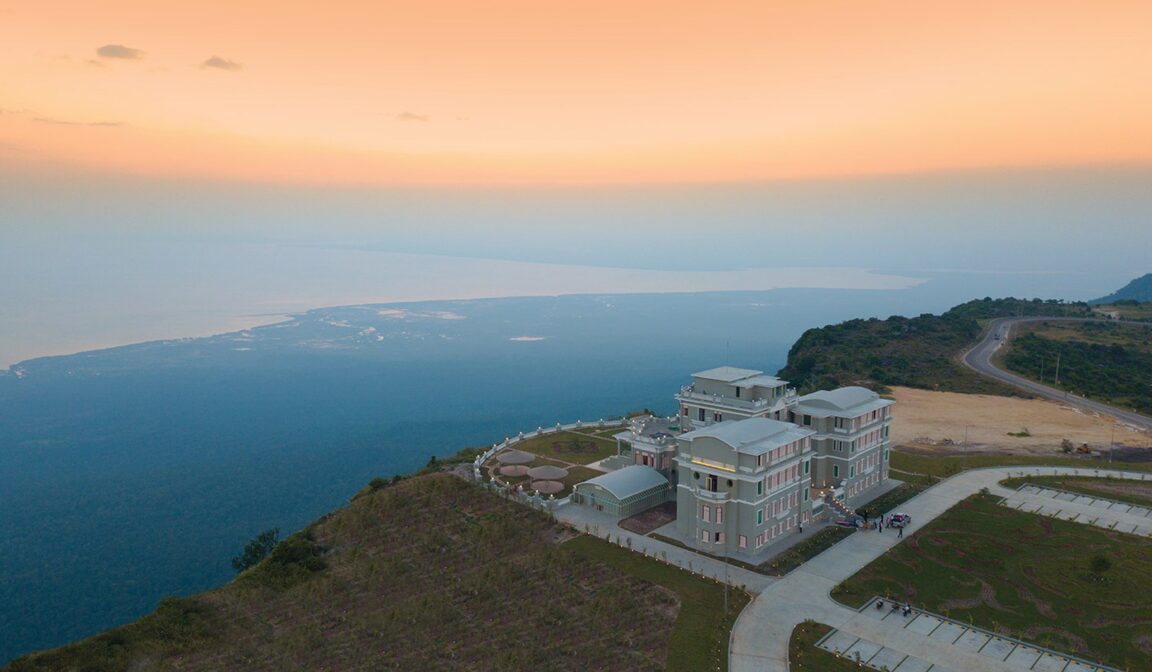
Start with the palace from the outside: the restored 1925 hotel stands at the edge of the plateau with the ground falling away toward the coast, and on a clear morning the view takes in Kampot, the Gulf of Thailand and, offshore, the Vietnamese island of Phu Quoc. Then walk to the old Catholic church, built by the French in the early 1920s, which remains the plateau’s true ruin: a weathered stone shell on a rise, often wrapped in cloud, its interior bare. The contrast between the two buildings, one rescued and one left, is the sharpest summary of modern Bokor. The featured photograph on this guide shows the restored palace above the gulf at sunset, from the hotel’s own site; the church, a few minutes away, looks nothing like it, and that is the point.
Wat Sampov Pram and the viewpoints
Wat Sampov Pram, the temple of five boats, named for five boat shaped rocks nearby, is the plateau’s active Buddhist temple and one of its best viewpoints. It is a working religious site, so shoulders and knees covered, shoes off where indicated, and a small donation is appropriate. Between the temple, the palace terrace area and the roadside pull offs on the descent, Bokor gives you three or four distinct chances at the coast view; if cloud closes one, another may open, which is why a unhurried day beats a two hour dash.
Popokvil Waterfall: save it for last, and for the wet season
Popokvil, whose name is usually translated as swirling clouds, is a two tiered waterfall a short drive beyond the main station area, reached by a short walk. Its upper tier is about 15 metres and its lower about 18 metres in park descriptions. The honest catch is seasonal: after rain, and through the rainy season from about May or June to October, the falls run strongly over their broad rock shelves; in the dry season they can shrink to a modest flow, and a dry season visit is a pleasant picnic stop rather than a spectacle. The small entry fee, reported at around 2,000 riel and including a bottle of water, is collected at the falls. Swim only where locals indicate it is safe, and expect the rocks to be slippery in any season.
When should you go, and what should you bring?
For views, the dry season from about November to March is the safer bet, and an early start matters more than the month: cloud builds on the plateau as the day warms, so a departure from Kampot at around 7 to 8 am gives you the best odds at the top. For the waterfall at full flow, the rainy season wins, at the price of wetter roads and greyer skies. Bring a layer for the summit, because 1,080 metres in wind and mist is genuinely cold in a t shirt, plus water, sun protection for the clear spells, and small cash in riel or dollars for the falls and for offerings or snacks. There is no need to book anything for the hill station itself; book only your transport or tour in Kampot the day before, and check the weather that morning, because a plateau wrapped in white cloud returns a very different day from the one in the photographs. Travellers continuing north can use the Vietnam visa free extension explainer to check entry for the onward leg toward Phu Quoc and the Mekong Delta.
Frequently asked questions
Is there an entrance fee for Bokor National Park?
Current visitor reports say no: entry to Preah Monivong Bokor National Park and its historic public landmarks is free. The exception is Popokvil Waterfall, which charges a small fee reported at around 2,000 riel, about 0.50 US dollars, including a bottle of water. Older guides quote higher park fees, and gate practice has changed over the years, so carry small cash and confirm at the gate on the day.
Can you go inside the Bokor Palace Hotel?
Not as a ruin. The 1925 palace was restored and reopened in December 2017 as Le Bokor Palace hotel, so its interiors are for hotel guests. Visitors view the building and its cliff edge setting from outside. The old Catholic church and the Black Palace remain open ruins.
How long does a Bokor day trip from Kampot take?
Plan a full day. The drive is about 37 kilometres each way and takes roughly 1 to 1.5 hours without stops, and the sights at the top, the palace, church, temple and waterfall, need three to four hours done properly, with slack for cloud to clear.
When is Popokvil Waterfall worth seeing?
In and just after the rainy season, roughly May or June to October, when the two tiers run at full flow. In the dry season the falls can be slight, and the stop becomes a short walk and a picnic rather than a headline sight.
How do you get up Bokor Mountain without a tour?
Rent a motorbike in Kampot if you are licensed and confident on mountain roads, or hire a tuk tuk or car for the day. There is no public transport up the mountain. Fuel up in town, start early, and leave extra time and daylight for the descent.
What should you wear and bring?
A warm layer for the summit, which is windy and often in cloud at about 1,080 metres, covered shoulders and knees if you plan to enter Wat Sampov Pram, water, sun protection, and small cash for the waterfall fee and offerings.
Facts checked 16 November 2026 against Preah Monivong Bokor National Park visitor sources, Kampot guides checked in October and November 2026, and the Le Bokor Palace official site. Fees on Bokor are reported inconsistently between seasons, so confirm charges at the gate and the falls on the day. Photo: Le Bokor Palace, the restored 1925 Bokor Palace Hotel, above the Gulf of Thailand at sunset. Photo by Le Bokor Palace, from the hotel’s official site, lebokorpalace.com.kh.