 Jordan Ellis
The scenic way through Pu Luong is not a detour at all: it is the trip itself. This is a 17,662 hectare nature reserve in western Thanh Hoa province where the road, the river and the footpaths all run through the same working landscape of terraced rice valleys, Thai and Muong stilt house villages and limestone ridges. Treat the bamboo raft on the Cham stream and the walk to Hieu Waterfall as the spine of a two or three day route, sleep in the valley villages along the way, and Pu Luong beats its busier neighbours on exactly the evidence that matters: quieter terraces than Sa Pa, a gentler valley floor than Ha Giang, and no entrance ticket at the gate, because there is no gate.
Quick Facts
- Where: Pu Luong Nature Reserve, western Thanh Hoa province, Vietnam, about 185 km by road from Hanoi through Mai Chau and about 140 km from Ninh Binh
- Reserve entry: Free. There is no entrance ticket for the reserve itself
- The raft: Bamboo rafting on the Cham stream near Chieng Lau village, about 50,000 VND per person for a 45 minute to one hour float, on rafts carrying 8 to 14 people
- The waterfall: Hieu Waterfall at Ban Hieu village, five small cascades and swimming pools, 12 to 20 km from Ban Don depending on the road taken
- Small fees: About 10,000 VND at the Kho Muong Bat Cave path; Pho Doan market runs on Thursday and Sunday mornings only
- Sleeping: A bed in a Thai stilt house homestay from about 100,000 VND per person per night; Ban Don eco resorts roughly 1,000,000 to 3,500,000 VND per room per night
- Getting there: Limousine vans from Hanoi cost about 250,000 to 450,000 VND one way and take 4 to 4.5 hours, with drop off at your homestay
- Best weeks: Golden rice in late May to June and late September to early October, each spell lasting only two to three weeks; green terraces through the summer between harvests
Why does the slow route win in Pu Luong?
Most visitors meet Pu Luong as a checklist: a viewpoint, a waterfall, a photograph of the terraces, then back in the van. That misses what the reserve actually is. Pu Luong was established in 1999 to protect the forest on the limestone ridges, and the valleys below it are farmed, lived in valleys where the waterwheels still turn, the markets still run on a twice weekly rhythm, and the villages of Ban Don, Kho Muong and Ban Hieu are strung along one mountain road system. Stringing those villages together slowly, on foot, by bicycle and by raft, is a fundamentally better trip than sprinting between them, and it is also the cheaper one, because the reserve charges nothing to enter and the headline activities cost a few dollars at most.
The honest comparison is with Mai Chau, 46 km away, which is easier and flatter but far more developed, and with Sa Pa, which has grander terraces and far bigger crowds. Pu Luong sits between them: serious scenery, village scale tourism, and roads quiet enough that the journey between sights is part of the pleasure. Two or three days is the right length. One day for Ban Don and Kho Muong, one for Hieu, the waterwheels and the raft, and a third if you want the peak or a market morning.
Leg one: Ban Don terraces and the walk to Kho Muong
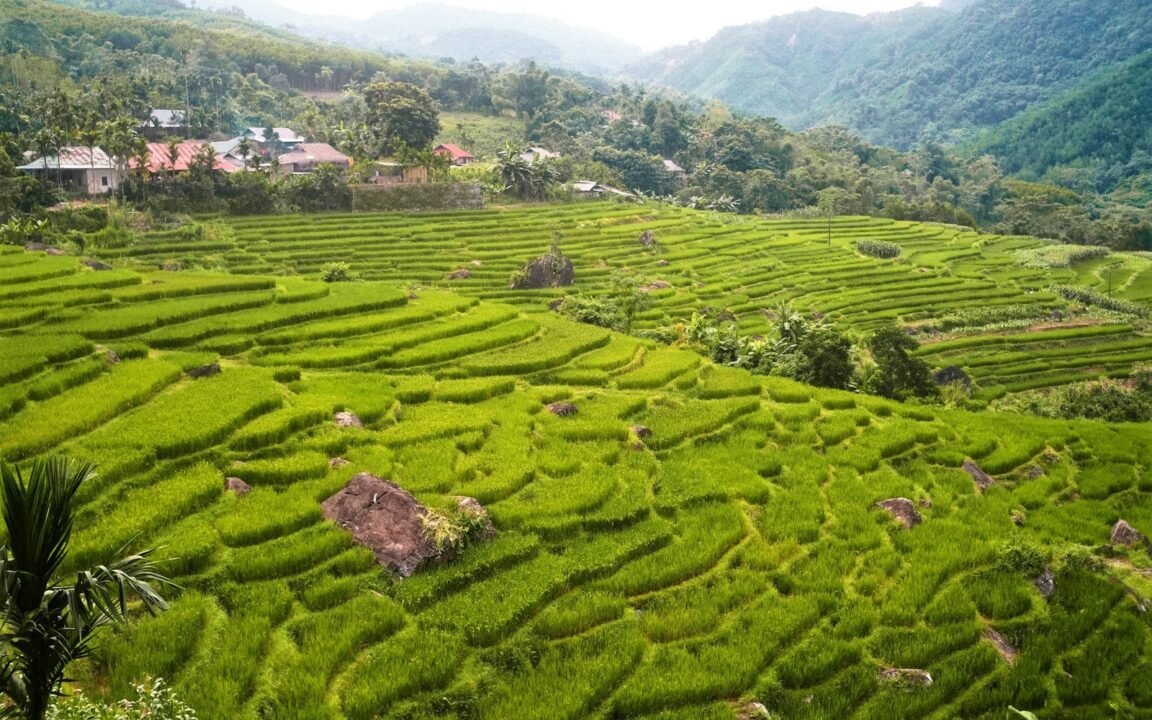
Base yourself in Ban Don, the main village, where most homestays and resorts sit above the reserve’s most photographed terraces. The easy walking here is the point of arrival day: field paths loop through the terraces to the villages of Uoi and Lan on a walk of about 5 km, gentle enough for the afternoon you arrive, with the light improving as the day cools. This is the landscape in the photograph above, green terraces stepped around limestone boulders, with the village roofs along the ridge.
Kho Muong is the harder, better second half of the leg. The Thai village of 62 households sits in a secluded valley about 10 km from Ban Don, reached by a steep, winding road with cliff edge sections. Cars stop at the village gate, where local motorbike taxis wait by a price board; agree the fare before you climb on, or walk down. Across the rice fields from the village, a path leads to Hang Doi, the Bat Cave, about 2.5 km long with stalactites, steep wet steps and the smell and noise of its bat colony. Visitors in recent seasons paid about 10,000 VND each at the path. Wear shoes with grip, hold the handrails, and skip the cave after heavy rain, when the steps run with water. One caution from current local reporting: cave visits have at times been suspended for safety checks after rockfalls, so ask your homestay on the day whether the cave is open before building the day around it.
Leg two: Hieu Waterfall and the Ban Hieu pools
Ban Hieu is a Thai village of stilt houses strung along a stream that drops through the village in a chain of cascades known together as Hieu Waterfall, roughly 800 metres of falls and pools. It is 12 to 20 km from Ban Don depending on the road, on narrow mountain lanes, so this leg needs wheels: homestays and resorts rent motorbikes for about 100,000 to 200,000 VND a day, fuel extra, and many lend bicycles for the shorter hops. If steep, broken roads are not your thing, ask your homestay to arrange a driver instead of renting. That is not a luxury here; it is the sensible default for many visitors.
At the falls, the pools are swimmable in dry weather and the national tourism site confirms swimming is possible at times, which is the honest phrasing: after heavy rain the stream runs high and brown and the pools are a look, not a swim. Entry is free or a small local fee of up to about 20,000 VND. The path in is lined with small eateries, so lunch folds into the visit naturally. Give the waterfall the middle of the day, when the light reaches the pools, and keep the walk back through the village for the cooler late afternoon.
Leg three: the Cham stream waterwheels and the bamboo raft
The raft is the leg that turns this route from a drive into a journey. Near Chieng Lau village, giant bamboo waterwheels stand along the Cham stream, turned by the current and lifting water into bamboo pipes that feed the fields above them, with no power involved at all. VnExpress notes the wheels only turn in the rainy season, so in the dry months you may find them still, which is worth knowing before you promise yourself the photograph. The rafts set off close to the wheels: a gentle 45 minute to one hour float at about 50,000 VND per person, on bamboo rafts carrying 8 to 14 people, poled through the valley with the terraces on both banks.
Sequence matters. Do the raft after the waterfall, not before, because the Cham stream leg points you back toward Ban Don and the valley road home. Travellers stringing a longer northern Vietnam route together often pair this valley with the karst country further east; our guide to the Trang An grottoes sampan circuits covers that very different boat day, and the contrast is instructive: Trang An is a ticketed, organised circuit, while Pu Luong’s raft is a village service you arrange through your homestay.
Where do you sleep on the route, and what does it cost?
Sleep inside the route, not outside it. A bed in a shared Thai stilt house, with mattresses on a wooden floor, costs about 100,000 to 250,000 VND per person per night at Kho Muong, Hieu, Kit or Ban Don, and puts you at the start of the next leg at dawn. The eco resorts around Ban Don, Pu Luong Retreat the best known, run about 1,000,000 to 3,500,000 VND per room per night depending on room and season, with cheaper resort rooms listed from around 300,000 VND. Homestays win on village life and price; resorts win on pools and valley views. Either way, meals fold into the stay, and your hosts are also your transport desk, your cave status check and your market alarm clock.
Time the whole route around Pho Doan market if you can. The market, which dates from the French colonial period and now fills a roofed hall of about 2,000 square metres, runs on Thursday and Sunday mornings only, from about 6 am to close to noon, serving the Thai and Muong villages around it. A stay that includes one of those mornings gets the reserve at its most itself. For the seasonal side of northern Vietnam planning, our guide to when to go to Hoi An’s Tra Hieu ward shows how much the calendar shapes a Vietnam trip further south.
What should you skip, and what can go wrong?
Skip Pu Luong peak unless you are a fit, guided walker. The summit is about 1,700 metres, the climb takes about six hours in good weather with steep, dangerous sections, and local advice is firm that beginners should go with a guided group. Skip, too, any plan that treats the reserve as a day trip from Hanoi: four hours each way in a van leaves the worst version of every leg. The real risk in Pu Luong is the roads after rain. In November 2025, landslides opened at several points along the main road through Ban Don after storms, cracking and sinking the asphalt; the commune fenced the slip sites and repair funds were allocated. There is no substitute for asking your homestay which roads are open on the morning you travel, respecting any barrier, and saving the cave, the Kho Muong road and the peak for a dry day.
Frequently Asked Questions
Is there an entrance fee for Pu Luong Nature Reserve?
No. The reserve has no ticket and no gate. Small local fees apply at individual sights: about 10,000 VND at the Kho Muong Bat Cave path and about 50,000 VND per person for the bamboo raft on the Cham stream.
How long is the bamboo raft trip and what does it cost?
About 45 minutes to one hour on the Cham stream near Chieng Lau village, at about 50,000 VND per person. Rafts carry 8 to 14 people and the trip is gentle, a float rather than whitewater. Arrange it through your homestay.
When are the Pu Luong rice terraces golden?
Twice a year, because the valley grows two rice crops: late May to mid June and late September to early October. Each golden spell lasts only two to three weeks and shifts by a week or two each year, so ask your homestay how the crop looks a week or two before you travel. The terraces are green through the summer between harvests.
Can you swim at Hieu Waterfall?
In dry weather, yes: the falls are a chain of five small cascades with pools at Ban Hieu village, and visitors swim in them. After heavy rain the stream runs high and the pools are unsafe, so treat swimming as a fair weather activity and check conditions locally.
How do you get to Pu Luong from Hanoi?
By limousine van, about 250,000 to 450,000 VND one way and 4 to 4.5 hours, with Old Quarter pickup and drop off at your homestay. Ordinary coaches run from about 150,000 VND. From Ninh Binh, shared limousines cost about 350,000 to 450,000 VND and take 3 to 4 hours.
How many days do you need for this route?
Two full days cover Ban Don, Kho Muong, Hieu Waterfall, the waterwheels and the raft. Add a third day for a Thursday or Sunday morning at Pho Doan market or for the guided peak climb.
Facts checked 16 November 2026 against Vietnam Discovery’s Pu Luong guide (information checked November 2026, citing the national biodiversity agency, vietnam.travel, VnExpress and VietNamNet), Sondax Travel’s Pu Luong guide updated October 2026, and Pu Luong Excursions route pricing. Featured image: green rice terraces with limestone boulders below a village ridge in Pu Luong. Photo by Harry Le on Unsplash, Unsplash License, via a captioned hosted copy on Vietnam Discovery.