 Thandiwe Nkosi
Choose Route 2 for a first visit to Trang An. The three main sampan circuits from the Trang An wharf in Ninh Binh all take roughly three hours and all cost the same flat ticket, 300,000 VND per adult under the price list in force since 1 January 2026, so the only real decision is what you want the boat to thread together: Route 1 gives you the most caves, nine of them, and the strongest temple sequence; Route 2 balances four caves, three temples and the open water scenery where Kong: Skull Island was filmed, and is the route most first timers are happiest with; Route 3 is built around Dot Cave, at over 1,000 metres the longest cave in the complex. Boats seat four passengers with a local rower, you pick your route at the wharf, and you cannot combine routes in one ride. Arrive before 9 am if you can, because the Hanoi day tour groups reach the wharf from mid morning and the caves are at their quietest early. This guide compares the circuits cave by cave, corrects one outdated expectation about the Kong film set, and pairs with the Borobudur visit guide for travellers chaining Southeast Asia’s great heritage landscapes.
Quick Facts
- What: Sampan boat circuits through the flooded limestone valleys, water caves and temples of the Trang An Landscape Complex in Ninh Binh Province, Vietnam, a UNESCO mixed cultural and natural World Heritage Site since 2014
- Where: Trang An wharf, about 7 kilometres west of Ninh Binh city and roughly 90 to 100 kilometres south of Hanoi, about 2 to 2.5 hours by road or train and taxi
- Tickets, from 1 January 2026: 300,000 VND per adult and per child over 1.3 metres tall, 150,000 VND for children from 1 to 1.3 metres, free for children under 1 metre. One ticket covers the scenic area entry and the boat ride on any route
- Hours: Daily from 7 am. Ticket sales and last departures run to about 4 pm, with boats finishing their circuits after that; be on the water by early afternoon at the latest for a full route
- Routes: Route 1, about 3 hours, 9 caves and 3 temples. Route 2, about 2.5 to 3 hours, 4 caves and 3 temples, plus the Kong filming area. Route 3, about 3 hours, 3 caves including Dot Cave at over 1,000 metres. A shorter fourth route, the Phoenix route at about 1.5 to 2 hours, is also now listed
- Boats: Small sampans carrying four passengers, rowed by a local rower. Life jackets are provided. Routes can change or close with water levels and weather
What is Trang An, and how is it different from Tam Coc?
Trang An is a flooded karst system: a chain of limestone valleys linked not by roads but by water caves, so the only way through is by boat, ducking under cave ceilings from one enclosed, cliff ringed valley into the next. UNESCO inscribed the Trang An Landscape Complex in 2014 as a mixed site, recognised for both the tower karst landscape and for archaeological evidence of human occupation stretching back some 30,000 years, and it sits in the orbit of Hoa Lu, Vietnam’s capital in the 10th century, whose temples anchor the cultural half of the story. The boat operation is state managed from a single wharf and ticket office, with numbered boats and fixed routes, which makes it calmer and more orderly than Tam Coc, the other famous Ninh Binh boat ride, where the river runs through rice fields and independent rowers and floating sellers work the route. The short version: Tam Coc is the prettier river in harvest season, Trang An is the bigger, quieter, more cave driven experience, and if you only have one boat ride in Ninh Binh, Trang An is the one to take.
Route 1, Route 2 or Route 3: which circuit should you pick?
Route 1: the cave collector’s circuit
Route 1 is the longest and most cave dense option, threading nine caves and stopping at three temples, including Trinh Temple, Tran Temple and Phu Khong. The Tran Temple stop is unique to this route and carries the strongest link to the Dinh dynasty history of Hoa Lu. Choose Route 1 if caves are the point of your visit and you are happy to spend about three hours on the water with repeated ducking through low, dark passages. It is the least varied of the three for open scenery, because so much of it happens underground.
Route 2: the balanced first visit, and the Kong question
Route 2 threads four caves and three temples, Cao Son Temple, Suoi Tien Temple and Vu Lam Palace among them, with longer stretches of open water between karst walls, and it passes the area used for filming Kong: Skull Island in 2017. One correction matters here, because older guides still sell this route on its film set: the tribal village set that visitors used to walk through was dismantled in 2019 on UNESCO’s advice, so what you see now is the filming landscape itself, the cliffs and water the film used, not a standing set. Even without the set, Route 2 remains the best first visit, because it mixes caves, temples and scenery in proportion and tends to run a little shorter than the other two, at about 2.5 to 3 hours.
Route 3: the longest cave in Trang An
Route 3 runs three caves and three temple stops, including Trinh Temple and Vu Lam Palace, and its headline is Dot Cave, at over 1,000 metres the longest cave in the complex, a single extended passage under the mountain that feels genuinely exploratory. Choose Route 3 if one spectacular cave beats nine smaller ones for you, and for the dramatic scenery at the far end of the circuit. A fourth option, the Phoenix route via Thuy Dinh water pavilion and Phoenix Mountain at about 1.5 to 2 hours, now appears in current route listings and is the answer for families and anyone genuinely short of time; ask at the ticket office which routes are running on the day, because water levels and weather can take a route out of service.
How do tickets, boarding and the ride itself work?
Buy at the Trang An Ecotourism ticket counter at the wharf, or through the official ticket site; note that e-tickets bought in advance cannot be cancelled, refunded or changed, so if your dates may move, buying at the counter on the day is the safer habit. The 2026 price list sets the adult ticket at 300,000 VND, up from the 250,000 VND that many older guides still quote, with children from 1 to 1.3 metres at 150,000 VND and children under 1 metre free. At the wharf you state your route, are assigned a rower and a boat with up to three other passengers, and set off; there are no fixed departure times, boats leave as they fill and as rowers come free. On the water, expect to help the rhythm settle: sit balanced, keep hands inside through the caves, duck when the rower signals, and wear the life jacket provided. Temple stops are short shore breaks where you climb out, look around and reboard the same boat, so keep shoes that slip on and off easily. Rowers are local residents working a rotation, and a tip of 50,000 to 100,000 VND per boat is the customary thank you suggested in Vietnam’s official tourism guidance. The site opens at 7 am, and the first hour is the quietest and coolest of the day; by late morning the wharf queues build, and by mid afternoon the heat on open water is real, so bring a hat, sunscreen and water in every season. Boats stop running in storms, heavy rain and flooding, and individual caves close when water levels are wrong, so a wet weather day can shrink the menu without warning.
How do you get to Trang An?
From Hanoi, limousine vans, buses and trains all run to Ninh Binh in about 2 to 2.5 hours, and the wharf is a further 7 kilometres west of the city by taxi or Grab. Many travellers base in Tam Coc, about 5 to 7 kilometres from the wharf, and cycle or ride over in the morning, which also makes an early start easy. Combine the boat with Hoa Lu’s temples or the Hang Mua viewpoint steps on the same day rather than returning to Hanoi at lunchtime, and use the Vietnam visa free entry explainer to check that your passport still matches the entry rules for the trip.
Frequently asked questions
Which Trang An route is best for first time visitors?
Route 2. It balances four caves, three temples and the best open water scenery, passes the Kong: Skull Island filming area, and runs a little shorter than the alternatives at about 2.5 to 3 hours. Pick Route 1 for the most caves and Route 3 for Dot Cave, the longest cave in the complex.
How much are Trang An boat tickets in 2026?
Since 1 January 2026 the adult ticket is 300,000 VND per person, with children from 1 to 1.3 metres tall at 150,000 VND and children under 1 metre free. The ticket covers both the scenic area entry and the boat ride on any route. Older guides quoting 250,000 VND are out of date.
Can you still visit the Kong: Skull Island film set at Trang An?
No. The tribal village set was dismantled in 2019 on UNESCO’s advice. Route 2 still passes the filming area, so you see the landscape the film used, but there is no standing set to walk through.
How long does a Trang An boat ride take?
Allow about 2.5 to 3 hours on the water for Routes 1, 2 and 3, plus queuing time at the wharf in busy periods. A shorter Phoenix route of about 1.5 to 2 hours is also now listed. Arrive before 9 am for the quietest caves, and be at the wharf by early afternoon at the latest, because last departures are around 4 pm.
Is Trang An better than Tam Coc?
For most visitors, yes. Trang An is longer, passes more caves and temples, is state managed from a single wharf with no floating sellers, and sits inside the UNESCO listed core. Tam Coc is the better photograph in rice harvest season, when its river runs between golden fields.
What should you bring on the boat?
A hat, sunscreen and water, because the boats are open to the sun; shoes that slip off easily for temple stops; small cash for the customary rower tip of 50,000 to 100,000 VND per boat; and a dry bag or zip pocket for your phone in cave drips and rain.
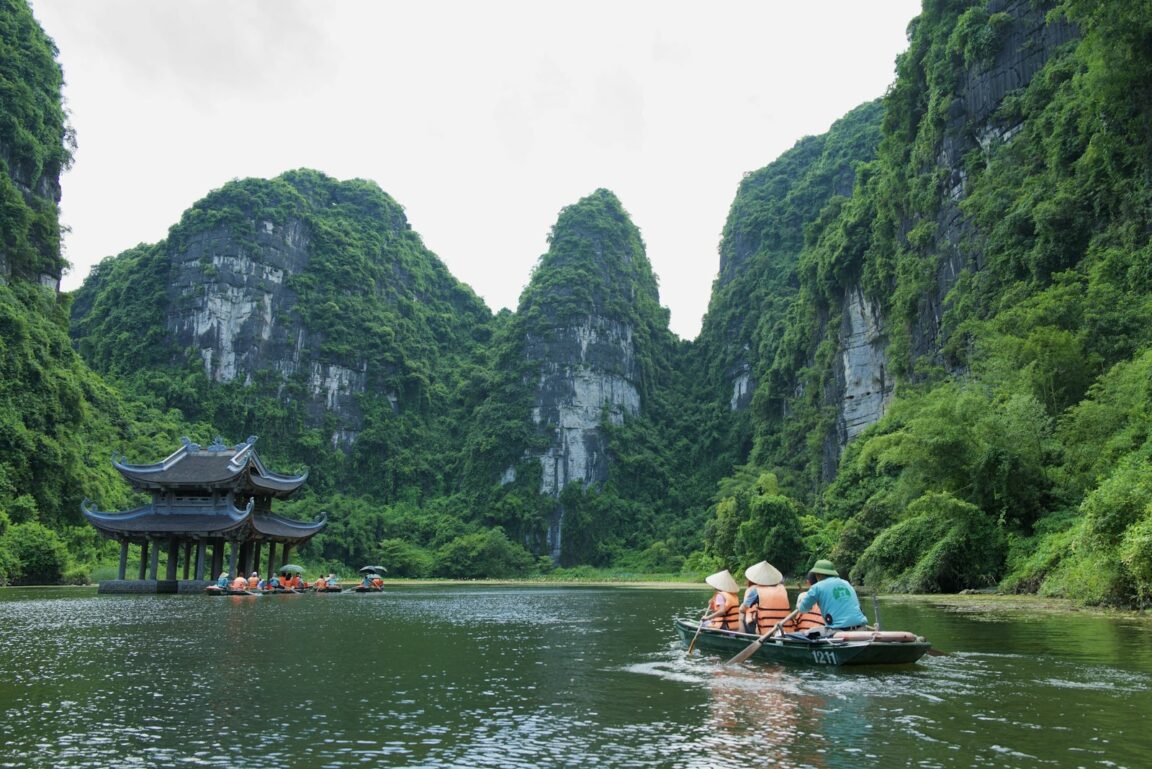
Facts checked 16 November 2026 against the Vietnam National Authority of Tourism guide to the Ninh Binh boat tours, Ninh Binh provincial tourism price listings for 2026 and Trang An Heritage ticket information. Routes and cave access change with water levels and weather, so confirm the running routes at the wharf on the day. Photo: a sampan with passengers in life jackets approaching the Thuy Dinh water pavilion under the Trang An karst. Photo by Jacob Pretorius on Unsplash, Unsplash License.