 Omar Haddad
Bangkok Suvarnabhumi third runway is already operating, and what it changes for travelers is capacity, not paperwork. The 4,000 meter runway on the west side of the airport entered service in November 2024, lifting the airports flight handling from 68 to 94 movements per hour at full build out, with a phased ramp through 75 movements per hour in 2025 and 85 in 2026 toward the 94 target in 2027. Together with the SAT-1 satellite terminal, it raises annual passenger capacity from 45 million to 60 million. There is no new form to file, no eligibility test and no extra fee for passengers: the benefit arrives as shorter holding patterns, more resilient schedules and better connection odds at Thailands main hub.
Quick Facts
- Airport: Suvarnabhumi Airport, Bangkok, IATA code BKK, operated by Airports of Thailand
- Third runway: 4,000 meters long, 60 meters wide, on the western side of the airfield, in service since November 2024
- Capacity effect: Flight handling rises from 68 to 94 movements per hour at full build out, about 800 to 1,000 flights per day
- Phased ramp: About 75 movements per hour in 2025, 85 in 2026, target 94 in 2027, per Airports of Thailand statements
- Formal inauguration: SAT-1 and the third runway were officially inaugurated on March 20, 2025
- Passenger capacity: 45 million to 60 million per year with SAT-1 and the third runway combined
- SAT-1 link: 28 contact gates, connected to the main terminal by an automated people mover ride of about 3 minutes including waiting time
- Official source: Airports of Thailand, suvarnabhumi.airportthai.co.th
Who qualifies to use the third runway, and is there anything to file?
Every passenger on every airline at Suvarnabhumi qualifies, automatically, and there is nothing to file. Runways are allocated by air traffic control, not by application. The headline framing of eligibility belongs to a different kind of Bangkok travel story, the entry form stories, and it is worth separating the two cleanly because travelers routinely mix them up. Your arrival obligations for Thailand, such as the digital arrival card requirements covered in our guide to Thailands Digital Arrival Card, are set by immigration and have nothing to do with which runway your flight lands on.
What the runway changes sits upstream of immigration entirely. With three runways, Suvarnabhumi can run more simultaneous arrival and departure streams, which trims the airborne holding and ground queuing that used to stack up in the evening long haul arrival banks. Airlines file for the benefit in the only sense that matters here: they schedule into the added slots. Airports of Thailand has described a deliberate phased increase, roughly 75 movements per hour in 2025, 85 in 2026 and the full 94 in 2027, so the reliability gain builds year by year rather than arriving in one step.
What does the third runway cost travelers?
Nothing directly. There is no runway fee, surcharge or ticket line item a passenger can choose to pay or avoid. The project cost sits with Airports of Thailand as infrastructure investment, recovered through the normal airport charges airlines already pay. The honest cost discussion for travelers is indirect and mostly positive: added capacity is the main lever an airport has against delay driven misconnects, and a missed connection in Bangkok can cost a night, a rebooking fight and the first day of a trip. If the third runway prevents even a fraction of those, it pays passengers in time rather than charging them in baht.
The one place to watch your wallet is unchanged by the runway: connection time itself. Minimum connect times at BKK vary by airline and by whether your transfer involves the SAT-1 satellite, which adds an automated people mover ride of about 3 minutes including waiting, plus walking time inside a very large satellite building. Book connections with margin, especially international to domestic transfers that require immigration and a terminal change of pace. Our first timer framework in First Time in Bangkok applies the same buffer logic to the city side of the airport.
How do SAT-1 and the third runway work together?
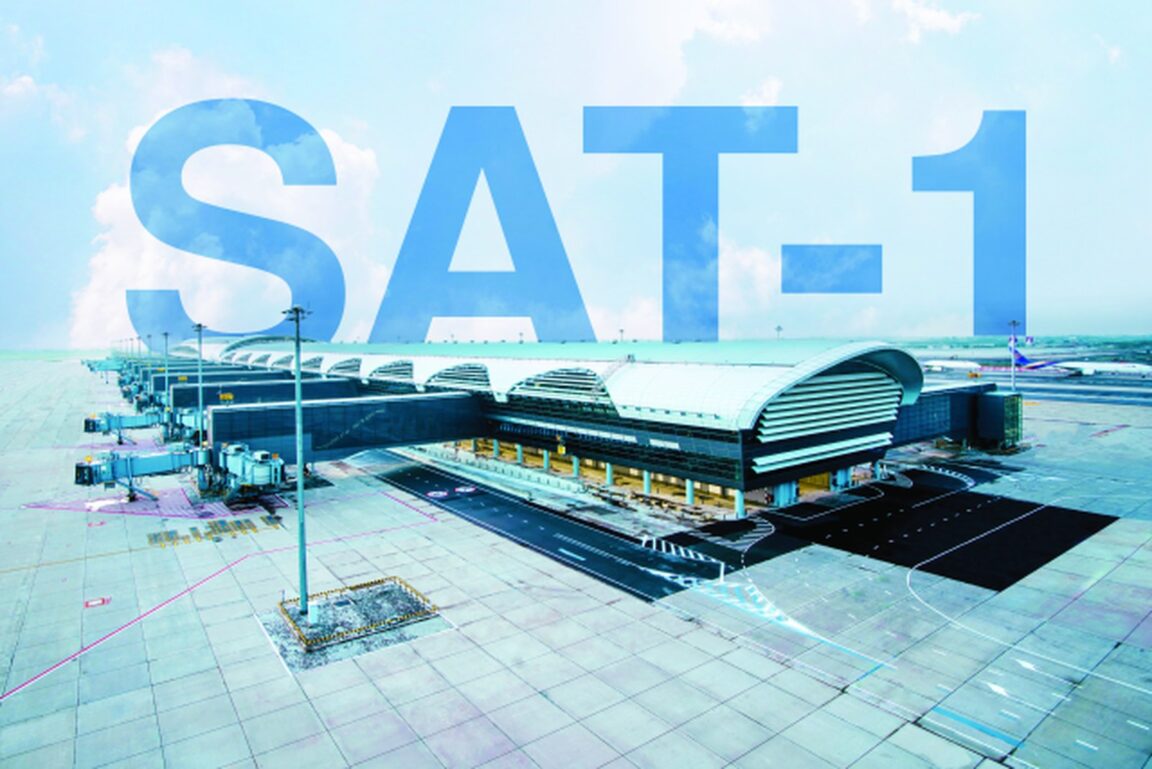
They are two halves of one expansion, Phase 2 of the Suvarnabhumi development project. SAT-1, in service since September 2023 and formally inaugurated with the runway on March 20, 2025, adds 28 contact gates, eight of them able to handle Code F aircraft such as the A380 and 747-8, across a four storey building of about 216,000 to 251,400 square meters depending on how the operator counts shared areas. It connects to the main terminal by an underground automated people mover, with each train carrying up to 210 passengers. The third runway gives those gates something to feed: without added movements per hour, new gates simply move the queue from the terminal to the taxiway.
For passengers the combined effect is specific. More gates mean fewer bus gate departures. More runway capacity means the first wave of morning departures and the late evening arrival banks clear faster. And the headline capacity number, from 45 million to 60 million passengers a year, is the sum of both projects, not the runway alone. Airports of Thailand is already looking beyond it, with an eastern expansion of the main terminal and longer term plans that include a south terminal and a fourth runway in studies toward the 2030s, targeting far larger capacity if traffic keeps growing.
What actually changes for connections through Bangkok?
Three things, in order of importance. First, resilience: with an extra runway, a single runway closure for inspection or an incident no longer cuts the airport to a fraction of its schedule, so irregular operations recover faster. Second, schedule choice: added slots let airlines add frequencies and retime banks, which over seasons turns into better connection options from Europe, the Middle East and across Asia into Southeast Asia and Australia. Third, taxi and holding time: parallel runway operations on the west side shorten the long taxi routes that wide body arrivals used to endure at peak hours.
What does not change deserves equal clarity. Immigration queues, security screening and the sheer walking distances at Suvarnabhumi are landside and terminal matters, untouched by a runway. SAT-1 departures still need the people mover margin. And Bangkok second airport, Don Mueang, keeps its own low cost carrier role entirely separate from this story. Travelers who treat the third runway as a reason to book a 45 minute self transfer will still lose that bet; travelers who book sane connections will simply find them working more often.
Frequently Asked Questions
When did Bangkok Suvarnabhumi third runway open?
The third runway entered service in November 2024, with operations reported from November 1 to 3, 2024 in different operator statements. It was formally inaugurated together with SAT-1 on March 20, 2025.
How much does the third runway increase capacity?
Airports of Thailand states flight handling rises from 68 to 94 movements per hour at full build out, roughly 800 to 1,000 flights per day, phased through about 75 per hour in 2025 and 85 in 2026 toward 94 in 2027. With SAT-1, annual passenger capacity rises from 45 million to 60 million.
Do passengers need to apply, register or pay to benefit?
No. Runway allocation is an air traffic control function. There is no passenger form, eligibility rule or fee connected to the third runway. Normal Thailand entry requirements apply separately.
How long is the transfer to SAT-1 gates?
SAT-1 connects to the main terminal by automated people mover. Airports of Thailand puts total travel time, including waiting at the station, at about 3 minutes, plus walking time inside SAT-1. Build that into tight connections.
Will the third runway fix delays at Bangkok?
It reduces the runway bottleneck, which was a real constraint, and improves recovery when one runway is out of service. It does not change immigration, security or weather, so delays will still happen, just less often for capacity reasons.
Is a fourth runway planned for Suvarnabhumi?
Airports of Thailand long term planning includes a possible fourth runway on the eastern side and further terminal expansion in studies toward the 2030s. Those are plans, not operating infrastructure, and no passenger action is connected to them.
How should travelers use this news when booking?
Practically, in three ways. First, stop padding Bangkok connections out of old habit alone: a hub that was famous for peak hour holding is measurably less constrained than it was in 2023, and published schedules already reflect the added capacity. Second, keep respecting the parts of the journey the runway does not fix, which are immigration on arrival, the SAT-1 people mover on departure, and the long walks inside both buildings. Third, watch the phased numbers as a signal of where the airport is heading: the step from 85 movements per hour in 2026 toward the 94 target in 2027 is the last big capacity unlock in this phase, and airlines tend to announce their most ambitious Bangkok schedules once that headroom is confirmed rather than promised. For most travelers the summary is reassuringly dull: nothing to file, nothing to pay, and a hub that works a little more often than it used to.
Last updated and facts checked: November 16, 2026, against Airports of Thailand releases and the Suvarnabhumi Airport official site.