 Lucas Meyer
If you give Ocean Springs one sight in depth, make it the Walter Anderson Museum of Art at 510 Washington Avenue, because no other stop on the Mississippi Gulf Coast explains the place the way Anderson’s watercolors, block prints and murals explain this coast. The museum is open Monday to Saturday from 11 a.m. to 5 p.m. and Sunday from 1 to 5 p.m., adult admission is 12 dollars, and an unhurried visit takes one to two hours. Front Beach and a side trip toward Biloxi are worth having, but they are the supporting evidence. The museum is the argument.
Quick Facts
- Sight: Walter Anderson Museum of Art (WAMA), 510 Washington Avenue, Ocean Springs, Mississippi
- Opened: 1991, dedicated to Walter Inglis Anderson (1903 to 1965) and his brothers Peter and James
- Hours: Monday to Saturday 11 a.m. to 5 p.m., Sunday 1 to 5 p.m., per the museum
- Admission: Adults 12 dollars; AAA, military and seniors 10 dollars; child or student 7 dollars; free for members and for ages 5 and under
- Holiday closures: New Year’s Day, Easter, Thanksgiving, Christmas Eve and Christmas Day
- Phone: 228-872-3164
- Time needed: At least one hour by the museum’s own guidance; 90 minutes to two hours for a deep visit
- Pairings: Shearwater Pottery, founded 1928; Front Beach; the Ocean Springs Community Center murals next door
- Last facts check: 16 November 2026, against walterandersonmuseum.org
Who was Walter Anderson, and why does he carry a whole town?
Walter Inglis Anderson painted the Gulf Coast the way it actually behaves: pelicans and herons, pine and palmetto, Horn Island weather arriving in real time. He rowed alone to Horn Island, one of the barrier islands off Ocean Springs, and camped there for weeks, painting through storms and heat, and those island logs and watercolors are the core of the collection. The museum, opened in 1991, also represents his brothers: Peter Anderson, the master potter who founded Shearwater Pottery in 1928, and James McConnell Anderson, a painter and ceramist. That family structure is what makes this a town story rather than a single artist shrine. The same family made the pottery you can still buy, painted the murals in the community center next door, and set the template for the arts colony Ocean Springs still is, with galleries and studios filling the oak shaded blocks around Washington Avenue.
What should you look at first inside the museum?
Start with the watercolors and drawings of Gulf wildlife, because they teach you how to see everything else on this trip, including the beach. Anderson painted animals as structure and pattern, not decoration, and a few minutes with the herons and crabs will change what you notice on Front Beach that afternoon. Move next to the block prints and the Horn Island material, where the solitary island trips are documented, and then to the ceramics and carvings by the three brothers together, which show the family range in one room. Save the Little Room for last. The Little Room is Anderson’s painted cottage interior from the Shearwater compound, moved and preserved as an immersive painted environment, floor to ceiling, and it lands hardest once you already know the island work that fed it. The museum is self-guided and suggests at least an hour; a deep dive that includes the changing exhibitions, which rotate work by Anderson and other significant artists through the year, runs closer to two.
What is the Community Center mural, and why does it matter?
Next door, the Ocean Springs Community Center holds Anderson’s largest mural work, painted for the town itself rather than for a gallery. It is the public, civic version of the same vision: the coast, its creatures and its history at architectural scale. Check on the day whether the center is open to visitors, because it is a working event space and the museum posts closure dates for weddings and private events; the museum listed a community center closure on Saturday 14 November in the week of this check, which is exactly the kind of detail that decides whether you see the murals or miss them by a door. If the center is closed, the museum visit still stands complete on its own, but if it is open, the pairing of the intimate watercolors and the town scale mural is the full Anderson sentence, and few small museums anywhere offer both halves within a one minute walk.
How do Front Beach and Biloxi test the case for Ocean Springs?
The honest comparison a traveler makes on this coast is Ocean Springs against Biloxi, its larger neighbour across the Biloxi Bay Bridge, with casinos, a bigger beachfront strip and more hotels. Front Beach is Ocean Springs’ answer on the water: a sandy bay beach running from the bridge toward the harbor, with a walking path of about two miles, fishing, picnic space and sunset over the bay. It is a bay beach, calm and shallow, not a surf beach, and its pleasure is the evening walk rather than the swim. Biloxi wins on scale and nightlife. Ocean Springs wins the traveler who wants a walkable downtown, live oaks, independent galleries and a museum of genuine national standing, then dinner without a casino floor in between. Our guides to the best hotels in New Orleans for a first visit and what to eat in New Orleans cover the big city end of a Gulf Coast trip; Ocean Springs is the small town counterweight, two hours east, and the Anderson museum is the reason it holds its own in that company.
What is the Shearwater Pottery add-on?
Shearwater Pottery, at 102 Shearwater Drive, is the living half of the museum story. Peter Anderson founded it in 1928, the family still makes and sells pottery there, and Walter’s cottage stood on the same wooded compound. Visitor listings place the showroom open daily, with shorter Sunday afternoon hours, and there is no admission charge to browse the showroom; you pay only for what you buy. Go after the museum, not before: with the watercolors in your head, the glazes and animal forms in the showroom read as the same language in clay. It is a 5 to 10 minute drive from Washington Avenue, and together the two stops make a half day that no other Gulf Coast town can copy, because no other town has this family.
How should you time a one sight visit?
Arrive in town by late morning, walk Washington Avenue first for context, and enter the museum near its 11 a.m. opening or just after lunch when tour groups thin. Give the museum 90 minutes, check the Community Center murals while you are on the block, then take coffee or lunch downtown and drive to Shearwater in the afternoon. End on Front Beach at sunset. If you are choosing a season, spring and late fall bring the Peter Anderson Arts and Crafts Festival crowds in early November and the mildest walking weather; summer is hot and humid, and the museum’s air conditioned galleries become a midday strategy as much as a cultural one. Allow a full day in town even though the headline sight takes two hours, because the point of a one sight deep dive is that everything else in the day is chosen to support it.
Frequently Asked Questions
How much does the Walter Anderson Museum cost, and when is it open?
Adults pay 12 dollars; AAA members, military and seniors pay 10 dollars with ID; children and students pay 7 dollars; members and children ages 5 and under enter free. Hours are Monday to Saturday 11 a.m. to 5 p.m. and Sunday 1 to 5 p.m., with closures on New Year’s Day, Easter, Thanksgiving, Christmas Eve and Christmas Day.
How long should I spend in the museum?
The museum suggests at least an hour for the self-guided visit. A deep visit covering the watercolors, block prints, the Little Room and the changing exhibitions takes 90 minutes to two hours.
What is the Little Room?
It is Walter Anderson’s own painted room from his cottage at the Shearwater compound, preserved as a complete painted environment. It is the museum’s most immersive work and is best seen after the Horn Island watercolors that inspired it.
Is Shearwater Pottery free to visit?
The showroom is free to browse; you pay only for pottery you buy. It stands at 102 Shearwater Drive, a short drive from the museum, and remains a working family pottery founded by Peter Anderson in 1928.
Ocean Springs or Biloxi: which should I choose?
Choose Biloxi for casinos, a bigger beachfront and more hotels. Choose Ocean Springs for a walkable arts downtown, the Anderson museum and pottery, and a quieter bay beach evening on Front Beach. The two are minutes apart across the bridge, so a stay in one can still visit the other.
When is the museum closed for holidays?
The museum lists closures on New Year’s Day, Easter, Thanksgiving, Christmas Eve and Christmas Day. The adjacent Community Center also closes on posted dates for private events, so check the museum site in the week you visit if the murals are a priority.
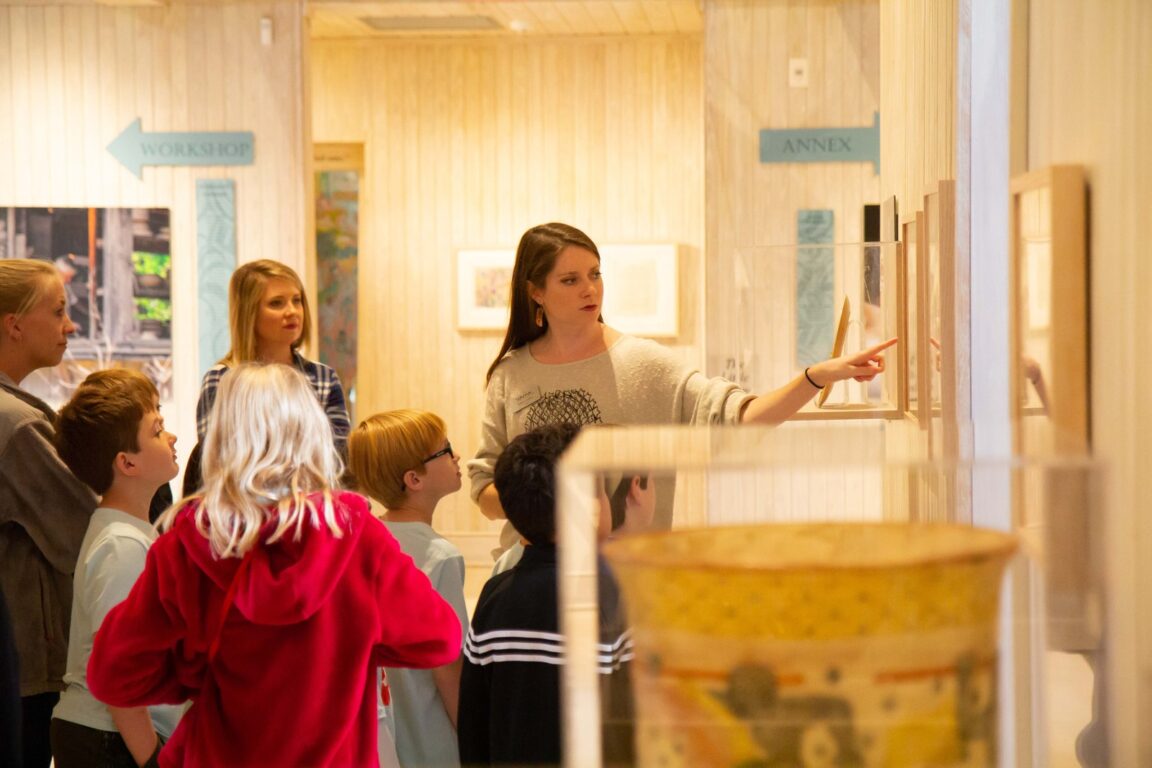
Featured image: A guided visit inside the Walter Anderson Museum of Art, Ocean Springs. Photo: Walter Anderson Museum of Art, via walterandersonmuseum.org, the museum’s official website.