 Jonas Lindqvist
Seville Metro Line 3 does not carry passengers yet, and it will not until 2030, but its northern section is now a live construction programme with most of the route from Pino Montano to the Prado de San Sebastián under contract or in the ground. One framing needs correcting at the start: the documents and deadlines in this story are not traveller paperwork. Nobody needs a permit or a form to visit Seville. The documents are the project’s own, expropriation notices, tender deadlines and works contracts issued by the Junta de Andalucía, and the newest of them was published today, 17 November 2026, when the official gazette BOJA opened the expropriation procedure for the fourth construction section, Macarena to María Auxiliadora. Here is where the line stands, section by section, and what to use instead until it opens.
Quick Facts
- Project: Line 3 North, Pino Montano to Prado de San Sebastián, about 7.5 kilometres of mostly underground double track plus a technical branch of about 1.4 kilometres to the depot (Junta de Andalucía).
- Stations: 12, one on the surface at Pino Montano Norte and 11 underground, including Hospital Virgen Macarena, Macarena, Capuchinos and María Auxiliadora, ending at Prado de San Sebastián with interchange to Line 1 and the Metrocentro tram.
- Budget: 1,366 million euros for the northern section, funded jointly by the Spanish state and the Junta de Andalucía under the agreement signed on 25 January 2023, with European Feder funds in the mix.
- Journey time when open: About 18 minutes end to end; forecast use is about 13 million passengers a year.
- Progress: Three construction sections in execution, covering 63 percent of the northern route, per the Junta; the fourth section is in contracting.
- Newest deadline: BOJA number 222, published 17 November 2026, opens expropriation for section IV (Macarena to María Auxiliadora): 15 working days of public information, with the preliminary occupation records scheduled for 18 December 2026.
- Opening target: 2030 for the northern section. The southern section, Prado to Hospital Virgen de Valme, is still in study and has no confirmed construction start.
- Meanwhile: Line 1 and the tram already serve Prado de San Sebastián; Tussam buses cover the northern corridor, with diversions around the works.
What is being built, in what order?
The northern section is being built as a technical branch plus six construction sections, working south from Pino Montano. The technical branch to the workshops and depot came first: awarded to a Lantania and DSV joint venture in December 2022, it started in February 2023 and is finished. Section I runs through Pino Montano itself, about 2.4 kilometres with three stations including the surface terminus at Pino Montano Norte, whose structure is already complete. It was awarded to an OHLA led joint venture for 95.7 million euros including VAT, and its groundbreaking on 8 April 2024, attended by the Spanish prime minister and the president of the Junta, marked the formal start of the main works.
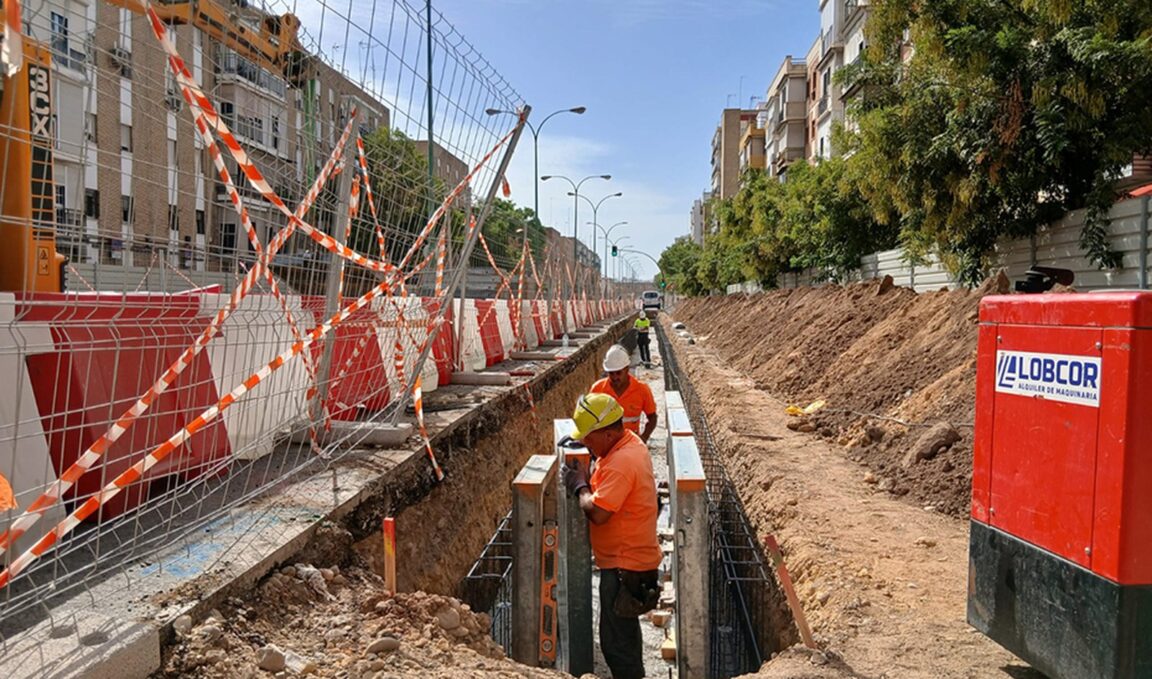
Section II, Los Mares to San Lázaro, is 1,463 metres with the Los Carteros and San Lázaro stations, tendered at close to 132 million euros. Section III, San Lázaro to the Ronda Histórica, is the shortest at 1,013 metres and the most expensive and difficult: awarded for 173.4 million euros to a joint venture of Vías y Construcciones, Lantania and DSV, with a 46 month programme, its works began in June 2025. It passes along Avenida Doctor Fedriani and under the car park of the Hospital Virgen Macarena at about 20 metres down, the deepest point on the northern section, where the Hospital Virgen Macarena station is being built with a level left ready for a future Line 4 interchange. Sections V and VI, from María Auxiliadora through Puerta Carmona and Jardines de Murillo to the Prado, are still to be tendered.
What are the live documents and deadlines?
Read in the order officials are processing them, the current paper trail looks like this. First, the works contract for section IV, Macarena to María Auxiliadora, about one kilometre and two stations, Macarena and Capuchinos: the Junta puts its budget at about 165 million euros, the tender was published on 1 April 2026 with a value of 163,090,932 euros, and bids closed on 15 May 2026. Second, the supervision contracts for that section, whose tender documents the Junta issued in July 2026. Third, and newest, the expropriation file: BOJA number 222 of 17 November 2026 announces the forced expropriation of the land and rights needed for section IV, opens a 15 working day public information period for objections, and sets 18 December 2026 for the lifting of the preliminary occupation records, the formal step before the state takes possession of affected plots.
That sequence is why the works themselves reach the Ronda Histórica, the ring road around the old town, only in the first months of 2027, with about 36 months of construction expected on that stretch. Reporting based on the section IV construction project describes diversions for ten Tussam bus lines and temporary land take affecting businesses along the corridor during those works. For a visitor, the practical translation is narrow but real: expect the Macarena and Ronda Histórica area to be a building site with diverted buses from 2027 into the end of the decade, and treat any source promising a Line 3 ride before 2030 as wrong. The permitting sequence here is the same species of process, at larger scale, as the one in our explainer on the Texas Central Dallas to Houston permitting story: land, paper and possession first, trains much later.
What has construction turned up so far?
Digging a metro under a city this old produces archaeology as a by product, and section III produced a major find. Excavations on Avenida Doctor Fedriani, beside the Hospital Virgen Macarena, uncovered an Andalusi necropolis dated to the eleventh to thirteenth centuries: between January and September 2026 archaeologists documented 214 burials, about five times the number of graves initially expected, spread over roughly 50 metres of the tunnel corridor. The cemetery is thought to belong to a farming settlement whose village has not yet been found, and a second phase of excavation is planned to check whether more burials lie along the route. The Junta’s published position remains that the northern section keeps its 2030 horizon; the discovery is documented here because it is the clearest illustration of why deep sections under the Macarena move at the pace they do.
What should you use instead until 2030?
For the Prado end of the route, nothing changes: Prado de San Sebastián is already a working interchange on Line 1, with the Metrocentro tram at the surface, and it is the natural gateway for the Plaza de España and the old town’s southern edge. For the northern neighbourhoods the line will serve, Pino Montano, Los Carteros, San Lázaro and the Macarena, the substitute is the Tussam bus network, which is also the thing the works disrupt, so check the operator’s current diversions around Avenida Doctor Fedriani and the Ronda Urbana Norte before relying on a specific route. The Junta has also built a compensatory 455 space car park at the Glorieta de los Ferroviarios in San Jerónimo, with a public transport connection, aimed at drivers displaced by the works. Travellers who plan Seville trips years ahead should file Line 3 the way they would file any long dated infrastructure promise: our piece on Japan’s Hokkaido Shinkansen Sapporo extension delay shows how official opening dates on projects like this behave over time.
Frequently Asked Questions
Can I ride Seville Metro Line 3 yet?
No. Line 3 is under construction and carries no passengers. The Junta de Andalucía’s target for the northern section, Pino Montano to Prado de San Sebastián, is 2030. Until then, use Line 1, the Metrocentro tram and Tussam buses.
Which stations will Line 3 North have?
Twelve: Pino Montano Norte, Pino Montano, Los Mares, Los Carteros, San Lázaro, Hospital Virgen Macarena, Macarena, Capuchinos, María Auxiliadora, Puerta Carmona, Jardines de Murillo and Prado de San Sebastián. Eleven are underground; only Pino Montano Norte is on the surface.
What is the 17 November 2026 BOJA notice about?
It opens the forced expropriation procedure for construction section IV, Macarena to María Auxiliadora. It lists the affected land and rights, allows 15 working days for public information and objections, and schedules the preliminary occupation records for 18 December 2026. It concerns property owners on the corridor, not travellers.
How much does Line 3 North cost and who pays?
The Junta de Andalucía puts the northern section budget at 1,366 million euros. Funding is shared between the Spanish state and the Junta under the agreement signed on 25 January 2023, each contributing half across 2023 to 2030, with European Feder funds supporting individual contracts.
When will the works reach the Ronda Histórica?
In the first months of 2027, according to the Junta’s programme as reported from the section IV construction project, with about 36 months of work expected there and diversions affecting ten Tussam bus lines. The expropriation steps running through December 2026 are the immediate predecessor.
What about the southern section to Hospital Virgen de Valme?
It remains in study, not construction. The Junta announced on 25 September 2026 that the southern section will run underground through Bellavista, after public objections to the earlier surface proposal, and the design, funding and calendar still have to be fixed. No opening date for the south has been officially confirmed.
Sources checked 17 November 2026: Junta de Andalucía, Consejería de Fomento, on Line 3 North progress, section budgets and the Doctor Fedriani works; BOJA number 222, 17 November 2026, expropriation announcement for section IV Macarena to María Auxiliadora; Junta tender records for the section IV works (published 1 April 2026, bids to 15 May 2026) and supervision contracts; OHLA and Lantania contract announcements for sections I and III; Diario de Sevilla reporting on the Ronda Histórica works programme and Tussam diversions; reporting of the Doctor Fedriani necropolis excavation, January to September 2026.