 James Wolfe
Winter is the season Bisbee rewards planners, because the one attraction that sells out in spring, the Queen Mine Tour, runs the same five departures a day with a fraction of the pressure on seats, and the town’s famous staircases can be climbed in cool air instead of desert heat. The order matters more than the list: reserve the mine first, because its fixed departure times anchor the day, then build the Brewery Gulch stairs, the Bisbee 1000 route and the Lavender Pit overlook around whichever departure you land. Everything else in Old Bisbee is walkable filler between those fixed points.
Quick Facts
- The anchor booking: Queen Mine Tour, 478 N Dart Road, just south of Old Bisbee off the US 80 interchange
- Tour times: Five departures daily, seven days a week, at 9 am, 10:30 am, noon, 2 pm and 3:30 pm, lasting about an hour
- Price: $18 for adults and $9 for children aged 6 to 12, taxes included. Children under 6 are not permitted underground
- Reservations: Required. Book through the official Queen Mine Tour site or call (520) 432-2071
- Underground: The mine train carries you about 1,500 feet into the mountain. It is a constant 47 degrees Fahrenheit underground, and hard hat, lamp and yellow slicker are provided
- Setting: Bisbee sits at roughly 5,400 feet in the Mule Mountains of south east Arizona, about 90 miles south east of Tucson and 11 miles from the Mexican border
- Winter character: Mild days, near freezing nights, occasional snow, early sunsets, and Arizona does not observe daylight saving time
- The stair headline: The Bisbee 1000, a route linking more than 1,000 public stairs through the hillside neighbourhoods above Old Bisbee
Why should the Queen Mine Tour be booked before anything else?
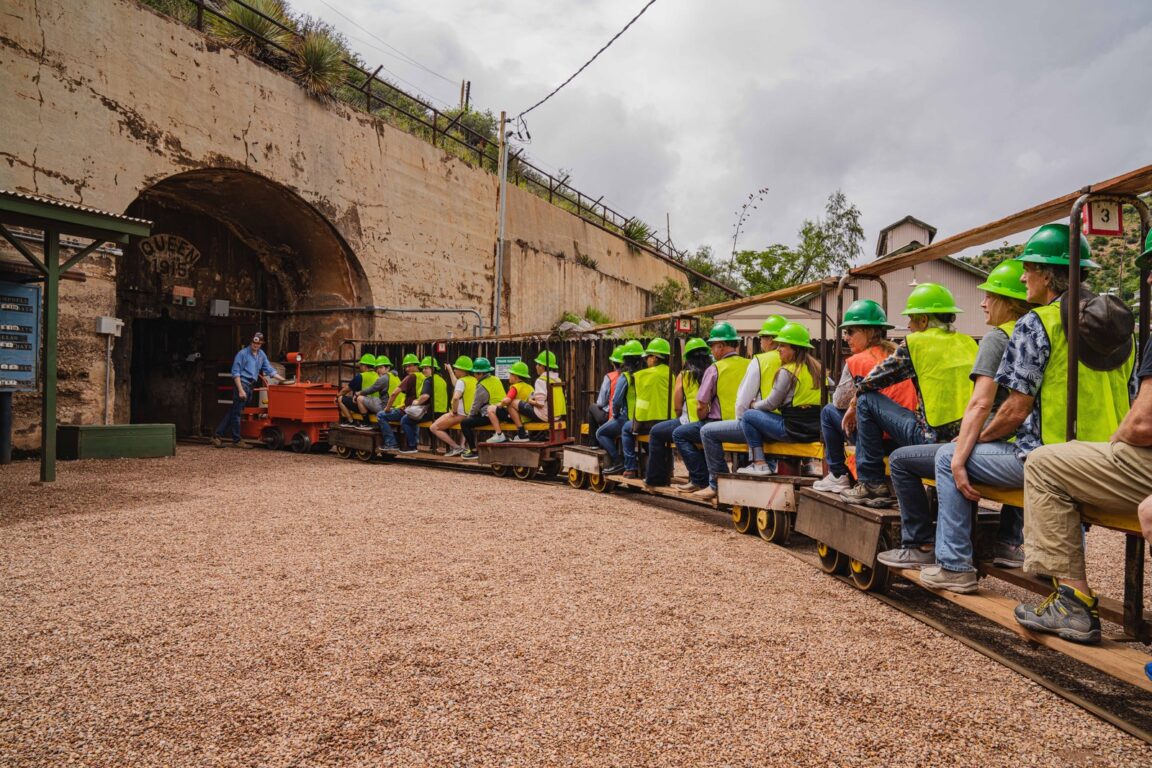
Because it is the only element of a Bisbee day with a hard clock and a capacity limit. The tour, run from the Queen Mine Tour building at 478 N Dart Road, outfits every visitor in a hard hat, miner’s lamp and yellow slicker, loads the group onto the original style mine train and runs about 1,500 feet into the Queen Mine, where guides, many of them retired miners, walk you through stopes and tunnels and demonstrate how copper was actually taken out of this mountain. The whole experience takes about an hour, plus check in time beforehand.
In winter the booking logic flips compared with spring. You no longer need to grab the first departure to escape the heat, because there is no heat to escape, and the underground temperature is the same 47 degrees in January as in July. The smart winter play is the opposite of the summer play: take the noon or 2 pm departure, spend the cold morning hours climbing stairs in the strengthening sun, and let the mine sit in the warmest part of the day when you will be happiest to trade surface light for an hour of constant underground cool. Dress for that trade. Closed toe shoes and a warm layer under the provided slicker are not optional comforts at 47 degrees; they are the difference between listening to the guide and counting the minutes.
Two hard rules shape who can go. Children under 6 are not permitted underground at all, so families with younger children should split the group rather than discover the rule at the ticket window. And reservations are required, not merely recommended, so a winter weekday walk up is still a gamble. Book the departure you want, then plan the stairs around it.
How should the Bisbee 1000 and the Brewery Gulch stairs be sequenced?
Bisbee was built vertically. The miners’ houses climb the gulches above the commercial canyon floor, and the town connected them with public staircases that now form the Bisbee 1000, a signed route of more than 1,000 steps threading the hillside neighbourhoods, with iron railings, landings, shrines, gardens and long views back over the rooftops to the Mule Mountains. It is also the course of the Bisbee 1000 Great Stair Climb, the town’s signature endurance event, which tells you how to treat it in winter: as a hike, not a stroll.
Sequence it in the morning for three reasons. First, the stairs face into the day’s warming sun while the canyon floor is still cold. Second, stair climbing generates its own heat, which is welcome at 10 am and punishing at 3 pm even in winter. Third, it leaves your legs fresh for the one part of the day where you cannot sit down, the walking sections of the mine tour. Start from the Old Bisbee end, climb through Brewery Gulch first, the narrow, bar lined gulch that was once the town’s raucous entertainment district and still holds its steepest, most characterful stair runs, then continue onto the signed Bisbee 1000 route above it. Take the descents slowly. Winter mornings can leave shaded steps damp, and Bisbee’s stairs are old concrete and stone, not gym equipment.
If the full thousand steps sounds like a lot on a short winter day, the honest shortcut is to climb Brewery Gulch and the first major stair flights above it, then traverse rather than summit. The views and the neighbourhood texture arrive early in the route; the later flights add altitude and repetition more than new sights.
What fills the rest of a winter day in Old Bisbee?
The Bisbee Mining and Historical Museum, in the former Phelps Dodge general office on Copper Queen Plaza, is the natural partner to the mine tour, and the order between them matters less than doing both. The museum gives you the corporate and social history, the ore specimens and the scale of an operation that made Bisbee one of the great copper camps of the world; the mine gives you the physical reality underneath it. It generally opens daily from 10 am to 4 pm, which fits neatly before a 2 pm tour or after a noon one, but check the day’s hours before walking over.
Save the Lavender Pit for the end of the day. The vast open pit mine on the south side of town, visible from the overlook on Highway 80, is a terraced amphitheatre cut into the mountain, and in winter the low sun rakes across its benches and throws every level into relief. It is a five minute stop, not an attraction, and it lands hardest as the last image of the day, the open air counterpart to the underground hour you spent inside the mountain the pit replaced.
Evenings in winter Bisbee are short and cold, and the town leans into it: galleries and shops on Main Street, the Copper Queen Hotel’s saloon, and dinner in Brewery Gulch, all within a few walkable blocks. Readers pairing Bisbee with Arizona’s other mining era landscapes should look at our guide to Walnut Canyon National Monument for first time visitors for cliff dwellings near Flagstaff, and Tuzigoot for first time visitors for the hilltop pueblo above the Verde Valley. Together with Bisbee they make a coherent Arizona heritage arc from prehistoric dwellings to industrial copper.
What does winter actually change in Bisbee?
Less than visitors fear and more than they expect. The mine, the museum and the town’s businesses run year round, and the tour schedule does not shrink. What changes is the margin for error. At 5,400 feet, a Bisbee winter night drops to around freezing even when the afternoon reaches the high 50s, and snow, while never guaranteed, is a real possibility that surprises travellers who packed for the Sonoran Desert floor. Tucson’s forecast is not Bisbee’s forecast; check the town itself. Daylight is short, Arizona stays on standard time all year, and the canyon loses the sun early behind the western ridge, so a 3:30 pm mine departure surfaces into near dusk. None of this is a reason to stay away. It is the reason the crowds are gone, the stairs are empty, the mine has seats, and the town belongs to the people who live in it, which is the Bisbee most worth meeting.
Frequently Asked Questions
How much does the Queen Mine Tour cost and when does it run?
Tours run daily at 9 am, 10:30 am, noon, 2 pm and 3:30 pm and last about an hour. Tickets are $18 for adults and $9 for children aged 6 to 12, taxes included, per the official Queen Mine Tour booking information checked on 17 November 2026. Reservations are required.
Can young children take the Queen Mine Tour?
No. Children under 6 are not permitted underground for safety reasons. Families with younger children usually split the group, with one adult taking older children on the tour while the others cover the museum and Main Street.
How cold is it inside the Queen Mine?
A constant 47 degrees Fahrenheit year round. You are issued a hard hat, lamp and yellow slicker, but bring your own warm layer and closed toe shoes, because an hour at 47 degrees in still air feels colder than the number suggests.
How hard is the Bisbee 1000?
It is a genuine climb of more than 1,000 public stairs through steep hillside neighbourhoods, used as the course of the Bisbee 1000 Great Stair Climb. Fit walkers can cover the main route in a morning. Doing Brewery Gulch and the first flights above it gives most of the scenery with half the climbing.
Does Bisbee get snow in winter?
It can. At roughly 5,400 feet in the Mule Mountains, Bisbee is far colder than Tucson or Phoenix, with winter nights around freezing and occasional snow. Check the forecast for Bisbee itself, pack layers, and expect shaded stairs to be damp or icy early in the morning.
Photo: Queen Mine Tour visitors in hard hats and slickers ride the mine train into the Queen Mine portal, Bisbee, Arizona. Credit: Copper Queen Mine Tour, the tour’s official website (queenminetour.com). Prices and times checked on the official site on 17 November 2026.