 LeVar Thomas
The Temple of Apollo in Ortygia needs no ticket, no booking and no queue, because there is nothing to book: it is an open air monument that is always visible from the street but never open to enter. That single fact, confirmed on the official Siracusa Turismo site with texts validated by the Syracuse Superintendence, reshapes how a visit works. You do not schedule the temple. You sequence everything else on the island around a slow, free walk around its fence, ideally in the morning when the Ortigia market beside it is in full swing and before the cathedral square fills up.
Quick Facts
- What it is: The oldest Doric stone temple in Sicily, built at the start of the 6th century BC on Largo XXV Luglio at the entrance to Ortygia
- Entry: Free. There is no ticket and no fee of any kind
- Access: Always visible from outside, but the site itself is not accessible. You view the remains from the surrounding streets and square
- Scale: The original building measured about 58.10 by 24.50 metres, a peripteral temple with 6 columns on the short sides and 17 on the long sides
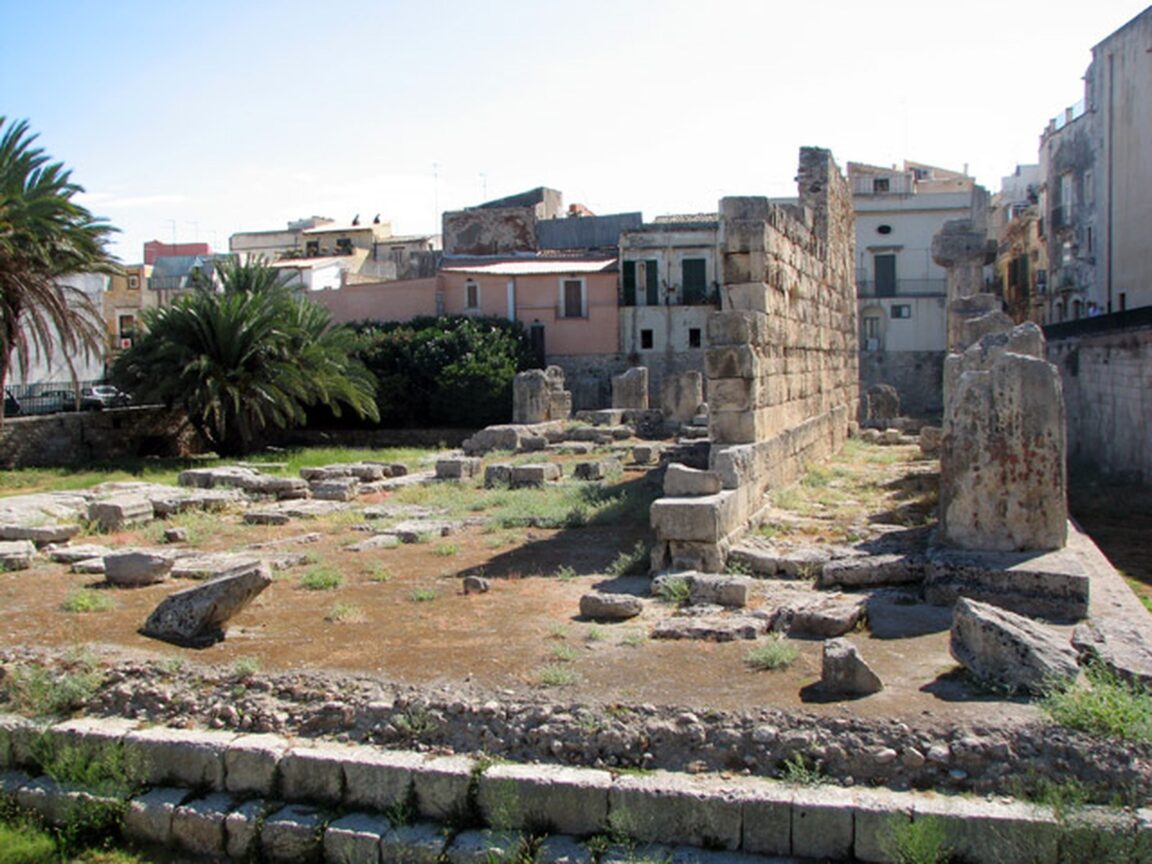
- What survives: Part of the cella wall, column bases and stumps, the stepped platform and the sanctuary enclosure remains on the south and west sides
- The signature detail: An inscription of about 8 metres on the top step of the east side names Kleomenes, son of Knidieidas, as the maker of the temple for Apollo
- Best timing: Morning, paired with the Ortigia street market next door, then on to Piazza Duomo and the cathedral
- Time needed: 20 to 40 minutes for a full, unhurried circuit of the remains
Do you need a ticket for the Temple of Apollo?
No, and this is where many first time visitors waste planning effort. The official visitor information for the temple lists opening hours simply as an open air monument, always visible but not accessible, and lists charges as none. There is no ticket office, no timed entry slot, no online booking page and no guided tour requirement. Anyone selling you a temple ticket is selling you something else, most likely a general Ortygia walking tour that passes the fence, which can be worthwhile for the commentary but is never required for access.
Because entry is not controlled, the temple also has no closing time in the usual sense. The remains sit in a public square at the island end of the bridges from the mainland, and the view is available early and late. What changes through the day is the light and the crowd, not the gate. Early morning gives you the carved stone in low, raking light with the square still quiet. Late afternoon gives you warm colour on the limestone and the start of the evening passegiata around you.
What exactly are you looking at?
The temple was built at the very beginning of the 6th century BC, which makes it the oldest Doric temple built in stone in Sicily, raised within living memory of the Greek settlement of Syracuse itself. The plan was unusually long and narrow, ringed by a colonnade of 6 by 17 monolithic columns with very tight spacing between them, a second row of columns on the east front, and a cella divided into three aisles by two rows of seven columns set on two levels. Behind the cella sat a closed rear chamber, the adyton, arranged symmetrically with the porch at the front.
Almost none of that stands at full height today, and understanding why is part of the visit. The official site history records a long sequence of reuses: the temple became a Byzantine church, traces of which survive in the front staircase and a doorway, then an Arab mosque, then the Norman church of the Saviour, which was later swallowed by a sixteenth century Spanish barracks and private buildings. That layered occupation badly damaged the ancient structure. The temple was rediscovered around 1860 inside the barracks and fully brought back to light between 1933 and 1943. What you see now, the platform, the cella wall, the column remains, is the excavated core of a building that spent most of its life hidden inside other buildings.
Two things reward a close look. The first is the inscription on the highest step of the eastern side, roughly 8 metres long and contemporary with the construction, which records that Kleomenes made the temple for Apollo and raised the colonnades, calling them beautiful works. Named architects are extremely rare in the Greek world, and the inscription is also the evidence that pins the temple to Apollo. The second is what is not on site at all: fragments of the temple’s painted terracotta revetments, which once sheathed the wooden elements high on the building, are preserved in the Museo Archeologico Regionale Paolo Orsi on the mainland. Serious visitors pair the two, the bones on Ortygia in the morning and the colour in the museum on another half day.
What is the best order for a morning on Ortygia?
Start at the temple, because geography puts it first anyway. Cross the bridges onto the island and the remains are immediately in front of you on Largo XXV Luglio. Walk the full circuit slowly, reading the platform and cella wall from the south side where the sanctuary enclosure remains survive, and save the east front and its inscription for last, when the morning light is on it.
From the temple, turn into the Ortigia market, which runs through the streets just behind the temple on weekday and Saturday mornings. This is the island’s working food market, fish, produce, cheese and street food stalls, and it is at its best before midday. Doing the temple first and the market second is the correct order for a simple reason: the temple does not care when you come, and the market very much does. Reverse the order on a late start and you will get the stalls packing up.
After the market, walk south through the lanes to Piazza Duomo. The cathedral there is the second temple of the morning: a 5th century BC temple of Athena whose Doric columns are still visible embedded in the cathedral walls, inside and out, behind a Baroque facade rebuilt after the 1693 earthquake. Seeing Apollo first and Athena second, the archaic ruin and the temple that survived by becoming a church, is the single most instructive pairing in Syracuse, and it costs you nothing but shoe leather. Finish the loop along the western seafront to the Fonte Aretusa, the freshwater spring with papyrus growing in it a few metres from the salt water, and you have covered the island’s essential arc in one unhurried morning.
How does the Temple of Apollo compare with Sicily’s other great temples?
It is older than all of them and far less complete, which is exactly its value. The famous Sicilian temples reward scale and preservation; Apollo rewards reading. Travellers building a Sicily antiquities route often pair it with the island’s other headline sites. Our guide to Segesta Archaeological Park done properly covers the great unfinished Doric temple in the west of the island, while Valley of the Temples in Agrigento done properly walks the temple order at opening time. Put Apollo first in the sequence chronologically, since it predates both, and its squat proportions and tight colonnades will show you what Doric architecture looked like before it grew confident. For a different Sicilian deep past altogether, Su Nuraxi done properly covers the Bronze Age nuraghe tradition across the water in Sardinia.
What should you know before you go?
Set expectations correctly and the visit sings. This is a viewing site, not an entering site, so there are no facilities, no shade structures and no interpretation centre at the fence; bring water in summer and do your reading in advance or on the spot from a guide you trust. The square is fully exposed, and in July and August the sensible windows are before 10 in the morning and after 5 in the afternoon. Photography is unrestricted from the public streets, and the best frames are from the south east corner, where the cella wall, the column stumps and the platform steps stack into one composition. Cars are restricted across much of Ortygia, so arrive on foot from mainland parking near the bridges and treat the whole island as a pedestrian zone.
Frequently Asked Questions
Is the Temple of Apollo in Ortygia free to visit?
Yes. The official visitor information lists no charges at all. It is an open air monument in a public square, visible from the street at no cost, with no ticket, booking or entry slot of any kind.
Can you go inside the Temple of Apollo?
No. The site is fenced and not accessible to enter. You view the platform, cella wall and column remains from the surrounding streets and square, which give a complete circuit of views from every side.
How old is the Temple of Apollo in Syracuse?
It dates to the start of the 6th century BC, making it the oldest Doric stone temple in Sicily. It was later reused as a Byzantine church, a mosque and a Norman church, hidden inside a Spanish barracks, and excavated fully between 1933 and 1943.
How long do you need at the Temple of Apollo?
Twenty to forty minutes is enough for a full circuit and a close look at the east front inscription. Pair it with the morning market beside it and the cathedral square, and the three together make a complete half day on Ortygia.
Where are the temple’s decorations kept?
Fragments of the temple’s painted terracotta revetments are preserved in the Museo Archeologico Regionale Paolo Orsi in Syracuse, on the mainland. The museum visit completes what the fenced remains on Ortygia begin.
Photo: The Temple of Apollo remains on Ortygia, Syracuse. Credit: Siracusa Turismo, the official Syracuse tourism site (siracusaturismo.net). Temple facts validated by the Soprintendenza of Syracuse and checked on 17 November 2026.