 Wei Chen
For a first visit, do Tuzigoot in this order and the place makes complete sense: check in at the visitor center museum in Clarkdale to see the pottery, tools and jewellery the Sinagua left behind, walk the paved third of a mile Pueblo Trail around and through the 110 room hilltop village, climb to the roof of the reconstructed citadel room for the full Verde Valley view, then walk down toward the green of Tavasci Marsh and the Verde River before spending the rest of the day on Clarkdale smelter town streets. Entrance is 10 dollars per adult, the same pass covers Montezuma Castle for seven days, and the monument is open 9 a.m. to 4.45 p.m. daily with last vehicle entry at 4.45 p.m. Allow half a day here, not the rushed hour most people give it.
Quick Facts
- Park: Tuzigoot National Monument, 25 West Tuzigoot Road, Clarkdale, Arizona
- Entrance fee: 10 dollars per adult aged 16 and over, children 15 and under free, valid seven days and covering Montezuma Castle National Monument, per the National Park Service
- Annual pass: 35 dollars for Tuzigoot and Montezuma Castle. America the Beautiful passes accepted
- Hours: 9 a.m. to 4.45 p.m. daily, last vehicle entry at 4.45 p.m., parking lot gate locked at 5 p.m. Closed Thanksgiving Day, 25 December and 1 January
- Pueblo: 110 rooms, built by the Sinagua people between about 1125 and 1400, on a ridge 120 feet above the Verde River floodplain
- Pueblo Trail: Paved loop of about one third of a mile, allow 30 to 45 minutes, with some steep sections and steps
- Marsh: Tavasci Marsh below the ridge, reached by a separate trail of about half a mile each way to the overlook
- Dogs: Welcome on trails on a leash of six feet or less
- Last facts check: 16 November 2026, against nps.gov
What exactly are you looking at on the hill?
Tuzigoot is the largest and best preserved of the Sinagua pueblo ruins in the Verde Valley, and its name, an Apache term usually translated as crooked water, points at the river bend and the lake below the ridge. The village began as a small cluster of rooms around 1125 and grew along the spine of a limestone and sandstone ridge for nearly three centuries, until it held 110 rooms rising two and three stories, home at its peak to roughly 225 to 250 people. The Sinagua were farmers and traders: they grew crops on the floodplain below, worked cotton, traded for shell, turquoise and goods from far beyond the valley, and built in stone directly along the ridge crest so the whole settlement reads from below as one long masonry silhouette. The people left the valley by about 1400 to 1450, as communities across the region consolidated elsewhere. President Franklin Roosevelt protected the ruin as a national monument on 25 July 1939, after excavations in the 1930s by Louis Caywood and Edward Spicer of the University of Arizona uncovered the rooms and the collection the museum now holds.
Why should the museum come before the pueblo?
What does the visitor center actually add?
About 20 to 30 minutes that transform the walk outside. Every visitor checks in at the visitor center first to pay or show a pass, and the small museum, housed in a building raised in the pueblo style in the 1930s, displays artifacts recovered from the pueblo floors and burials during excavation: pottery, stone and horn tools, jewellery, matting and textiles. Seen first, those objects turn the empty stone rooms on the hill into kitchens, storerooms and workshops. Seen afterwards, they are just a nice small museum. The bookstore, restrooms and drinking water are all here too, and there is no shade and no water up on the Pueblo Trail, so this stop is also where you fill bottles, apply sunscreen and pick up the trail guide before you climb.
How does the Pueblo Trail work?
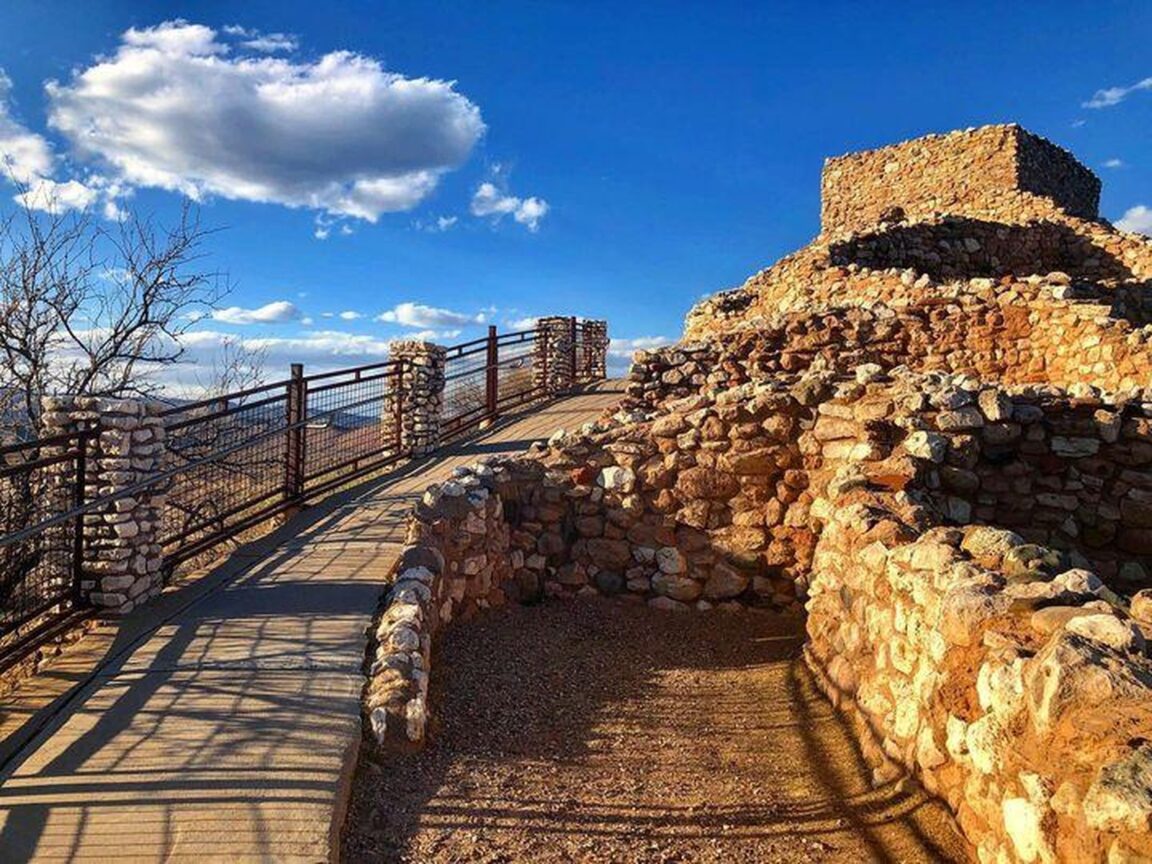
The paved Pueblo Trail loops about one third of a mile around and through the ruin, climbing the ridge with some steep sections and steps. Wayside exhibits explain the natural and cultural history as you go. Only a small number of rooms are entered: a reconstructed room in the citadel at the top, reached by stairs, with access up to its roof, and one large room on the north side of the loop. The roof is the viewpoint the whole visit builds toward. From it the settlement layout finally reads clearly, room blocks stepping down the ridge in both directions, and the valley opens out: the Verde River below, Tavasci Marsh green against the desert tones, Pecks Lake, the Black Hills and the red rock country toward Sedona in the distance. Budget 30 to 45 minutes for the loop itself, longer if the light is good, and note that the visitor center is wheelchair accessible while the pueblo climb, with its steps and steep grades, is the demanding part of the site.
Why should you not skip Tavasci Marsh and the river?
Because the marsh explains why the pueblo is here. Below the ridge, Tavasci Marsh covers about 96 acres of perennial wetland fed by springs, described as the largest freshwater marsh in Arizona unconnected to the Colorado River, and the Verde River runs green and cottonwood lined through the valley floor. A farming village needs reliable water more than it needs a view, and standing at the marsh overlook with cattails and open water below a desert ridge makes the Sinagua choice of this hilltop obvious. The Marsh Overlook Trail runs about half a mile each way from near the visitor center on a paved, gently sloped path, while longer dirt and gravel marsh routes connect toward Dead Horse Ranch State Park and need at least two hours and the same entrance fee. Check current trail status at the visitor center before committing to the longer routes, since marsh trails have been affected by fire and flooding closures in recent years. Even the short overlook walk earns its time for birdlife alone, in a valley the Park Service counts among the richest riparian corridors in Arizona.
How does Clarkdale complete the day?
Clarkdale is not just the nearest town; it is the second half of the story. The town was built as a company town for the United Verde copper smelter that processed ore from Jerome, the mining town on the hill above, and its planned streets, historic downtown and smelter era buildings show what the valley became seven centuries after the pueblo was emptied. The two settlements face each other across a short distance: a stone village that farmed the river, and a brick and timber town that smelted the hills. Walking Clarkdale after Tuzigoot, with coffee or lunch in town, turns a monument visit into a full Verde Valley day. From Clarkdale you are also well placed for the rest of the valley circuit: Jerome and its mine museum up the hill, Cottonwood and its Old Town main street a few minutes away, Dead Horse Ranch State Park on the river, and Montezuma Castle, covered by the same seven day pass, about 20 miles southeast. If Sedona is also on your itinerary, our Sedona red rock and wellness guide covers the neighbouring country, and our guide to US National Park reservations in 2026 explains where passes like the joint Tuzigoot and Montezuma Castle ticket fit in the wider system.
When should a first timer go?
Go in the morning. The pueblo faces the day early, the ridge is at its most comfortable before midday heat builds on the exposed stone, and the museum plus trail sequence fits cleanly before the 4.45 p.m. last entry becomes a factor for late arrivals. Spring and fall are the kindest seasons in the Verde Valley, summer demands an early start, a hat and full water bottles for a trail with no shade, and winter brings crisp views and the outside chance of snow dusting the pueblo walls. Whatever the season, time your arrival honestly: the parking lot gate is locked at 5 p.m., the site closes fully on Thanksgiving Day, Christmas Day and New Years Day, and a first visit that tries to squeeze the museum, the pueblo and the marsh into the final hour will short change all three.
Frequently Asked Questions
How much does Tuzigoot cost and what does the ticket cover?
Entrance is 10 dollars per adult aged 16 and over, with children 15 and under free. The pass is valid for seven days and covers both Tuzigoot and Montezuma Castle National Monuments. A 35 dollar annual pass covers both sites for a year, and America the Beautiful passes are accepted.
How long do you need for a first visit to Tuzigoot?
Allow about two hours for the museum and the Pueblo Trail together, and half a day if you add the Tavasci Marsh overlook and time in Clarkdale. The Pueblo Trail itself takes 30 to 45 minutes and the museum another 20 to 30 minutes.
What are the opening hours at Tuzigoot?
The monument is open daily from 9 a.m. to 4.45 p.m., with last vehicle entry at 4.45 p.m. and the parking lot gate locked at 5 p.m. It closes on Thanksgiving Day, 25 December and 1 January. All visitors must check in at the visitor center before exploring.
Can you go inside the pueblo rooms?
Mostly you walk around and through the ruin on the paved loop rather than entering room after room. A reconstructed citadel room can be entered by stairs, with access to its roof, and one large room on the north side of the loop is also open. The roof gives the best view in the monument.
Are dogs allowed at Tuzigoot?
Yes. Dogs are welcome on the park trails at Tuzigoot as long as they are kept on a leash of no more than six feet. Bring water for them, since the Pueblo Trail has no shade and no water sources.
How do you combine Tuzigoot with Montezuma Castle?
Easily, because one pass covers both for seven days. Montezuma Castle, a cliff dwelling about 20 miles southeast near Camp Verde, pairs with Tuzigoot as a hilltop pueblo plus cliff dwelling day, with Clarkdale, Cottonwood or Camp Verde as the lunch stop between them.
Featured image: The stone pueblo walls and Pueblo Trail at Tuzigoot National Monument above the Verde Valley, Arizona. Photo: National Park Service, via nps.gov.