 Omar Haddad
Los Angeles Metro D Line Section 1 is open, and it has been carrying passengers since 12.30pm on Friday 8 May 2026. LA Metro confirms the opening on its official D Line Extension project page, and its rider guide lists the three new stations by name: Wilshire La Brea, Wilshire Fairfax and Wilshire La Cienega. The 3.92 mile extension takes the subway west from its old terminus at Wilshire Western in Koreatown, under Wilshire Boulevard through the Miracle Mile, to the edge of Beverly Hills. For a visitor, this is the first Los Angeles rail opening in years that changes a real itinerary. Museum Row, the Academy Museum, the Petersen Automotive Museum, the La Brea Tar Pits and the Grove district are now a subway ride from downtown, with no Wilshire bus crawl and no parking garage at the end of it.
Quick Facts
- Opening: Section 1 opened at 12.30pm on Friday 8 May 2026, per LA Metro.
- New stations: Wilshire La Brea, Wilshire Fairfax and Wilshire La Cienega.
- Length: 3.92 miles of new subway from Wilshire Western to Wilshire La Cienega.
- Current terminus: Wilshire La Cienega, at the eastern edge of Beverly Hills. It is a temporary terminus.
- Full project: Nearly nine miles to Westwood in three sections, with seven new stations in total.
- Still building: Section 2 to Beverly Hills and Century City, and Section 3 to Westwood, UCLA and the West Los Angeles VA campus. Metro forecasts Sections 2 and 3 to open in 2027.
- Service pattern: The D Line runs from Union Station through downtown, Koreatown and the new stations, roughly from 4.10am to 12.30am daily, per Metro rider information.
What opened on 8 May 2026, exactly?
Section 1, and only Section 1. That precision matters because Los Angeles has talked about a subway to the sea for decades, and headlines about the D Line can easily imply more railway than exists. What exists today is a single seat ride from Union Station, through 7th Street Metro Center and Koreatown, to three new underground stations on Wilshire. Metro marked the opening with community celebrations at street level by the new stations and free rides across the bus, rail, bike share and Micro system from the morning of 8 May through the early hours of 11 May. Tunnelling for the whole extension finished in April 2024, which is why Sections 2 and 3, already bored, are following close behind Section 1 rather than a decade behind it.
What is each new station actually for?
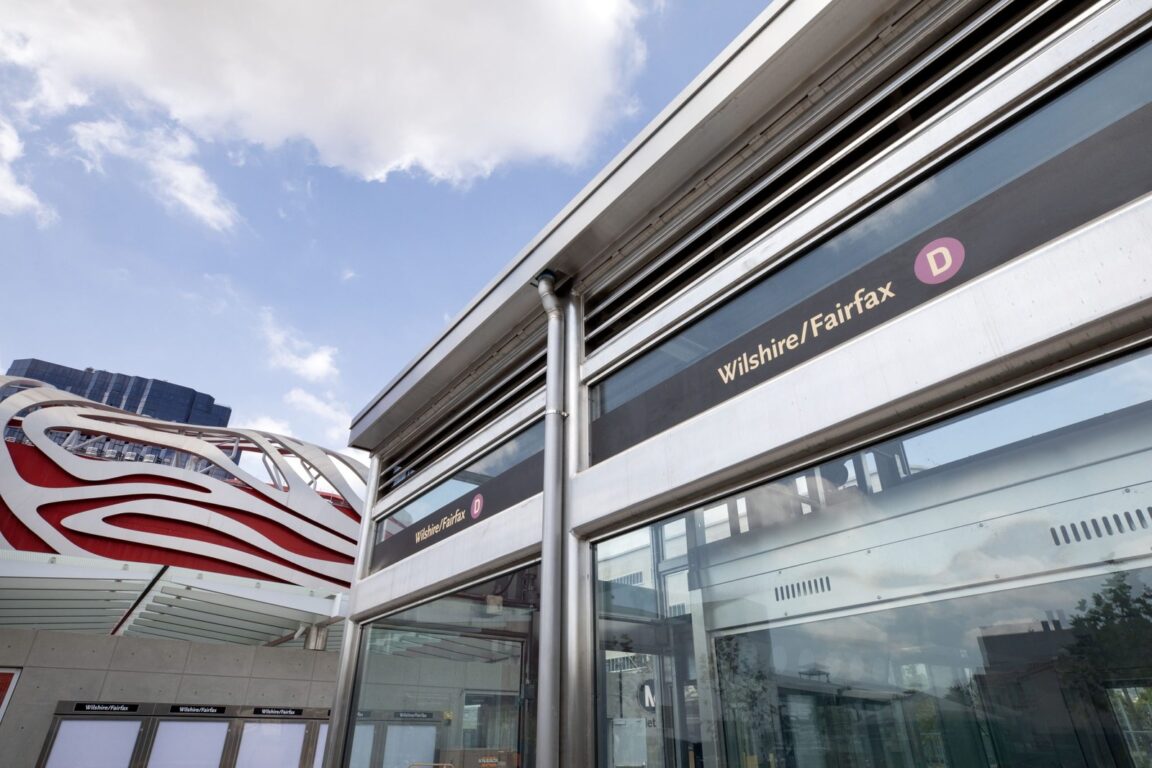
Wilshire La Brea serves Mid Wilshire, the Miracle Mile, Park Mile and Hancock Park. It is the residential station of the three, the one that puts the boulevard apartment districts and the La Brea corridor on the rail map, and the handiest for visitors staying in Mid City rather than downtown. Wilshire Fairfax is the cultural station. It serves Museum Row directly: the Los Angeles County Museum of Art, the Academy Museum of Motion Pictures, the Petersen Automotive Museum and the La Brea Tar Pits and Museum are all within a short walk, and the Fairfax District, the Grove and the Original Farmers Market lie just north. The station entrance sits beside the Petersen building, whose red and silver ribbon facade is the easiest landmark to navigate by. Wilshire La Cienega is the gateway station, the temporary end of the line, serving Carthay Circle and the eastern edge of Beverly Hills, with buses carrying riders the last stretch into Beverly Hills proper until Section 2 opens.
How do you use the extension on a visitor day?
Ride it as a string of stops, not as a commute. Start downtown, where the D Line shares the corridor with the B Line to Wilshire Vermont before branching west. Take the D Line, not the B Line, at any shared station, and check the destination sign for Wilshire La Cienega. Get off at Fairfax for a museum block of at least three hours, because LACMA, the Academy Museum and the Tar Pits reward slow visits and punish a rushed hour. Reboard westbound for one stop to La Cienega if you are connecting to a Beverly Hills bus or a Westside hotel shuttle, or ride back east to La Brea for a Miracle Mile evening. Pay with a TAP card or contactless payment at the gates, and remember the line name. Older Los Angeles material calls this the Purple Line. Metro now calls it the D Line, the signage says D, and searching a phone map for Purple will still work but the platform signs will not match the word.
For wider United States planning, our guide to where to stay in Chicago for first timers covers the other American city where a single rail corridor shapes a first visit, and our best hotels in New Orleans for a first visit pairs well with Los Angeles in a two city trip.
What opens next, and when should you believe it?
Section 2 adds Wilshire Rodeo in downtown Beverly Hills and Century City, about 2.6 miles beyond La Cienega. Section 3 adds Wilshire Westwood, Westwood UCLA and Westwood VA Hospital, completing the nine mile route and a downtown to Westwood ride Metro puts at about 25 minutes. Metro current forecast, stated on its own rider guide for Section 1, is that Sections 2 and 3 open in 2027. Treat that as a forecast, not a promise. Section 1 itself opened years after its earliest targets, at a Section 1 cost reported at about 3.51 billion dollars against an original budget near 2.8 billion. The sensible visitor position is the one this article takes throughout: plan around La Cienega as the terminus for any 2026 trip, enjoy Beverly Hills and Century City by bus or car for now, and let a 2027 opening be a pleasant upgrade to a future trip rather than the foundation of a current booking.
Why does a 3.92 mile subway matter this much in Los Angeles?
Because Wilshire is the corridor Los Angeles always needed rail on and never had. It is one of the most heavily travelled routes in the region, dense with jobs, schools, healthcare and culture from downtown to the sea, and until May 2026 its western half relied on buses in mixed traffic. A subway under Wilshire does not just speed up the trips it carries. It makes those trips predictable, which in Los Angeles is the difference between a museum morning you can plan and one you gamble on. With the 2028 Olympic and Paralympic Games ahead and the Twenty Eight by 28 program pushing transit projects to completion before them, Section 1 is also the proof of concept. Los Angeles can still finish a subway. Sections 2 and 3 will decide how far west that proof extends.
Frequently asked questions
When did the Los Angeles D Line extension open?
Section 1 opened at 12.30pm on Friday 8 May 2026, with new stations at Wilshire La Brea, Wilshire Fairfax and Wilshire La Cienega, according to LA Metro.
Can I ride the subway to Beverly Hills now?
Almost. Wilshire La Cienega, the current terminus, sits at the eastern edge of Beverly Hills. Downtown Beverly Hills gets its own station, Wilshire Rodeo, in Section 2, which Metro forecasts for 2027. Until then, buses bridge the short gap from La Cienega.
Which station is best for LACMA and the Academy Museum?
Wilshire Fairfax. It serves Museum Row directly, including the Los Angeles County Museum of Art, the Academy Museum of Motion Pictures, the Petersen Automotive Museum and the La Brea Tar Pits and Museum.
Is the D Line the same as the Purple Line?
Yes. The D Line is the former Purple Line under Metro current naming. Platform signage uses the letter D in a purple circle.
When will the D Line reach UCLA and Westwood?
Section 3, to Westwood, UCLA and the West Los Angeles VA campus, is forecast by Metro to open in 2027, together with Section 2. No exact date has been published, and Section 1 history argues for treating the year as a forecast.
Photo: Wilshire Fairfax station entrance, Los Angeles Metro D Line, with the Petersen Automotive Museum behind. LA Metro, via the official Metro D Line Extension project page.