 Camille Baptiste
Hakone works best as a paced soak, not a packed loop. The restorative way to do it is to pick one bathing style for the day and build around it: the swimsuit novelty baths at Hakone Kowakien Yunessun in Kowakudani, where you float in wine, coffee and sake themed pools with friends or family, or a quiet open-air rotenburo, either at a day-use house near Hakone-Yumoto station or booked privately at a ryokan. Hakone has 17 recognised hot spring areas, set out by the official Hakone destination site, and the choice that shapes the whole day is not which spring, but which rules you are bathing under, because swimsuit zones, traditional nude baths and private rooms each handle tattoos, time and company differently. Decide that first, buy the right pass second, and the day stays slow.
Quick Facts
- The setting: Hakone, in Kanagawa Prefecture, is a volcanic mountain area with 17 hot spring districts, from Hakone-Yumoto at the valley entrance up to Kowakudani, Gora and Sengokuhara
- Getting there: Odakyu Romancecar from Shinjuku to Hakone-Yumoto takes about 85 minutes, all seats reserved, and the Hakone Freepass does not cover the Romancecar surcharge
- Hakone Freepass: 2 days costs 7,100 yen from Shinjuku or 6,000 yen from Odawara for adults, 3 days costs 7,500 yen or 6,400 yen, at the prices in force since 1 October 2025, covering eight forms of transport in the Hakone area
- Yunessun swimsuit zone: Adults pay 2,500 yen, 2,800 yen or 3,000 yen depending on the date band, children pay 1,400 yen to 1,700 yen, and a passport covering both zones costs 3,500 yen to 4,000 yen for adults
- Mori no Yu, the traditional zone at the same complex: Adults pay 1,500 yen, 1,700 yen or 1,800 yen by date band, open 11am to 8pm with last entry at 7.30pm
- Hakone Yuryo, near Hakone-Yumoto: Shared baths cost 1,700 yen to 1,800 yen on weekdays and 2,000 yen to 2,200 yen on weekends and holidays for adults, with a free shuttle of about three minutes from the station
- Private open-air baths at Hakone Yuryo: 19 rooms, booked for a minimum of two hours, from 10,400 yen per room on a weekday for up to two people in the smallest grade
- Tenzan Tohji-kyo, in Yumoto: Adults pay 1,450 yen, cash only, open 9am to 11pm with last entry at 10pm
- Tattoos: There is no single Hakone rule. Hakone Yuryo lifted its tattoo restriction on 1 April 2025, Tenzan admits one tattooed guest at a time, and Yunessun and Mori no Yu require tattoos to be covered, each on different terms set out below
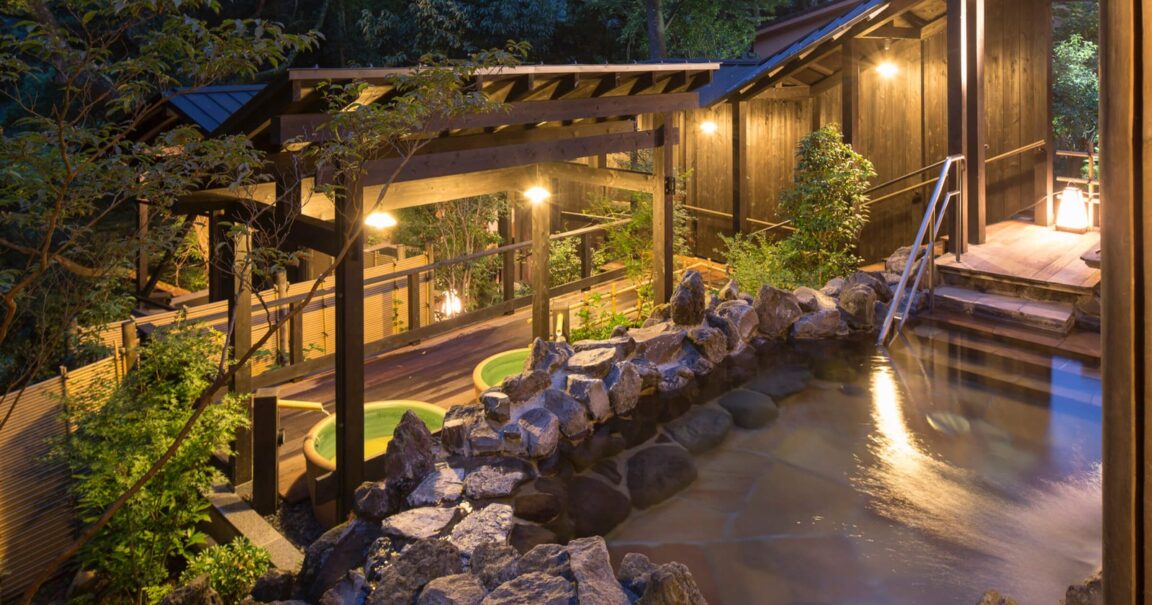
- Photo: The open-air bath at Hakone Yuryo at dusk. Photo: Hakone Yuryo, via its official website, hakoneyuryo.jp
What is the difference between Yunessun and a traditional onsen?
Yunessun is a hot spring theme park, and it says so itself. In the swimsuit zone in Kowakudani, bathing suits are required, groups of different genders bathe together, and the draw is a rotating set of themed baths that has included wine, coffee, sake and green tea, alongside a large indoor pool modelled on the Aegean Sea, slides and outdoor pools. It is social, noisy in a cheerful way, and designed for families and groups who want the hot water without the ritual. Opening hours for the swimsuit zone run 10am to 6pm on weekdays and 9am to 7pm on weekends and holidays, with last entry an hour before closing, and prices step up across three date bands, so a quiet weekday is both calmer and cheaper than a peak Saturday.
Next door in the same complex, Mori no Yu is the opposite proposition: a conventional Japanese bathhouse, split by gender, where you bathe naked, wash thoroughly before entering, and choose between indoor baths and an open-air rotenburo looking out at the mountains. If your group contains both people who want the novelty and people who want a proper soak, the passport ticket that covers both zones is the honest compromise, and it costs less than paying for the two zones separately on the same day.
A ryokan rotenburo is a third thing again. A ryokan is a traditional inn, and its open-air bath is usually smaller, quieter and tied to a stay, a meal or a booked private slot rather than walk-in day entry. The official Hakone destination site notes that many ryokan and hotels open their baths to day visitors in the mid-afternoon, before overnight guests check in, but that window, the price and whether a private bath can be reserved at all are set house by house. There is no standard Hakone ryokan day rate to quote, and any guide that invents one should not be trusted. Book directly with the inn, in writing, and confirm whether the private bath is reserved by the room, by the hour, or only offered to overnight guests.
How do the day-use houses at Hakone-Yumoto work?
Most restorative Hakone days start and end at Hakone-Yumoto, the terminus station and the oldest spring area in the valley. Two day-use houses cover most needs, and they suit different temperaments. Hakone Yuryo sits on a wooded hill in Tonosawa, about three minutes from the station on its own free shuttle, which runs every 10 to 15 minutes. Its shared bath hall is open 10am to 8pm on weekdays and to 9pm on weekends and holidays, with last entry an hour earlier. Towels are sold rather than included, at 550 yen for a bath towel and 300 yen for a face towel, so bringing your own saves a small but real cost. What sets Yuryo apart is its row of 19 private open-air baths, the Hanare Yuya Kaden rooms, booked for a minimum of two hours. Weekday prices start at 10,400 yen per room for the grade that holds two people, rising by grade and on weekends, and the rooms can be reserved online in advance, which makes Yuryo the most straightforward way in Hakone to guarantee a private rotenburo without booking a hotel room for the night.
Tenzan Tohji-kyo, further up the valley in Yumoto, is the traditionalist choice: a cluster of indoor and open-air stone baths along the river, a flat 1,450 yen for adults and 700 yen for children, and the longest hours of any house here, 9am to 11pm. Two practical warnings come straight from the house. Payment is cash only, with no cash machine on site, and groups are kept small, so it does not work as a big group outing. Arrive with yen in your pocket and time in hand, because Tenzan rewards an unhurried evening soak after the day-trip crowds have caught their trains home. If you are building a wider first trip around the soak, our first time in Tokyo itinerary shows where a Hakone day or overnight fits sensibly into a five day plan.
What are the tattoo rules, house by house?
This is the section to read before you travel, because Hakone has no town-wide tattoo policy and the rules changed recently enough that older guides are actively misleading. Each house sets its own rule, and the four that matter here say four different things on their own sites.
Hakone Yuryo is now the simplest answer in Hakone. The house states that it lifted its bathing restriction for tattoos on 1 April 2025, for the shared baths as well as its private rooms. No cover, no sticker and no special booking is required on tattoo grounds alone. Tenzan takes a narrower line: a tattooed guest is admitted only as the single tattooed person, so two tattooed friends travelling together will be refused even if they would bathe in different gender sections, and the house asks tattooed guests to cover up with a jacket while moving around the building. At Yunessun, the starting position on the official site is that guests with tattoos are refused in principle, with two stated exceptions. In the swimsuit zone you may enter if the tattoo is covered, for example by a rash guard, which can be rented on site. In Mori no Yu you may enter only if two of the facility paid tattoo cover seals cover the tattoo completely. If your tattoo is larger than that, the facility directs you to its private baths instead, which are booked online in advance. At a ryokan, there is no general rule at all: some houses refuse tattoos in shared baths but allow them in a privately booked bath, where nobody else sees them, and others refuse outright. That is a question to put to the specific inn before you pay, not at the front desk on the day.
The practical shortcut is this. If you have tattoos and want certainty, book a private bath at Yuryo, where the shared baths are open to you anyway, or reserve a private bath at Mori no Yu. If you are tattoo-free, the rules cost you nothing, but the same houses are still the calmest choices in the valley.
How should you pace a Hakone onsen day?
Start later than the sightseeing crowds, not earlier. The classic Hakone loop, train, cable car, ropeway, lake cruise and bus, is a fine day, but bolting a full loop onto a serious soak is how a restorative trip turns into a timetable. Pick the bath first and let one piece of scenery join it, not the other way round. A workable shape is a mid-morning Romancecar from Shinjuku, a slow lunch in Yumoto, an afternoon at one house, and either the last train home or a night in a ryokan with its own rotenburo for an early morning soak before the day visitors arrive. Staying overnight changes the maths completely, because the best hour in any Hakone bath is the quiet one at either end of the day.
Use the pass with your eyes open. The Hakone Freepass, at 7,100 yen for two days from Shinjuku or 6,000 yen from Odawara since the October 2025 price revision, covers the Odakyu round trip plus eight forms of transport inside Hakone, and it pays for itself if you ride the mountain railway, ropeway and lake cruise. It does not cover the Romancecar limited express surcharge, which is charged on top for each leg, so budget for that separately rather than discovering it at the ticket gate. If your day is station, shuttle, bath, station, single fares may well cost less than the pass, and that is a perfectly good outcome. Packing light helps either way, and our guide to what to pack for Japan in spring covers the small kit that transfers directly to an onsen day: a quick-dry towel, a change of underwear, and a waterproof pouch for wet swimwear after Yunessun.
Finally, observe the bath itself properly, whichever house you choose. Wash and rinse fully at the shower stations before entering, keep towels out of the water, tie up long hair, and do not wear swimwear in a traditional bath, only in the Yunessun swimsuit zone where it is required. Soak in shorter rounds, sit on the edge between them, and drink water afterwards. Restoration is a pace, not a purchase, and Hakone, done this way, delivers it.
Frequently Asked Questions
Can you visit Yunessun and Mori no Yu on one ticket?
Yes. The passport ticket covers both zones on the same day and costs 3,500 yen, 3,700 yen or 4,000 yen for adults depending on the date band, which is less than buying the swimsuit zone and Mori no Yu separately. Children pay 1,800 yen to 2,000 yen for the passport. Check which date band your day falls into on the official Yunessun site before you go, because peak days cost the most and sell the fastest.
Which Hakone onsen is best if you have tattoos?
On the houses own published rules, Hakone Yuryo is the clearest choice, because it lifted its tattoo restriction entirely on 1 April 2025, in both its shared baths and its private open-air rooms. Tenzan admits one tattooed guest at a time, Yunessun requires tattoos to be covered by a rash guard in the swimsuit zone, and Mori no Yu requires two of its own paid cover seals to hide a tattoo completely, with its private baths as the fallback for larger tattoos.
How much does a private open-air bath in Hakone cost?
At Hakone Yuryo, the most bookable day-use option, 19 private open-air rooms are rented for a minimum of two hours, from 10,400 yen per room on a weekday for up to two people, with higher grades holding up to four people and weekend prices starting at 11,400 yen. Ryokan private baths are priced individually by each inn, usually alongside a stay or a meal plan, so confirm the exact price and time slot directly with the ryokan before travelling.
Is the Hakone Freepass worth it for an onsen day trip?
Only if you ride Hakone transport as well as bathe. At 7,100 yen for two days from Shinjuku, the pass covers the Odakyu round trip and eight forms of transport in Hakone, and it suits a loop day using the mountain railway, ropeway and lake cruise. It never covers the Romancecar surcharge, which is extra on each leg. For a simple station to bath to station day, compare single fares first, because they can come in under the pass price.
What is the difference between a rotenburo and a private bath?
A rotenburo is simply an open-air bath, and it can be shared or private. A private bath, often called a kashikiri or family bath, is any bath, indoor or open-air, reserved for your own party alone for a set time. The combination most travellers are looking for in Hakone is a private rotenburo: open-air, bookable by the hour or the stay, and the one format where tattoo rules, mixed groups and privacy all stop being problems at once.
When is the quietest time to soak in Hakone?
Weekday mornings at the day-use houses and the first and last hours of the day are consistently the calmest, because most visitors arrive in Hakone on a mid-morning train and leave by late afternoon. Yunessun is also cheapest on its lowest date band, which tracks ordinary weekdays. An overnight stay in a ryokan gives you the quietest soak of all, an early morning rotenburo before day visitors reach the valley.