 Wei Chen
You cannot walk freely inside Timanfaya National Park, and that single fact should shape the whole day. The core of the park, the Montanas del Fuego, is seen from a coach on the Ruta de los Volcanes, on a timed ticket bought online in advance from CACT Lanzarote, with no ticket sales at the gate. The walking in this adventure happens at the edges and next door: on the park authority’s free guided walks, booked ahead through the Spanish national parks booking centre, and on foot among the vine pits of La Geria, the protected wine landscape that borders the park to the east. Pace the day as a seated volcano morning and a walking wine afternoon, based in Yaiza, and it works beautifully. Try to treat Timanfaya itself as a hiking park and it will not.
Quick Facts
- Park: Timanfaya National Park, south west Lanzarote, in the municipalities of Yaiza and Tinajo
- Size: More than 5,100 hectares of volcanic terrain, per CACT Lanzarote
- Formed by: Eruptions lasting six years, from 1730 to 1736, with a further eruption in 1824
- Main visit: Montanas del Fuego, Islote de Hilario, Ruta de los Volcanes coach route of about 14 kilometres and about 35 minutes
- Ticket: 30 euros per adult and 15 euros for children aged 7 to 12, with under 7s free, sold online only for a fixed date and time slot, per CACT Lanzarote. Prices checked 17 November 2026
- Arrival rule: Be at the ticket office 15 minutes before your slot. Late arrival voids the ticket, and changes and refunds are not allowed
- Walking inside the park: Only on free guided walks run by the park authority, booked in advance via reservasparquesnacionales.es, or on the signed coastal path. There is no free roaming on the lava
- Walking next door: La Geria Protected Landscape, about 5,255 hectares, where single vines grow in pits dug through volcanic ash, each sheltered by a semicircular stone wall called a zoco
- Best base: Yaiza, the whitewashed town on the park’s southern edge, with Uga and the La Geria road, the LZ-30, close by
- Total visit time: About 1 hour and 15 minutes for the standard Montanas del Fuego visit, per CACT, plus half a day for La Geria
Can you actually walk in Timanfaya National Park?
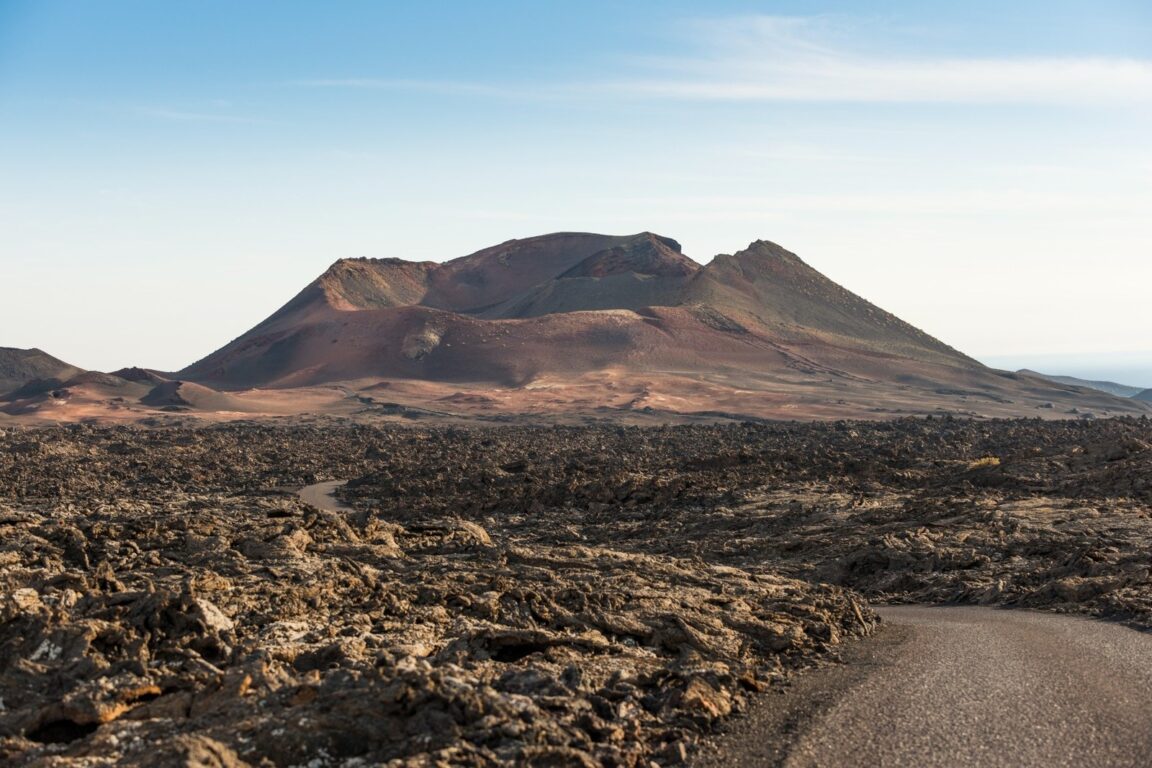
Not on your own, and not across the lava fields. CACT Lanzarote, which runs the Montanas del Fuego visitor centre for the Cabildo de Lanzarote, states the rule plainly: to protect the fragile ecosystem of the park, it is not permitted to explore it freely by car or on foot. From the El Taro checkpoint to the car park on the Islote de Hilario, visitors stay inside their vehicle. The volcanoes themselves are then seen from the Ruta de los Volcanes coach, which departs from the Islote de Hilario roughly every 20 minutes and follows a regulated road of about 14 kilometres through the main core of the 1730 to 1736 eruptions.
There are exactly two ways to put boots on the ground inside the park boundary, and both need planning. The park authority runs free guided walks, including the Tremesana route, for small groups, booked through the central booking office of the Spanish national parks at reservasparquesnacionales.es, with dates released in advance and places limited. Separately, CACT sells the Insolita Experience, a small group guided visit that adds exclusive access on foot to Montana Rajada and the Refugio de Tinecheide, with a stop and ascent at Montana Rajada and a tasting of local produce and Lanzarote wine at the end. If walking inside the park matters most, book one of those first and build the rest of the trip around its date, because neither can be improvised on the day.
How does the Timanfaya bus ticket work, step by step?
Buy the ticket before anything else. CACT sells Montanas del Fuego tickets online only, at ventaonline.cactlanzarote.com, for a specific date and a specific entry time. There are no ticket sales at the box office. The standard ticket, checked on 17 November 2026, costs 30 euros for an adult and 15 euros for a child aged 7 to 12, and children under 7 enter free. The ticket includes the coach route, the geothermal demonstrations and access to the Islote de Hilario. Download the ticket or save the QR code before leaving your base, because mobile coverage around the park is limited.
On the day, drive the LZ-67 towards the park entrance and arrive at the ticket office 15 minutes before the time on your ticket. CACT is explicit that these are time slot tickets with limited capacity: arrive outside your scheduled time and the ticket is no longer valid, and changes and refunds are not allowed. There are no waiting areas inside the site or nearby if you arrive far too early, so aim for the 15 minute mark rather than an hour of buffer. Once through, park on the Islote de Hilario, taking care with car doors on the sloping car park, where CACT warns that the slope can swing a door into the next vehicle.
What happens on the Ruta de los Volcanes and at Islote de Hilario?
The coach route is the heart of the visit. Conceived by Cesar Manrique, the road threads about 14 kilometres between craters, lava blankets, caves and malpais lava fields, with an audio narrative in Spanish, English and German that names the forms as they pass. CACT lists the standard route at about 35 minutes, with departures from the Islote de Hilario about every 20 minutes, and adapted coaches are available. Nobody gets off the coach inside the park. The halfway view takes in a line of named cones, among them Montana Rajada, Montana Termesana and Pico Redondo, and the ash covered Valle de la Tranquilidad, named for the Moon’s Sea of Tranquility.
Back at the Islote de Hilario, the visit slows down. Geothermal demonstrations show the heat still held just below the surface, in ground formed less than three centuries ago. More than 25 craters are concentrated in the few square kilometres visible from this one hill. The El Diablo restaurant, also designed by Manrique, grills meat and vegetables over a five metre well where the natural temperature reaches around 250 degrees, and its dining room looks out over the malpais through a large circular glass wall. The restaurant takes no reservations and seats guests first come, first served, so an early slot visit pairs well with an early lunch before the room fills. Allow about 1 hour and 15 minutes in total for the standard visit, per CACT, and longer if lunch is part of the plan.
Where does the real walking happen in La Geria?
East of the park, along the LZ-30 between Uga and Masdache, the same eruption ash becomes a working farm landscape, and here visitors can walk. La Geria is a protected landscape of about 5,255 hectares across the municipalities of Yaiza, Tias, Tinajo, San Bartolome and Teguise. After the 1730 to 1736 eruptions buried farmland under deep volcanic ash, known locally as picon, farmers dug funnel shaped pits, called hoyos, down through the ash to the older fertile soil. Each pit, typically a few metres across, holds a single vine, and a low semicircular wall of lava stone, a zoco, shelters it from the north east trade wind. The ash itself does quiet work too, holding night moisture and insulating the roots.
Walking La Geria means walking the road corridor and the bodega lanes, not trampling the pits. The pits are private farmland and the vines are a livelihood, so stay on roads, tracks and bodega grounds, and view the pattern from the roadside stops and winery terraces. The signature grape is Malvasia Volcanica, and the wines are released under the D.O. Lanzarote appellation. Bodega La Geria, at kilometre 19 of the LZ-30 in Yaiza, faces straight out over the vineyards, and El Grifo, founded in 1775 and among the oldest wineries in Spain, sits at the north eastern edge of the protected landscape in San Bartolome. A slow afternoon of short walks between viewpoints and two bodega stops covers the landscape properly without a long hike, which suits a day that began with an early park slot.
How should you pace the day from a Yaiza base?
Yaiza is the practical base for this pairing. It sits on the southern edge of the park, minutes from the LZ-67 park road and the start of the La Geria corridor at Uga, with whitewashed streets that stay quiet once day visitors leave. Book the earliest Montanas del Fuego slot that suits the group, because the first visits of the day run with the shortest coach queues and the softest light on the cones. Be at the ticket office 15 minutes early, ride the route, watch the demonstrations, and take an early lunch at El Diablo if the room is still calm.
Then deliberately downshift. Return to Yaiza for a rest in the heat of the day rather than stacking a second ticketed centre on tired legs, because the walking half of this adventure is gentle but exposed, with no shade over the ash fields. Head into La Geria in the later afternoon, when the low sun rakes across the pits and the zoco walls throw long shadows that make the pattern readable. Walk the bodega lanes, taste once or twice, and finish with dinner back in Yaiza. Travellers building a wider Spain trip around volcanic and historic landscapes can pair this day with the ticket discipline of visiting the Alhambra in Granada, which rewards the same book ahead habit, and with the slow food pacing of a pintxos crawl in San Sebastian, a useful reminder that the best Spanish days alternate one big sight with one long, unhurried table.
How fit do you need to be, and what should you wear?
The standard Timanfaya visit is low effort by design. The volcanoes are seen from a coach, and the only walking is around the Islote de Hilario facilities, where CACT notes that pushchair access can be difficult and recommends a baby carrier for families. The fitness question belongs to the add ons. The park authority’s guided walks and the Insolita ascent of Montana Rajada involve uneven volcanic ground and sustained sun, and suit walkers who are comfortable on rough paths in warm weather. La Geria walking is flat to gently rolling, but the black ash radiates heat and there is almost no shade, so distance feels longer than the map suggests.
CACT’s own clothing advice is simple: comfortable clothing and footwear, a cap or sun protection in summer, and warm clothing in winter, because this is a windy area. Apply that across the whole day. Closed shoes with a grippy sole handle both the Islote paths and the loose picon on La Geria tracks, a hat and water are non negotiable in the ash fields, and a light wind layer earns its place in a day pack from October to April. There is no overnight stay or camping inside Timanfaya, so recovery happens back in Yaiza: a slow evening, a proper meal and an early night if a guided walk is booked for the following morning.
Frequently Asked Questions
Can you hike freely inside Timanfaya National Park?
No. CACT Lanzarote states that the park cannot be explored freely by car or on foot, to protect its fragile ecosystem. Inside the park, visitors travel on the Ruta de los Volcanes coach, join a free guided walk run by the park authority and booked in advance, or book the small group Insolita Experience, which includes a guided ascent of Montana Rajada.
How much is a Timanfaya ticket and where do you buy it?
The standard Montanas del Fuego ticket costs 30 euros per adult and 15 euros for children aged 7 to 12, with under 7s free, checked on the official CACT Lanzarote site on 17 November 2026. Tickets are sold online only, for a fixed date and time slot, at ventaonline.cactlanzarote.com. There are no sales at the gate, and changes and refunds are not allowed.
What happens if you arrive late for your Timanfaya time slot?
The ticket stops being valid. CACT requires visitors to be at the ticket office 15 minutes before the selected time, warns that capacity is limited by slot, and states that a ticket used outside its scheduled time will no longer be valid. Build the drive to the park around that deadline, not around the slot time itself.
What is La Geria and can you walk there?
La Geria is the protected wine landscape east of Timanfaya, where single vines grow in pits dug through volcanic ash, each sheltered by a semicircular stone wall called a zoco. Visitors can walk the road corridor, lanes and bodega grounds along the LZ-30, and visit wineries such as Bodega La Geria and El Grifo. The vine pits themselves are working farmland and should be viewed from roads and terraces, not walked through.
How long does the standard Timanfaya visit take?
About 1 hour and 15 minutes, per CACT Lanzarote, covering the Ruta de los Volcanes coach route of about 35 minutes, the geothermal demonstrations and time at the Islote de Hilario. Add time for lunch at the El Diablo restaurant, which takes no reservations and seats first come, first served.
Where is the best base for combining Timanfaya and La Geria?
Yaiza, on the southern edge of the park, is the most practical base. It is close to the LZ-67 park entrance road and to Uga, where the La Geria wine road begins, so an early Timanfaya slot and a late afternoon in the vineyards fit into one unhurried day without long drives at either end.