 Wei Chen
The blocos are the free half of Rio Carnival, and for Carnival 2027 they come with one honest catch: the party is confirmed, but the street schedule is not. Rio Carnival 2027 runs from Friday 5 February to Tuesday 9 February, with Ash Wednesday on 10 February and the Champions Parade on Saturday 13 February. The street carnival is planned to start on 16 January 2027, but Riotur, the city tourism body that authorises every bloco, does not finish approvals until 15 January 2027, so no official list of bloco dates, routes and gathering times exists yet. Book a cancellable base near a metro station now, build your days around the named anchor blocos below, and lock the exact street plan when Riotur publishes it in January.
Quick Facts
- Carnival 2027 dates: Friday 5 February to Tuesday 9 February 2027; Ash Wednesday 10 February; Champions Parade Saturday 13 February
- Sambadrome: Serie Ouro parades 5 and 6 February; Special Group parades 7, 8 and 9 February, four schools a night
- Blocos: Free, no ticket, no booking; just arrive at the gathering point, called the concentracao, before the start time
- Street season: Planned to start 16 January 2027; the authorised 2027 bloco list is published by Riotur after approvals finish on 15 January 2027
- Scale: Riotur authorised 462 blocos for 2026, across a street season that ran from 17 January to 22 February
- Biggest bloco: Cordao da Bola Preta, founded 1918, in Centro on Carnival Saturday morning, with crowds reported at well over a million
- Sambadrome benchmark price: Standard grandstand and numbered chair seats for 2027 listed at R$250, or R$125 half price where eligible, through the official LIESA and Ticketmaster Brasil channel
- Checked: 18 November 2026, against LIESA and Riotur reporting; the 2027 bloco calendar itself is not yet published
What exactly is a bloco, and how is it different from the Sambadrome?
A bloco is a street parade built around a band: a bateria of drummers, brass players and singers, often on foot or on a slow sound truck, followed by a costumed crowd that is the real show. There is no ticket, no grandstand and no separation between performers and audience. You join, you sing, you move with it for a block or for three hours, and you peel off when you have had enough. The Sambadrome, by contrast, is a ticketed competition in a purpose built avenue, where the samba schools parade past judges and seated spectators late into the night. Both are Carnival. The blocos are the version Rio throws for itself, in its own neighbourhoods, in daylight, at street level.
The system behind the spontaneity is municipal. Every bloco registers with Riotur, gets an authorised route, a gathering point and a time, and the city publishes the full programme each year. For 2026 that meant 462 authorised blocos and a street season stretching from mid January to the Sunday after Carnival. Expect the same shape in 2027: dozens of outings on peak days, a handful of giant mega blocos in Centro, and hundreds of smaller neighbourhood parades where a first timer can actually breathe.
Which blocos should a first timer build around?
Start with the anchor that defines Carnival Saturday. Cordao da Bola Preta, founded in 1918 and named for its black polka dot symbol, gathers in Centro early on Carnival Saturday morning, at 7 am in the 2026 programme, and is regularly described as one of the largest street gatherings in the world. Go once, go early, and treat it as a spectacle to witness from the edge rather than a crowd to dive into. Arriving before the gathering time, standing near a side street exit, and leaving before the peak crush is the experienced way to do it.
For the classic beach zone experience, Banda de Ipanema is the name. Founded in the mid 1960s and later declared part of the city’s cultural heritage, it parades in Ipanema on Carnival Saturday and again on Tuesday afternoon, with a famously joyful, drag friendly crowd and a marching band rather than a sound truck. Simpatia E Quase Amor, also in Ipanema, is its younger sibling, a big but manageable Zona Sul bloco that went out on the Saturday before Carnival and again on Carnival Sunday in 2026. In Santa Teresa, the hilltop neighbourhood above Centro, Bloco das Carmelitas brings a smaller, more local crowd and a storybook setting of tram tracks and colonial streets, parading on the Friday afternoon and Tuesday morning in 2026. Cordao do Boitata in Centro is the connoisseur’s pick, a traditional bloco with giant puppets and an orchestra, gathering early on Sunday mornings. And if you stay past Ash Wednesday, Monobloco closes the season in Centro on the Sunday after Carnival, a huge, polished party band performance that many visitors find the easiest mega bloco of all.
None of those 2027 times are confirmed yet, and that is normal. The pattern of days and neighbourhoods is stable year to year; the exact hours are what January’s Riotur list settles. If you want the rehearsal room version of this world before Carnival, our guide to visiting a Rio samba school rehearsal shows how the schools open their doors in the months before the parades.
Where should you base yourself?
Base for the metro, not for a single bloco. Ipanema and Leblon put you inside the Zona Sul bloco circuit, on the beach, and on the metro line that reaches Centro in about 20 minutes. Copacabana has the deepest stock of hotels at every price and its own busy bloco scene, with a slightly more tourist heavy feel. Santa Teresa is atmospheric and close to Centro’s mega blocos but hilly, with fewer hotel options and slower late night transport. Centro itself is the bloco epicentre on Saturday morning and quiet at night, which is why most first timers sleep in the Zona Sul and commute in for the big mornings. Book cancellable rates early: Carnival week is Rio’s highest demand period of the year, and prices climb steeply from December. Sort your entry paperwork with the same lead time; our explainer on Brazil’s eVisa start date for US, Canadian and Australian visitors covers who needs what and when it applies.
What does a bloco day actually cost?
The bloco itself costs nothing, and that is not a marketing line: there is no ticket to buy and no official merchandise you need. Your real spend is a costume, which can be as simple as a themed T shirt, glitter and a hat bought from a street vendor; water and drinks from the licensed vendors who work the crowds; metro fares; and food before and after. The expensive half of Carnival is everything around the blocos: flights and hotels in peak week, and Sambadrome tickets if you add a parade night, where standard 2027 seats through the official channel are listed at R$250. Buy Sambadrome tickets only through LIESA’s official Ticketmaster Brasil route; the resale market around Carnival is a well documented scam risk. For a Caribbean comparison of how a street carnival budget breaks down, see our Trinidad Carnival first timer guide.
How do you handle costume, heat and safety basics?
Dress for a summer street party in the tropics, because that is what this is. Costumes are lightweight, funny and group coordinated; full heavy outfits are a heat mistake. Closed, broken in shoes matter more than the costume, because you will stand and walk on hot asphalt for hours. Carry water, use sunscreen before you leave and reapply, and pace drinks in the heat. For safety, the bloco rules are the same ones Rio regulars repeat every year: bring one phone in a pouch worn under your shirt, carry a small amount of cash and one card, leave jewellery, watches and anything irreplaceable at the hotel, agree a meeting point outside the crowd in case your group separates, and use the metro rather than trying to cross closed parade routes by car. In the biggest crowds, stay near the edges, keep moving with the flow, and step out into a side street the moment density stops feeling fun. Morning blocos are cooler, lighter and easier than afternoon ones, which is why so many of the best gatherings start at 7 or 8 am.
Frequently Asked Questions
Are the blocos really free?
Yes. Authorised blocos are free street parades with no ticket, no entry fee and no booking. You simply arrive at the published gathering point before the start time and join the crowd.
When will the 2027 bloco schedule be published?
Riotur’s authorisation process for 2027 finishes on 15 January 2027, and the street season is planned to start on 16 January. The full list of bloco dates, routes and gathering times appears around that window, so plan anchors now and details in January.
What is the biggest bloco on Carnival Saturday?
Cordao da Bola Preta, founded in 1918, gathers in Centro on Carnival Saturday morning and draws the largest crowd of the street carnival, reported at well over a million people at its peak. Go early and watch from the edge.
Should I do the Sambadrome as well as the blocos?
They are different experiences and most first timers enjoy both: blocos by day, one Sambadrome night for the Special Group parades on 7, 8 or 9 February 2027. Standard official seats are listed at R$250 through LIESA and Ticketmaster Brasil.
What should I wear to a bloco?
A light costume or themed outfit, closed broken in shoes, sunscreen and a phone pouch worn under your shirt. Leave valuables at the hotel and carry water; morning blocos are the coolest and easiest.
Where is the best base for a first bloco trip?
Ipanema or Copacabana in the Zona Sul, near a metro station. You get the beach zone blocos at your door and a direct metro ride to the Centro mega blocos.
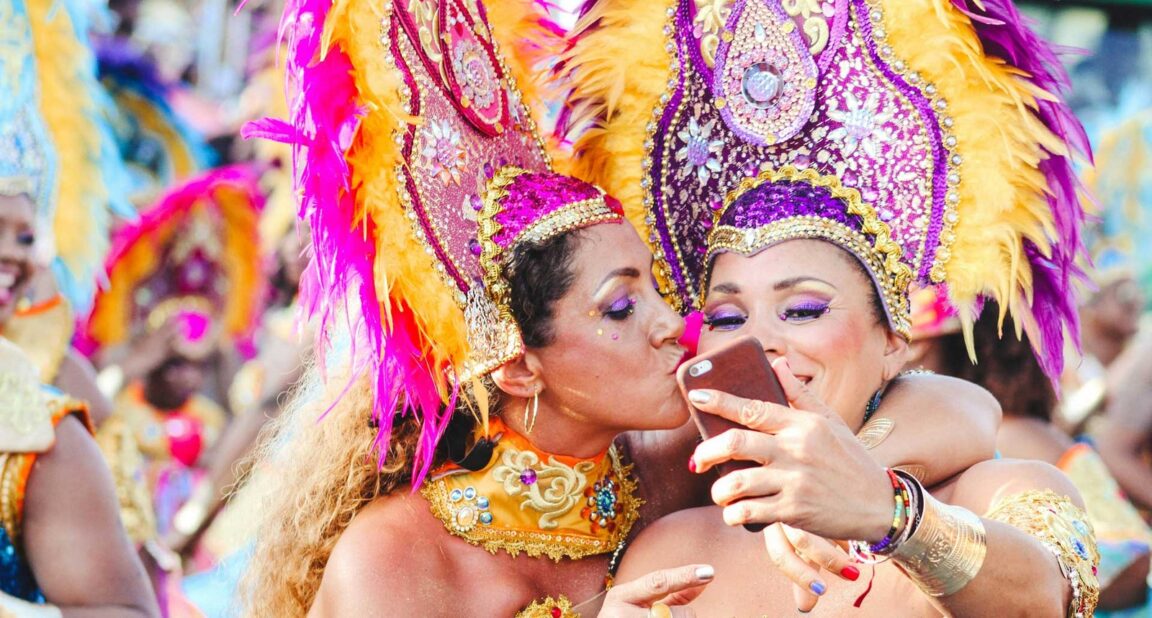
Featured image: Carnival performers in feather headdresses in Rio de Janeiro. Photo by Quinten de Graaf on Unsplash, Unsplash License. Dates verified 18 November 2026 against LIESA and Riotur reporting; the authorised 2027 bloco calendar had not been published at the time of writing.