 Wei Chen
There is no road to Aguas Calientes, the town below Machu Picchu, so the train is not one option among many; it is the journey. Two companies run it, PeruRail and Inca Rail, over the same single track line along the Urubamba River, and the honest differences between them are narrower than the marketing suggests. PeruRail runs more departures and is the only operator with direct trains from Cusco itself. Inca Rail runs a tighter operation from Ollantaytambo, with a bus connection from Cusco. The decision that matters most is not the logo on the carriage. It is where you board, Ollantaytambo or Cusco, and how much window you pay for. Everything else is detail, and this guide works through the detail with dated, checked fares.
Quick Facts
- Operators: PeruRail and Inca Rail, sharing the same line to Aguas Calientes, also called Machu Picchu Pueblo
- Main departure: Ollantaytambo in the Sacred Valley, about 1 hour 22 minutes to 1 hour 45 minutes to Aguas Calientes
- Cusco departures: PeruRail direct from Poroy, about 3 hours 14 minutes to 3 hours 46 minutes, and San Pedro, about 4 hours 12 minutes to 4 hours 41 minutes, May to December only
- Rainy season: January to April, Cusco trains are replaced by bimodal service, a bus to the Sacred Valley connecting with a train
- Fares: Dynamic. One way from Ollantaytambo started at US$62 with both operators when official booking engines were checked on 29 October 2026 for travel on 18 November 2026
- Luggage rule: Plan on one small bag of up to 8 kg per person on both operators; large suitcases stay behind in Cusco or the Sacred Valley
- Book first: Your timed Machu Picchu entry ticket, then the train that fits it; carry the passport you booked with
- Last leg: From Aguas Calientes station it is a walk through town, then a bus of about 20 to 25 minutes up to the citadel gate
Ollantaytambo or Poroy: which departure actually suits your trip?
Ollantaytambo is the working heart of the route. Both operators run their full schedules from this Sacred Valley town, the ride to Aguas Calientes takes roughly an hour and a half, and the timetable gives you early trains for a morning entry slot and late returns for a full day. It also fits how the region is best travelled: sleep in the Sacred Valley, at lower altitude than Cusco, visit its sites, and take the train from the station in town. Our guide to the Sacred Valley, Pisac and Ollantaytambo covers that base in full. The cost of the Ollantaytambo choice is the transfer to get there, about two hours by road from Cusco, which most travellers absorb into a Sacred Valley day rather than a dedicated trip.
Poroy, on the edge of Cusco, and San Pedro, in the city itself, are PeruRail only, and they trade time for simplicity. The direct train from Poroy takes around three and a half hours, and from San Pedro over four hours on the longest schedules, because the train climbs out of Cusco slowly before it ever reaches the valley. What you save is a transfer and an early road journey: you board in the city and step off in Aguas Calientes. These direct trains run from May to December. From January to April, in the rainy season, the Cusco end of the line closes and both companies sell bimodal tickets instead, a bus from Cusco to the Sacred Valley and a train from there, which is also how Inca Rail serves Cusco all year from its office on Avenida El Sol. If a Cusco start matters to you in the dry season, PeruRail is your only direct option. That single fact settles the operator question for many itineraries before classes are even compared.
What do the panoramic tiers actually buy you?
Both operators sell the same ladder in different clothes. At the base, PeruRail Expedition and Inca Rail The Voyager are comfortable standard trains with large windows, snacks for sale and fares that, on the checked date, started at the same US$62 one way from Ollantaytambo. The mid tier is where the two brands compete hardest: PeruRail Vistadome wraps the carriage in panoramic glass, and Inca Rail The 360 answers with the widest windows on the line and an open air observation element. On a route where the valley walls, the river and the cloud forest are the entertainment, the mid tier is the rational upgrade; the view genuinely is the product here, and the price step from the base tier is usually the smallest in the range. Above that, PeruRail Vistadome Observatory adds an observation car with live music and a bar, and the ladder tops out in true luxury: the Belmond Hiram Bingham on the PeruRail side, with brunch, dinner and a dedicated bus and guide bundled in, and Inca Rail First Class and its chartered Private carriage on the other. Those top tiers cost several times the base fare and sell an occasion, not transport. If Machu Picchu is the once in a decade trip and the train day is part of the celebration, they deliver it. If it is a means to an entry slot, they do not change where you arrive.
One seat tip is free and reliable: heading toward Aguas Calientes, the left side of the train follows the Urubamba River most closely. Window configuration varies by class, so treat it as a preference to request at booking, not a guarantee.
How strict is the Aguas Calientes luggage rule?
Strict, and it is the rule that catches the most people. Both operators now frame the allowance around one small bag of up to 8 kg per passenger. PeruRail’s luggage guidance allows a backpack of up to 8 kg within 100 cm total dimensions, or a carry on of up to 12 kg within 115 cm, while its own FAQ and fare conditions quote 8 kg and 115 cm, so pack to the stricter reading: one bag, 8 kg, soft sided. Inca Rail allows one piece of up to 8 kg within 118 cm and notes there are no luggage racks in its carriages. Older guides still quote a 5 kg limit, which reflects earlier PeruRail conditions; the current operator pages are the ones that count, and 8 kg is the figure to pack to for either company. The system behind the rule is simple: leave the big suitcase at your hotel in Cusco or the Sacred Valley, where storage while you visit Machu Picchu is routine, travel with a day pack and an overnight layer, and use the station storage PeruRail offers free at Ollantaytambo and at Machu Picchu station if you need it. Travellers combining the train with a trek should read the luggage logic alongside our Salkantay Trek explainer, since lodge to lodge routes change what you carry entirely.
How should you book, step by step?
Book the citadel before the train. Machu Picchu entry is timed and capacity controlled, so secure the entry slot first, then choose trains that put you in Aguas Calientes the night before a morning slot, or early enough on the day for an afternoon one. Sleeping in Aguas Calientes the night before is the low stress pattern: it absorbs a delayed train, a slow bus queue and a bad night’s altitude sleep in Cusco, none of which you want stacked against a fixed entry time. In the high season, roughly May to October, the best train times sell out weeks ahead, and operators advise booking as early as you can. Book on the operators’ own sites, perurail.com and incarail.com, where the dynamic fare for your exact train is the real price; the US$62 starting fare in the Quick Facts is a checked snapshot from 29 October 2026, not a promise for your date. Bring the passport you booked with, because both the train and the citadel check it. Finally, keep the return flexible where the fare rules allow: the last hour inside the citadel and the bus down rarely run to the minute, and a slightly later return train is cheap insurance. Travellers extending south afterward can pair the route with Puno and Lake Titicaca, the classic onward leg from Cusco.
Frequently Asked Questions
Which is better, PeruRail or Inca Rail?
Neither, decisively. PeruRail offers more departures and the only direct Cusco trains, from Poroy and San Pedro in the dry season. Inca Rail matches it from Ollantaytambo and runs a well regarded panoramic 360 service. Choose by departure station and timetable first, class second.
How long is the train to Machu Picchu?
From Ollantaytambo, about 1 hour 22 minutes to 1 hour 45 minutes. From Poroy, about 3 hours 14 minutes to 3 hours 46 minutes. From San Pedro in Cusco, about 4 hours 12 minutes to 4 hours 41 minutes. All times vary by specific service.
Can I take a suitcase on the train?
No large suitcase. Both operators limit you to one small bag of up to 8 kg. Leave main luggage at your Cusco or Sacred Valley hotel, or use station storage, and travel with a day pack.
Do trains run from Cusco all year?
Direct trains from Poroy and San Pedro run May to December. From January to April, the rainy season, services from Cusco run as bimodal bus plus train combinations on both operators.
How much does the train cost?
Fares are dynamic. Checked on 29 October 2026 for travel on 18 November 2026, one way from Ollantaytambo started at US$62 on both PeruRail Expedition and Inca Rail The Voyager, with panoramic and luxury tiers above that. Check your date on the operator sites.
Should I stay in Aguas Calientes or day trip?
Staying the night before your entry slot is the resilient plan, especially for morning slots. A day trip is possible on the earliest and latest trains but leaves no slack for delays.
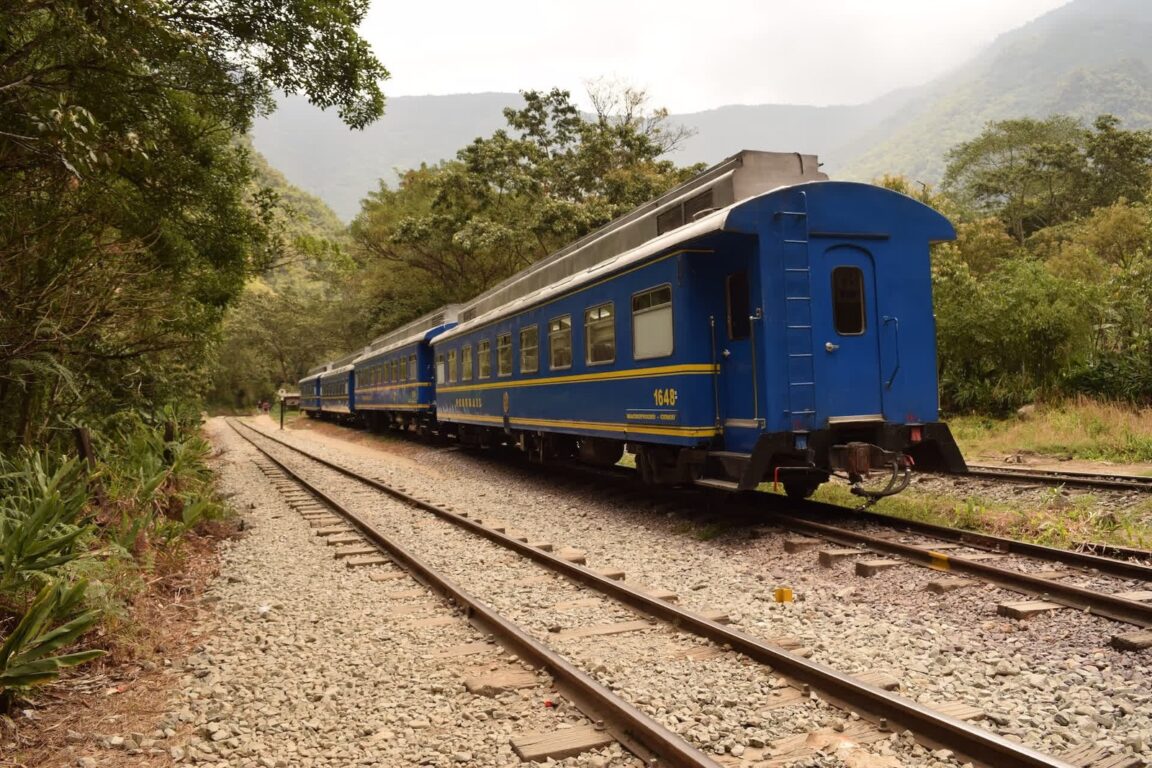
Featured image: A PeruRail train on the line to Aguas Calientes, Peru. Photo by Emmanuel Hernandez on Unsplash, Unsplash License. Fares and times checked against operator reporting on 29 October and 18 November 2026; fares are dynamic and change by date and demand.