 Wei Chen
A European night train ticket buys one of four very different nights, and the booking page rarely explains the gap. On ÖBB Nightjet, the network this guide uses as its reference because it is Europe’s largest, the ladder runs from a seat, through couchettes in shared compartments of four or six berths, to a private sleeper for one to three people, with the new generation trains adding a solo Mini Cabin and sleeper categories called Comfort and Comfort Plus. The four versus six berth question has a simple answer: six berth couchettes are the older, cheaper, tighter layout, three bunks a side, while four berth compartments give every passenger more air and are the only couchette layout on the new trains. Luggage, not the berth, is what catches most first timers out, because there is no luggage car for passenger bags on a Nightjet. Everything you bring sleeps in the compartment with you.
Quick Facts
- Reference operator: ÖBB Nightjet, booked at nightjet.com. Other operators, including European Sleeper, SNCF Intercités de Nuit and RegioJet, use the same berth vocabulary with different details.
- Couchettes: Shared compartments of 4 or 6 berths on classic Nightjet trains. New generation trains have 4 berth couchettes only, plus Mini Cabins.
- Sleepers, classic trains: Private compartments for 1, 2 or 3 people with a washbasin. Deluxe adds an en suite shower and toilet.
- Sleepers, new generation: Comfort compartments sleep 2 with an en suite toilet and shower hose. Comfort Plus sleeps 2 across the car with a separate shower cubicle. Every new generation sleeper has its own toilet and shower.
- Mini Cabin: A lockable solo pod in the couchette car. Hand luggage locker maximum 40 x 55 x 23 cm, shoe compartment 18 x 57 x 15 cm, berth 189 cm long.
- Bed lengths: Couchette berths are 190 cm. Mini Cabin berths are 189 cm.
- Luggage: One suitcase or travel bag plus one piece of hand luggage per passenger on Nightjet services sold through NS International, and it must fit the racks in your compartment. There is no separate luggage car for passenger bags.
- Bicycles: Only on selected Nightjet routes with a bicycle carriage, with a bicycle ticket and a mandatory reservation booked before departure. Otherwise a bike travels only dismantled and packed as luggage.
- Breakfast: Included with couchette and sleeper fares. A small breakfast in couchettes, a larger à la carte choice in sleepers.
What is a couchette, exactly?
A couchette is a padded berth in a shared compartment, sold per berth rather than per room. By day the compartment is a six seat or four seat sitting room. In the evening the seats fold and bunks come down, the attendant or the passengers make the conversion, and each berth comes with a pillow, a blanket and a sheet that you arrange yourself. Washing facilities and toilets are shared, at the end of the carriage. The compartment locks from the inside, women only compartments can be booked on many routes, and a whole compartment can be booked privately for a group or family, which is how many families turn a couchette into a budget sleeper. Expect company: a single berth in a four or six berth compartment means sharing the night with strangers, their alarms and their luggage. For travellers crossing the continent on a budget after a flight into Europe, the entry rules in the EU Entry and Exit System explainer for US travelers are worth reading before the night train leg, because the train does not pause the paperwork.
Four berths or six: which couchette should you book?
Book four whenever it is offered. A six berth compartment stacks three bunks on each side, and the middle bunk is the awkward one: no view, limited headroom, and a ladder climb for the top bunk that tests tired legs. A four berth compartment drops the middle pair, so every berth has sitting headroom once the bunks are down and the floor stays usable for bags. The price gap between the two is usually the smallest money on the whole trip relative to the sleep it buys. On the new generation Nightjet trains the choice disappears, because their couchette cars carry only 4 berth compartments alongside the Mini Cabins, three 4 berth compartments and 28 Mini Cabins per couchette car. On classic trains both layouts run, sometimes on the same route on different dates, so check the accommodation code at booking rather than assuming. If only six berth remains, a lower berth is worth selecting at booking where the system allows it, and an upper berth is the quieter, more private choice for a sound sleeper who travels light.
What does a sleeper add over a couchette?
Privacy, a made bed and a washbasin, in that order. A classic Nightjet sleeper is a private compartment for one, two or three people, sold as single, double or triple occupancy, with beds made up by the attendant, a washbasin inside the compartment, towels and toiletries, a wake up call and an à la carte breakfast chosen from a menu. Deluxe sleepers on classic trains add an en suite shower and toilet. The new generation trains rebuild the category: their sleeping cars hold ten compartments each, nine Comfort compartments with two fixed beds along the window and an en suite toilet with a pull out shower hose that turns it into a wet room, and one Comfort Plus compartment per car with two beds across the car, more floor space and a separate shower cubicle. Fixed beds matter more than they sound. A couchette bunk is a converted seat, while a new generation sleeper bed is a bed all day, so the compartment works as a private room from the moment you board. Solo travellers should note that sleeper berths are sold per bed: booking one bed in a two bed Comfort compartment can mean sharing unless the whole compartment is booked.
What is a Mini Cabin, and who suits it?
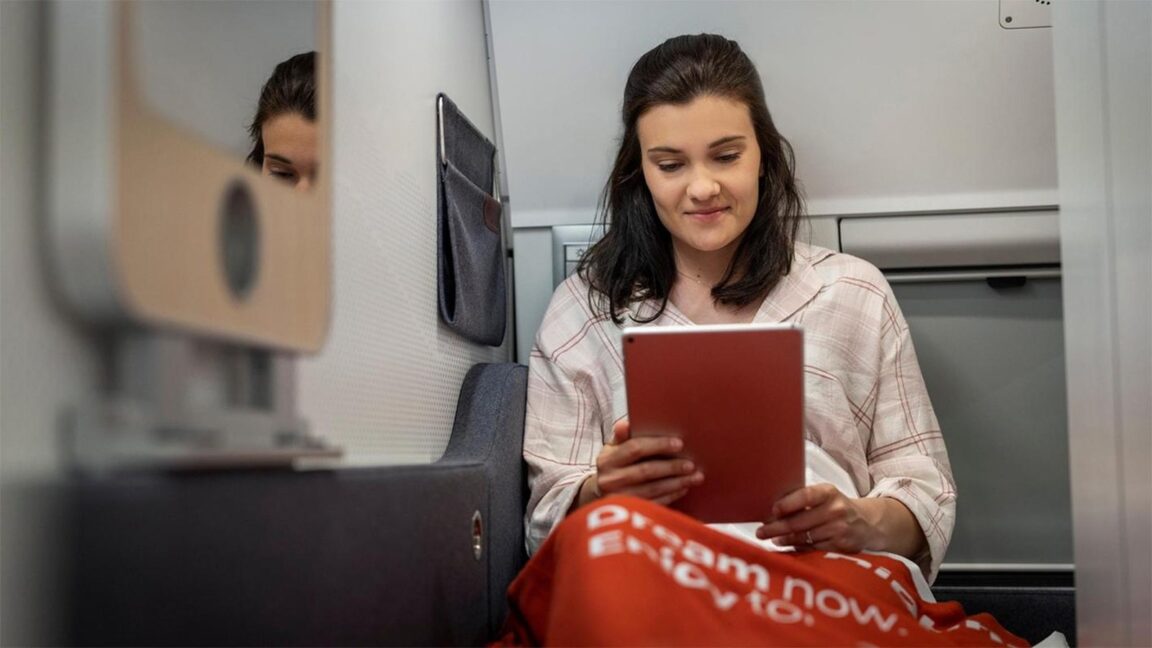
The Mini Cabin is the new generation Nightjet’s answer to the solo traveller: a private, lockable sleeping pod inside the couchette car, sold for one person, with a berth 189 cm long and 94 cm of sitting height above the mattress. Inside are a movable folding breakfast table with a mirror, coat hooks, a reading light and storage, and two adjoining cabins can be opened to each other through a small connecting door for pairs travelling together. The honest limit is luggage. The lockable hand luggage compartment takes a bag of at most 40 x 55 x 23 cm, cabin bag size, plus a separate shoe compartment, and larger luggage goes in lockers beside the cabins rather than at your feet. A solo traveller with one cabin bag gets a private night at close to a couchette price. A solo traveller with a 70 litre backpack and a second bag should book a couchette berth or a sleeper instead, because the pod has nowhere to put them.
Where does the luggage actually go?
With you. Nightjet trains have no luggage car for passenger suitcases, and the allowance sold through NS International is one suitcase or travel bag plus one piece of hand luggage per person, which must fit the available racks. In practice the space is overhead racks, the floor under the lower berths and the gap beside the compartment door, and in a full six berth couchette that space is shared six ways. Pack for the compartment, not the trip: one soft bag that compresses under a berth beats a hard shell case that fits nowhere, and a small daypack for the night itself, washbag, sleepwear, valuables and morning clothes, means the big bag stays shut and stowed. New generation trains improve the edges, with lockable luggage racks secured by code or card in the seating cars and a multifunction car with more luggage room, plus six bicycle spaces. Keep doors, aisles and seats clear, because ÖBB’s luggage guidance is explicit that those are escape routes, and you remain responsible for your own bags throughout the night.
Can a bicycle come on a night train?
Only in the bicycle carriage, and only where one exists. ÖBB allows bicycle transport on selected Nightjet routes with a bicycle ticket and a mandatory reservation, bought before departure, and NS International sets the unpacked bike limits for Nightjet trains with a bicycle carriage at 185 cm long, 110 cm high, 60 cm wide and 30 kg, with tandems and recumbents excluded. On trains without a bicycle carriage a bike travels only dismantled and packed, within a 90 x 60 x 40 cm package that fits under a seat or berth or in a rack, and then it counts as luggage and needs no bicycle ticket. The new generation Nightjet multifunction car carries six bicycle spaces, which is the layout to look for when booking a cycling trip. Folding bikes, folded, travel free as luggage. The practical rule is to reserve the bike space when the passenger ticket is bought, because a night train with a full bicycle carriage will not improvise room at midnight.
How do seats compare, and when are they enough?
The seat is the honest budget floor: a reclining seat in an open carriage on new trains or a six seat compartment on classic ones, with shared toilets and no bedding beyond what you bring. It suits a short overnight hop, a very tight budget or a traveller who genuinely sleeps anywhere. For a full night of eight hours or more, the couchette is the value pick for most people, and the step from seat to couchette buys more sleep than the step from couchette to sleeper. Whichever category you book, the morning routine is the same: breakfast in couchette and sleeper categories, a wash in the shared facilities or your own basin, and arrival in a city centre station. If the night train is one leg of a longer first trip, a first timer’s Paris itinerary shows the kind of arrival day a night train makes possible, stepping off the train at breakfast and walking straight into the city.
Frequently Asked Questions
What is the difference between a couchette and a sleeper?
A couchette is a berth in a shared compartment of four or six, with bedding you arrange yourself and shared toilets. A sleeper is a private compartment for one to three people with made up beds, a washbasin, and on deluxe and new generation categories an en suite shower and toilet.
Is a 4 berth couchette worth it over a 6 berth?
Yes, for most travellers. Four berth compartments drop the cramped middle bunks, give every passenger headroom and floor space, and are the only couchette layout on new generation Nightjet trains.
How much luggage can I bring on a Nightjet?
One suitcase or travel bag plus one piece of hand luggage per passenger, and it must fit in your compartment’s racks, under the berths or beside the door. There is no luggage car for passenger bags.
Can I take a bicycle on a European night train?
On selected Nightjet routes with a bicycle carriage, yes, with a bicycle ticket and a reservation made before departure. Without a bicycle carriage, only a dismantled bike packed to 90 x 60 x 40 cm travels, as luggage.
What is a Mini Cabin on the new Nightjet?
A private lockable pod for one person in the couchette car, with a 189 cm berth, a folding breakfast table and a hand luggage locker sized 40 x 55 x 23 cm. It suits solo travellers with cabin sized luggage only.
Is breakfast included on night trains?
On Nightjet, yes for couchette and sleeper fares: a small breakfast in couchettes and a larger à la carte selection in sleepers. Seat fares do not include it.
Photo: A Mini Cabin in an ÖBB Nightjet couchette car. Photo from the ÖBB Nightjet official website, nightjet.com, ÖBB.