 Wei Chen
The O Circuit is the full loop around the Paine Massif in Torres del Paine National Park, roughly 120 to 130 km over eight days and seven nights, and it is booked, not simply walked. Two facts decide whether a trip happens at all. First, the loop runs through two separate booking systems: CONAF sells the park entry ticket through pasesparques.cl, while the campsites and refugios are split between two private operators, Las Torres Patagonia on the east side and Vértice Patagonia on the north and west, and every night must line up in a fixed anticlockwise order, Serón, Dickson, Los Perros, then over John Gardner Pass to Grey, before the route joins the W Trek. Second, the season is short and conditional: the northern side was closed until 31 October 2026, full O itineraries run from November into March, and the pass can close on any given morning for wind. Book the nights in order, in one sitting, as soon as the operators open their calendars, and build the fitness for the pass day before paying for any of it.
Quick Facts
- Distance and time: About 120 to 130 km, sold by the park’s operators as 8 days and 7 nights. Shorter counts near 93 km exclude some W Trek stages and side trips, which is why published distances disagree.
- Direction: Anticlockwise only on the northern side. The park labels the Serón to Dickson to Los Perros to Paso trails one way, and bookings follow that order.
- Park entry: Buy in advance on pasesparques.cl, CONAF’s portal. The CONAF tariff table published for visits to 31 December 2026 lists a foreign adult at CLP 34,000 for one day and CLP 48,500 for more than one day. An O Circuit trip needs the multi day ticket. Confirm the live price when buying, because tariffs are reset.
- Campsite split: Las Torres Patagonia runs Serón and the eastern W sector sites including Cuernos, Chileno and Central. Vértice Patagonia runs Dickson, Los Perros, Grey and Paine Grande. Both must be booked, in sequence, plus the CONAF ticket.
- Season: The O Circuit’s northern side was closed until 31 October 2026, with reopening subject to weather and safety review. Las Torres lists Serón closing 25 March and its circuit camps on 30 March at the end of the season.
- The hard day: Los Perros to Grey over John Gardner Pass, listed by operators at 15 to 18 km and up to 10 to 12 hours, with a warden go or no go decision on the morning based on the wind forecast.
- Base town: Puerto Natales. Buses run about two hours to the Laguna Amarga entrance, where you register with CONAF with your passport.
- Reservations: Campsite and refugio reservations have been mandatory on the circuit since October 2016. There is no walking in and hoping for a bed.
How does the split booking actually work?
Think of the O as three purchases that must agree with each other. The first is the CONAF park ticket on pasesparques.cl, bought for your entry date with your passport details, and downloaded as a QR code before you leave Puerto Natales, because there is no reliable signal at the gate. The second is the Las Torres Patagonia booking: Serón for night one, and the eastern nights at the end of the loop if your itinerary finishes through Cuernos, Chileno or Central. The third is Vértice Patagonia: Dickson for night two, Los Perros for night three, then Grey and Paine Grande on the west side. The order is not a suggestion. Because the northern trails are one way, a booking that starts at Dickson before Serón cannot be walked, and the operators’ systems are built around the anticlockwise sequence. Book both operators on the same day, working from the scarcest nights outward: Los Perros and Dickson have the least capacity on the loop, so fix those dates first, then fit Serón and the W sector nights around them. If a night in the chain is sold out, the whole itinerary moves, not just that night. Walkers planning the southern half only will find the distances and refugio order in the Patagonia packing guide for El Calafate and Torres del Paine a useful companion, because the wind that shapes the O shapes the bag too.
What does the refugio and campsite order look like, day by day?
Day one runs from the Laguna Amarga entrance and the Las Torres sector to Serón, about 13.5 km and roughly four hours across open pampa, the gentlest full pack day of the loop. Day two, Serón to Dickson, is about 18 km and six hours, rolling country with one exposed and windy section, ending at the shore of Lago Dickson with its glacier view. Day three shortens to about 12 km and four and a half hours from Dickson to Los Perros, climbing through forest to the campsite below the Los Perros Glacier, and the short day is deliberate: it stages you under the pass. Day four is the pass day, covered below. Day five continues from Grey along Lago Pehoé to Paine Grande, about 11 km, where the O joins the W Trek and the trail fills with W walkers. From there the standard finish runs through the French Valley side trip, Cuernos or Francés, Central and Chileno, ending with the pre dawn climb to the Base of the Towers viewpoint and the walk out to the bus. Operators package this as eight days and seven nights; nine days, splitting a stage or adding a weather buffer at Dickson, is the more humane version for most walkers.
Why does John Gardner Pass set the fitness bar?
Because it is a mountain pass crossed with a full pack at the end of three loaded days, in the windiest inhabited trekking country most walkers will ever meet. The stage from Los Perros climbs about 800 m to the pass and descends roughly 1,100 m to Grey, and operator timings for the full day run from 7 to 12 hours depending on conditions and how far you walk. The Los Perros warden posts a go or no go decision in the morning based on the official wind forecast, and a no go is not negotiable: you wait, which is why the itinerary needs a spare day or a short following stage. The honest fitness test is not a single hike. It is two back to back loaded days at home, six hours each with the pack you will actually carry, finishing day two able to do it again. If that test fails, train for another month or walk the W instead, which keeps the French Valley, Grey Glacier and the Towers and drops the pass. Patagonian wind is a load in itself, and the packing system in the Patagonia guide above, built around windproof layers, is the right starting point for the O as well.
When should you go, and when should you book?
The full O runs in the southern summer window, November to March. The northern side stayed closed until 31 October 2026 and the earliest full itineraries start 1 November, subject to CONAF’s weather and safety review, while the far end of the season closes in stages, with Serón listed as closing on 25 March and the Las Torres circuit camps on 30 March. November offers long days and quieter northern camps but the highest chance of snow on the pass. December and January bring the strongest winds and the fullest camps. February and early March are the settled choice for many walkers, with the pass more often open and the crowds thinning. Booking opens months ahead on the two operators’ own calendars and the scarce northern nights go first, so the working rule is to book the moment your dates are fixed, buy the CONAF ticket once the camps are confirmed, and book the Puerto Natales buses in the same session. Keep the park’s daily trail report in your routine from the week before you fly: closures on the northern side are announced there first.
What does the O cost before food and gear?
The fixed costs are the park ticket, the campsite or refugio nights and the buses, and they are paid to three different sellers. The CONAF multi day ticket for a foreign adult is CLP 48,500 on the tariff table published for visits to 31 December 2026. Campsite nights with your own tent are the budget route, refugio bunks with meals the expensive one, and the two operators price separately, so the only honest total is the sum of your own two booking confirmations: build the itinerary in both systems before paying either, and screenshot every confirmation, because check in at each camp is against your booking and your passport. Add the return bus between Puerto Natales and Laguna Amarga, food for eight or nine days bought in Puerto Natales, and gas if you are cooking at the camps that allow it. Fires are banned in the park and cooking is only at designated camp kitchens, which is one more reason the refugio meal plans tempt tired walkers on the pass day’s far side. For a sense of what the park’s headline lodge costs by contrast, the Explora Torres del Paine lodge guide covers the conservation reserve on the park’s edge.
Frequently Asked Questions
Can I walk the O Circuit clockwise?
No. The northern side is walked anticlockwise as a park rule, the trails from Serón through Dickson and Los Perros to Paso are labelled one way, and campsite bookings are sold in that sequence.
How far ahead do I need to book the O Circuit?
As early as the operators open their calendars, months ahead for December and January. The northern camps, Dickson and Los Perros, have the least capacity and sell out first, and every night must line up in order, so a single sold out night moves the whole trip.
Who do I book with for the O Circuit?
Three sellers: CONAF for the park ticket on pasesparques.cl, Las Torres Patagonia for Serón and the eastern sector, and Vértice Patagonia for Dickson, Los Perros, Grey and Paine Grande.
How hard is the John Gardner Pass day?
It is the hardest day of the loop: about 15 to 18 km, a climb of roughly 800 m and a long descent to Grey, taking 7 to 12 hours depending on conditions. The warden at Los Perros makes a morning go or no go call on the wind forecast.
When is the O Circuit open?
In the southern summer. The northern side was closed until 31 October 2026, full itineraries run from November, and camps close in stages in late March, with Serón listed to 25 March and the Las Torres circuit camps to 30 March.
Is the O Circuit harder than the W Trek?
Yes. The O includes the entire W plus the remote northern side and the pass, at roughly 120 to 130 km over eight days against the W’s four to five days. It asks for prior multi day trekking experience and a bigger weather margin.
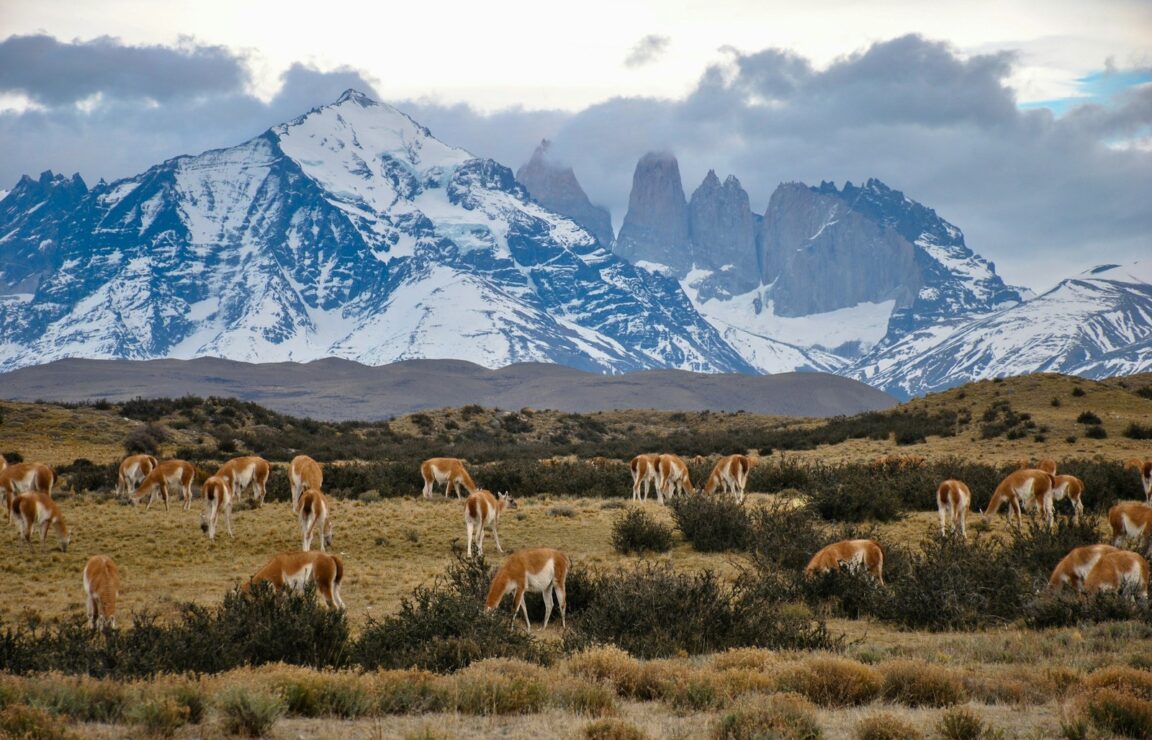
Photo: Guanacos grazing below the towers of the Paine Massif, Torres del Paine National Park, Chile. Photo by Alex Wolowiecki on Unsplash, Unsplash License.