 Elena Vasquez
George Town rewards a second, quieter food plan beyond the famous laksa and char kway teow queues: start the day with roti canai at a mamak stall, spend the late morning reading the colour code of a Nyonya kuih tray, and finish on the Chew Jetty boardwalk with small snacks eaten standing up, looking at the water. Eaten in that order, the three stops explain the city better than any single signature dish, because each one belongs to a different community that built this port. Nothing here needs a reservation except your own appetite planning: kuih sells out by early afternoon, roti canai is a breakfast food, and the jetty stalls wind down in the evening, so the order below is the order that works.
Quick Facts
- Where: George Town, the capital of Penang, on the north eastern tip of Penang Island, Malaysia.
- The three stops: A mamak roti canai breakfast, a Peranakan kuih shop in the heritage core, and the snack stalls along Chew Jetty on Weld Quay.
- Heritage status: George Town was inscribed with Melaka on the UNESCO World Heritage List in 2008 as the Historic Cities of the Straits of Malacca.
- Best order: Roti canai first, kuih late morning, Chew Jetty in the late afternoon light.
- Book ahead: Almost nothing. The one exception is a kuih order for a group or a take home box, which small family shops take by phone a day or two ahead.
- Facts checked: 19 November 2026, against UNESCO, George Town World Heritage Incorporated and the Chew Jetty visitor guide linked below.
Why does George Town have three breakfasts at once?
The short answer is trade. UNESCO describes Melaka and George Town as exceptional examples of multicultural trading towns, shaped over almost 500 years by Malay, Chinese and Indian cultures and by successive European colonial powers, and the food still follows that map street by street. Read the summary on the George Town World Heritage Incorporated site and then walk it: a Tamil Muslim mamak stall flipping flatbread, a Peranakan family steaming layered rice cakes a few streets away, and Hokkien clan families selling snacks from their own stilt houses on the waterfront. The UNESCO case study of the two cities makes the same point in heritage language. On the ground it is simpler: in George Town, who cooked your food tells you which wave of the port you are tasting.
That is also why this article skips the greatest hits. Asam laksa, char kway teow and nasi kandar deserve their own queues and their own article. The table below, the other table of kuih colours, flatbread and jetty snacks, is the one locals graze from daily, and it is the one a short visit usually misses.
First stop: how do you order roti canai like you mean it?
Order roti canai kosong, the plain version, with dhal, and watch the dough work before you eat. Roti canai is the mamak breakfast of Penang: a ball of rested dough oiled, stretched paper thin on a marble or steel top, folded into layers and griddled until the outside shatters and the inside stays soft and chewy. Kosong means plain, and plain is the right first order because the bread itself is the point. The dhal that comes with it is a mild lentil curry for tearing and dipping, and most stalls will add a spoon of sambal if you ask.
Two upgrades are worth knowing. Roti telur folds a beaten egg into the layers and turns breakfast into something closer to lunch. Roti tissue, where it is offered, is the showpiece: the dough stretched so thin and cooked so crisp that it stands up in a cone, usually sweetened. Order tissue to share at the end, not as your main plate, because it eats like a dessert. A glass of teh tarik, pulled tea with condensed milk, is the standard partner, and its sweetness is calibrated for exactly this combination of ghee, lentil and chilli heat.
Practical points matter more than stall rankings here. Roti stalls do their best business early, the dough is freshest in the morning, and the griddle queue moves fast because regulars order without a menu. Eat at the stall rather than taking the bread away: roti canai steams itself soft in a bag within minutes, and the crisp layered texture you queued for is gone. If a stall offers banana leaf or a steel tray, take what comes and eat with your right hand, tearing with thumb and fingers. Cutlery exists, but the tear, dip and fold rhythm is half the pleasure.
Second stop: what does the kuih colour code actually tell you?
By late morning, move to a kuih shop and treat the tray like a menu written in colour. Kuih are the small steamed, baked and set cakes of Malay and Peranakan cooking, sold in bite size pieces and eaten as snacks, tea items and festival food rather than as a plated dessert. In a Nyonya, or Peranakan, shop the colours are not decoration for its own sake. They traditionally come from the ingredients themselves, and learning the code lets you choose by flavour before you point.
Green usually means pandan, the fragrant leaf that gives kuih its vanilla grass perfume, or sometimes suji and mung bean in the filling beneath. Deep blue and purple tones traditionally come from butterfly pea flower, most famously in pulut tai tai, pressed glutinous rice served with kaya coconut jam, where the blue rice is as much signature as flavour. White and pale layers signal coconut milk and rice flour, as in kuih talam, whose soft green pandan base sits under a salty white coconut top. Pink, red and rainbow layers point to kuih lapis, the steamed layer cake you can peel apart sheet by sheet, sweet, rich and deliberately playful. Brown and amber pieces lean on palm sugar, gula melaka, with its toffee depth. Yellow often means egg, pumpkin or turmeric warmth depending on the family recipe.
Three pieces teach the range in one visit. Start with kuih talam for the salt sweet balance that defines the Nyonya palate. Take onde onde next, glutinous rice balls rolled in grated coconut with a centre of palm sugar that liquefies as the ball cooks, so the whole thing bursts rather than chews. Finish with ang ku kueh, the red tortoise cake of moulded glutinous rice skin over mung bean or peanut filling, made for celebrations and temple offerings, which is why its shape is a tortoise, a symbol of longevity. A mixed box of six to nine small pieces is the correct unit of purchase. Kuih are rich, perishable and made fresh daily, and shops sell through their trays by mid afternoon, which is why this stop belongs in the late morning and not after lunch.
One honesty note for buyers: natural colour varies. A pandan layer can be pale in one batch and deep green in another, and some modern sellers use colouring for consistency. Colour is a guide to flavour, not a guarantee of an all natural tray, and the good family shops are happy to tell you what is in each piece if you ask before you buy.
Third stop: what should you eat on Chew Jetty, and how do you behave there?
End the day on Weld Quay at the clan jetties, the waterfront villages of wooden houses on stilts built by Chinese clan communities in the nineteenth century. Chew Jetty, the largest and most visited of the jetties, runs a single boardwalk out over the water, lined with small shops and snack stalls in front of houses where Chew clan families still live. The food here is snack food in the best sense: small fried items, sweet drinks, ice desserts and packaged local biscuits bought one at a time and eaten as you walk to the temple at the end of the boardwalk and back.
Eat lightly and graze. A cold drink first, because the boardwalk is exposed and Penang heat sits on the water in the late afternoon. Then one hot fried snack from whichever stall has a queue of residents rather than a queue of tour groups, and something sweet to finish as the light drops and the strait turns gold. The jetty is a sunset place as much as a food place, and arriving in the last two hours of daylight gives you both.
Behaviour matters more here than at any hawker centre, because the boardwalk is a residential street, not a food court. The Chew Jetty visitor guidance is clear that this is a living neighbourhood inside the World Heritage Site: keep to the public walkway, do not enter houses or photograph residents through their doors, keep noise down in the evening, and remember that stalls keep daytime hours even though the walkway itself is a public lane. Entry to the jetty is free. What you spend goes on snacks, drinks and souvenirs, bought from the families who live there.
How do the three stops fit one day, and what should you book ahead?
The working pattern is simple. Breakfast at a mamak stall near your hotel before nine, when the roti dough is fresh and the city is still cool enough to walk. Kuih in the late morning, bought as a mixed box, eaten some now and some with afternoon tea, because the trays are fullest and freshest before noon. A proper hawker lunch of your choice in between, since neither kuih nor jetty snacks replace a meal. Then Chew Jetty from about five, for snacks, sunset and the walk back into the heritage core for dinner.
Almost nothing on this route takes a booking, and that is its charm. The exceptions are small and practical. If you want a full kuih tray or a take home box on a weekend or festival day, call the shop a day or two ahead, because family batches are finite. If you are travelling as a group, a guided heritage food walk in the core zone is worth booking ahead in peak months, December to February, when George Town is busiest and driest. Everything else is walk in, queue briefly and eat standing up, exactly as the city intends. For the wider Malaysia picture around this day, pair it with our 3 days in Kuala Lumpur itinerary at the start of a trip and our 2 days in Melaka guide, George Town’s sister city on the same UNESCO listing, at the end.
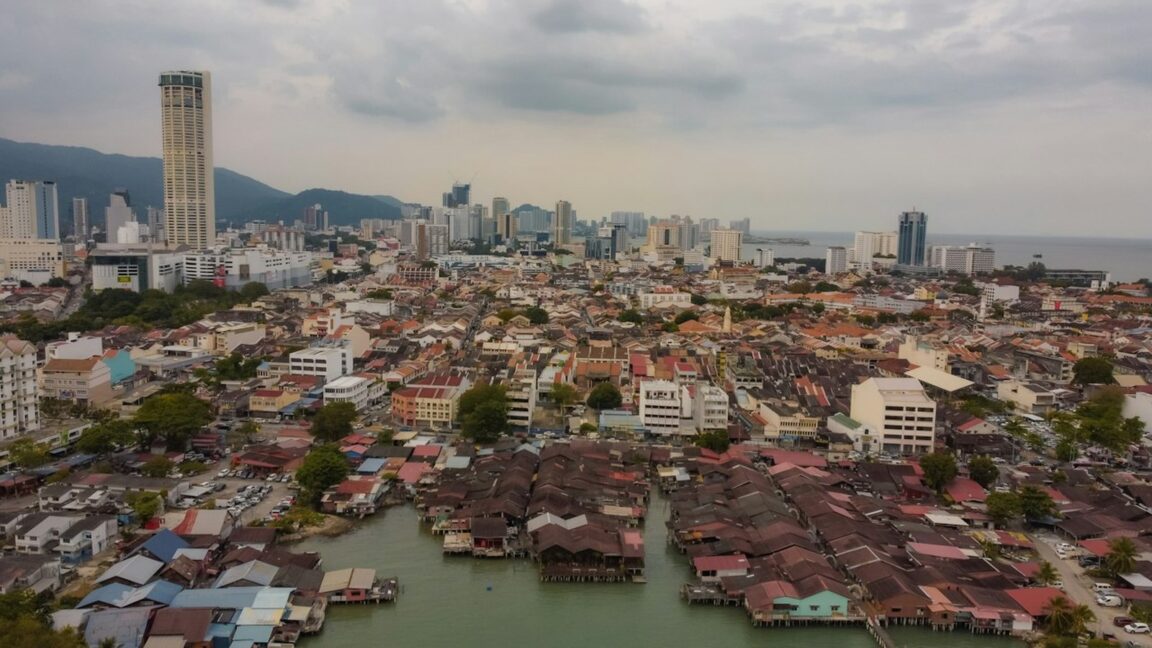
Featured image: The clan jetties of George Town, Penang, with the heritage core and KOMTAR behind them. Photo by Wind Tan on Unsplash, Unsplash License, via a captioned hosted copy on Places Unveiled.