 Jordan Ellis
Creek season at Great Sand Dunes is a narrow, predictable window: Medano Creek usually reaches the main dunes parking area in April, builds through May, and peaks in late May or early June, when its strange surge flow can send small waves rolling across the sand at the base of the tallest dunes in North America. Time a trip for that window, rent a sand sled before arriving because the park rents none, and climb early or late in the day because summer sand surfaces can reach 150 degrees F. Get those three decisions right and the Sangre de Cristo backdrop, the beach like creek and the big dune climbs all fit into one well ordered visit.
Quick Facts
- Park: Great Sand Dunes National Park and Preserve, San Luis Valley, southern Colorado, against the Sangre de Cristo Mountains
- Entrance fee: $25 per private vehicle for 7 days, $15 per person on foot or by bike for visitors 16 and older, park annual pass $45, per the National Park Service fees page checked on November 20, 2026
- Reservations: None. The park has no timed entry, no advance reservations and no visitor limits
- Creek peak: Late May to early June in an average year, at about 40 cubic feet per second where the creek first reaches the sand
- Dunefield: About 30 square miles, with no trails in the sand
- Tallest dunes: Hidden Dune, 741 feet, the tallest in North America; Star Dune, 736 feet, second tallest
- Sand sleds: Never rented inside the park; rent in the San Luis Valley before arriving
- Prices checked: November 20, 2026, against National Park Service sources
When exactly does Medano Creek flow, and when is it worth planning around?
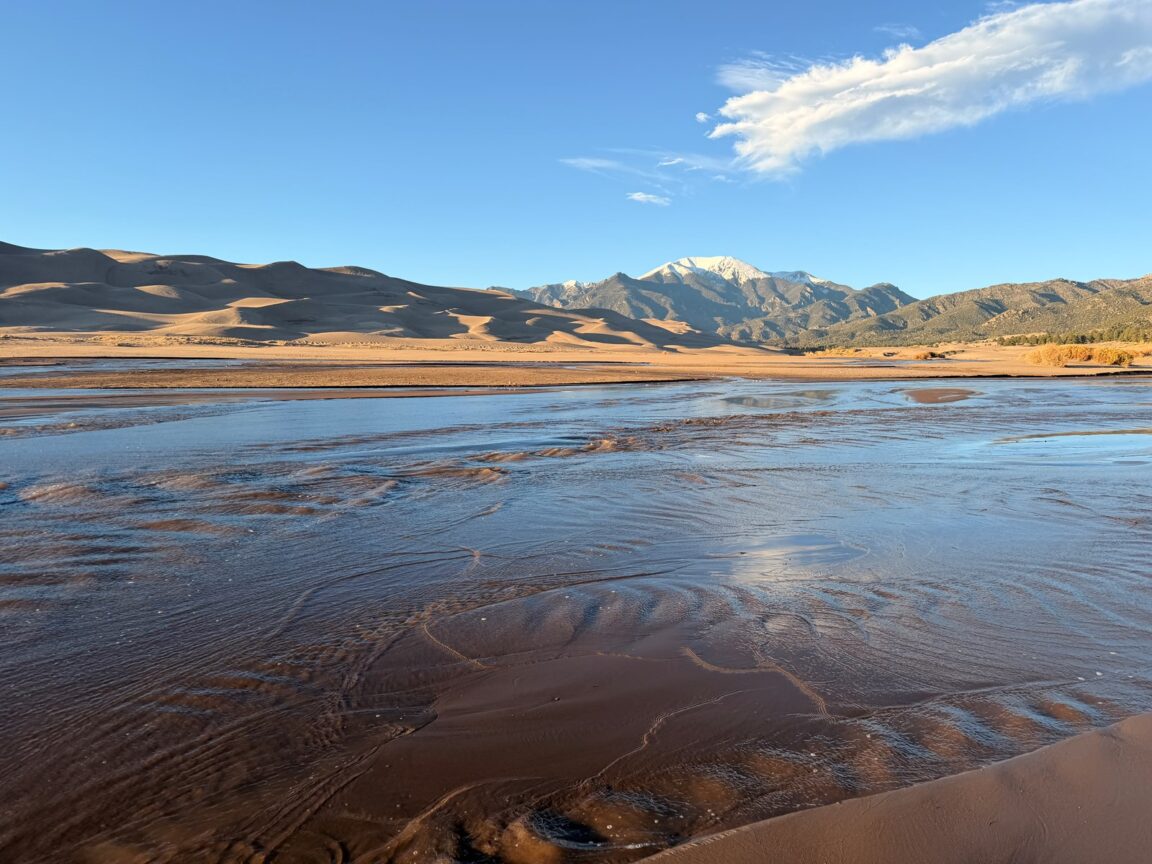
Medano Creek is a snowmelt stream, and its calendar is set by the Sangre de Cristo snowpack rather than by the park. The National Park Service Medano Creek page lays out the average year plainly: the creek usually arrives at the Dunes Parking Area sometime in April, at first as a trickle, deepens through May, and reaches peak flow in late May or early June. That peak is the season this article is built around. The water spreads wide and shallow across the flat sand at the base of the dunefield, warming as it goes, and in average or wetter years it produces surge flow, a phenomenon where collapsing sand dams release small waves that travel down the creek. At peak flow those waves can be high enough for children to float short distances on flat inflatable toys, which is why late spring weekends here look more like a beach day than a desert hike.
The trade offs of the window are just as clear. Late May and early June weekends are, in the park’s own words, extremely crowded, with long entrance lines, overflowing parking lots and full campgrounds, so a weekday visit is worth real effort. By the second week of June mosquitoes emerge in large numbers as the flow drops, and by late June the creek at the main visitor area is often only an inch or two deep or drying up entirely. By July it has usually retreated toward the mountains. Creek season is therefore not a summer long condition but a roughly six week event, and a trip booked for July on the assumption of a flowing creek at the main beach will miss it. The park’s creek page also posts a flow forecast each spring and current conditions through the year, and that page, checked in the week before travel, is the final word. In an unusual wet autumn the creek can reappear briefly, as it did in late October 2026, but that is a bonus, never a plan.
How do sand sleds and sandboards actually work here?
Sledding is the park’s signature active hour, and the single most common planning failure is arriving with the wrong gear. Only purpose built sand sleds and sandboards slide reliably on dry sand: they have a slick base material used with special wax. Snow sleds, snowboards, cardboard and plastic saucers dig in and drag, a point the National Park Service sandboarding and sledding page makes without much sympathy. The second failure is assuming a rental counter exists. The park does not rent sleds or boards at all, and rentals are scattered across the San Luis Valley, some a 30 to 45 minute drive away, so the rental stop belongs on the drive in, not after arrival.
The closest option is the Oasis Store, about 4 miles from the visitor center near the park entrance, open spring through early fall; it will not rent sleds when the sand is wet, because wet sand damages the slick base. Further out, Kristi Mountain Sports in Alamosa, roughly 35 miles southwest of the visitor center, rents year round and asks visitors to call the day before to reserve, but it is closed on Tuesdays and Wednesdays and will not rent when the sand is frozen or snow covered. Sand Dunes Recreation near Hooper, about 32 miles away, also rents year round, and Spin Drift in Blanca rents in the spring through early fall season. Sledding and boarding are permitted anywhere on the dunefield away from vegetated areas, with one firm exception the park states clearly: the steep eastern dune ridge above Castle Creek is not a sledding slope, because those faces end abruptly in firm wet sand along the creek and injuries occur there. Readers who want the failure modes in one place can pair this guide with our mistakes to avoid at Great Sand Dunes, which covers the same ground from the error side.
Which dune should a creek season visitor climb, High Dune or Star Dune?
There are no trails in the 30 square mile dunefield, so every climb is a route choice rather than a path. The sensible first objective is High Dune on the first ridge. Despite the name it is neither the tallest dune nor the highest point, at about 688 feet from base to top, but it is the most common destination in the park for good reason: about 2.5 miles round trip from the Dunes Parking Lot, across roughly half a mile of creek bed and then up zigzagging ridgelines, with a full view over the dunefield from the top. The park puts the average round trip at 2 hours and warns that visitors not acclimated to the elevation should allow as much as 4 hours. In creek season the approach crosses the flowing creek itself, so the climb and the beach are naturally one outing: wade in, climb in the cool of the morning, and come back down to the water.
Star Dune is a different commitment and should be chosen knowingly. At 736 feet from base to summit it is the second tallest dune in North America, behind only Hidden Dune at 741 feet, and its pyramid shape is the backdrop in most photographs of the park. The direct route follows the Medano Creek bed about 2 miles south from the parking lot to the base, then follows a ridge to the summit: about 6 miles round trip, an average of 6 hours, and as much as 9 hours for visitors not acclimated. Hidden Dune itself is a 7 mile, 6 hour plus round trip to a summit hidden behind a false summit for most of the approach. The timing rule governs all three: the park warns that summer sand surfaces can reach 150 degrees F in the afternoon, with dangerous thunderstorms on top of the heat, and directs hikers to early morning or evening. A Star Dune attempt that starts at noon in June is not a bold plan, it is the park’s stated hazard. Closed toe boots or shoes are the footwear the park recommends on hot sand, never sandals.
What fills the rest of a creek season day?
The shaded half of the park is the correct afternoon answer. The Montville Nature Trail, a short forested walk named for a late 1800s settlement, and the Mosca Pass Trail, 3.5 miles one way up a creek to a low pass in the Sangre de Cristos, both trade sand for aspen and evergreen shade, and the park itself suggests Montville as an afternoon escape from dune heat. The Medano Pass Primitive Road, for high clearance four wheel drive vehicles only, opens the eastern side of the dunefield at Sand Pit and Castle Creek picnic areas, where the creek usually flows gently long after it has left the main beach. After dark the park’s remoteness pays a second dividend: Great Sand Dunes is a designated International Dark Sky Park, and a creek season evening that ends on the sand under a dark sky is the natural close to the day. For a useful comparison of a very different dune system, see our weekend guide to White Sands, where the sand is gypsum, the sledding logic is similar and the heat rules are stricter still.
Where should a creek season visitor base, and what should be booked first?
Book in this order: campground or lodging first, sled rental second, and nothing else needs reserving, because park entry itself requires no reservation. The park campground at Pinon Flats is the closest base and fills first in the peak creek weeks; the park noted that for 2026 its sites could be reserved 3 months in advance. Alamosa, about 35 miles southwest, is the full service base town, with the year round sled rental at Kristi Mountain Sports on the way in and the widest choice of beds and food. Staying in Alamosa and driving in early beats a late start from anywhere: the creek beach and the dune climbs both reward the first hours of the day, and the entrance line on a late May Saturday is the one queue this park reliably produces. Check the park’s alerts and the creek forecast in the final week, and treat a low snowpack spring as a reason to move the trip earlier rather than later, because a weak creek year peaks sooner and ends faster.
Frequently Asked Questions
When is the best time to see Medano Creek at Great Sand Dunes?
Late May to early June in an average year. The creek usually arrives at the main parking area in April, peaks in late May or early June at about 40 cubic feet per second, and is often reduced to an inch or two, or gone from the main beach, by late June and July. Check the National Park Service Medano Creek page for the current spring forecast before booking.
Can sand sleds be rented inside Great Sand Dunes National Park?
No. The National Park Service does not rent sand sleds or sandboards anywhere in the park. Rent before arriving: the Oasis Store about 4 miles from the visitor center is closest in season, and Kristi Mountain Sports in Alamosa and Sand Dunes Recreation near Hooper rent year round. Ordinary snow sleds and cardboard do not slide on dry sand.
How long does it take to climb Star Dune?
About 6 hours on average for the roughly 6 mile round trip from the Dunes Parking Lot, following the Medano Creek bed south to the base and then a ridge to the 736 foot summit. The park warns that visitors not acclimated to the elevation may need as much as 9 hours, and that climbs should start in early morning to avoid extreme sand heat.
How much does it cost to enter Great Sand Dunes?
A private vehicle pass costs $25 and is valid for 7 days. Visitors on foot or by bike aged 16 and older pay $15 per person, and the park annual pass costs $45. No reservation or timed entry is required. Fees were checked against the National Park Service on November 20, 2026.
Is the creek deep enough to swim in?
No, and it is not meant to be. At the main beach the creek spreads wide and shallow, typically inches deep, suited to wading, splashing, sand play, skimboarding and, at peak surge flow, short floats for children on small inflatables. The appeal is a beach at the foot of the dunes, not a swimming hole.
What happens if it rains during creek season?
Two things change. Wet sand stops sled rentals at some shops, because it damages the slick base of the boards, and afternoon thunderstorms are the park’s most serious stated hazard on the open dunefield. Move dune climbs to the morning, leave the sand if thunder builds, and expect the creek itself to run briefly higher after heavy rain.
Featured image: Medano Creek flowing across the sand at the base of the dunes, with the snow capped Sangre de Cristo Mountains behind. Photo from the National Park Service official site (nps.gov), NPS Photo / Sierra Willoughby, US Government work, used with credit.