 Lucas Meyer
The fastest way to spoil Great Sand Dunes is to treat it like a beach car park with bigger sand. Arrive at midday in summer with a snow sled, no water and a plan to splash in a creek that stopped flowing weeks earlier, and North America’s tallest dunes will correct every assumption within an hour. Avoid those three traps, time the creek and the light properly, and this strange, magnificent park in southern Colorado becomes one of the easiest national park days in the West to get right.
Quick Facts
- Entrance: $25 per private vehicle for 7 days, per the National Park Service fees page for Great Sand Dunes; the park is open 24 hours a day.
- Tallest dune: Star Dune rises 750 feet from base to crest, per NPS park FAQs. High Dune, on the first ridge, rises 699 feet.
- Surface heat: Sand surface temperatures can reach over 150 degrees Fahrenheit on summer afternoons, per NPS.
- Medano Creek: In an average year it starts flowing in April, peaks in late May and dries up by late June, per NPS.
- Dunefield size: About 30 square miles, inside a park and preserve of about 150,000 acres.
- Visitor centre elevation: 8,170 feet, so altitude is a real factor on every climb.
Mistake One: Bringing the Wrong Sled
Snow sleds, snowboards, cardboard and saucers do not slide on dry sand. They dig in, stall and turn a joyful idea into a long trudge carrying useless plastic. Sand sledding and sandboarding at Great Sand Dunes work only with equipment built for sand: a smooth, hard base, often waxed, designed to glide over grains rather than plough through them. The National Park Service is explicit that the park itself does not rent this gear, so the decision has to be made before the entrance station, in Alamosa or at outfitters near the park. Rent the real thing, wax it as instructed, and choose a steep, clean face away from other climbers for the first runs.
There is a second, quieter sled mistake: starting too low. Short, gentle slopes near the creek bed produce short, disappointing runs and a lot of sand in everything. Walk a little higher, pick a face with a clear runout, and the physics finally cooperates. Keep sessions short in warm weather, because every ride down is paid for with a climb back up at altitude, in sand that gives back half of every step.
Mistake Two: Underestimating Surface Heat
The single most dangerous misjudgement here is a barefoot midday start. NPS warns that sand surface temperatures can exceed 150 degrees Fahrenheit on summer afternoons, hot enough to burn feet and blister a dog’s paws. Air temperature in the San Luis Valley can feel mild while the sand itself is punishing, because the surface, not the air, is what skin touches. The fix is timing and footwear. Hike the dunes early in the morning or in the evening, wear closed shoes if there is any chance of being on the sand near midday, and treat a summer afternoon as time for the visitor centre, a shaded picnic or the drive in, not the climb out.
Heat pairs with altitude here. The visitor centre sits at 8,170 feet and the park tops out at 13,604 feet on Tijeras Peak, per NPS. A sea level visitor who sprints up the first ridge at noon in July is stacking three stressors at once: thin air, reflected heat and soft sand. Start slow, zigzag up the ridgelines as NPS suggests, and expect the roughly one mile line to the top of the first ridge to take an average person about an hour. That is not failure. That is the normal, honest pace of this place.
Mistake Three: Misreading Medano Creek
Medano Creek is the park’s beloved seasonal beach, a broad, shallow sheet of snowmelt flowing along the base of the dunes, complete with surge flow, a rare phenomenon in which small waves pulse down the stream. It is also the park’s most misread feature. In an average year, NPS says, the creek starts to flow in April, peaks in late May and dries up by late June. In heavy snow years it can run into July. In dry years it may never reach the main parking area at all. A family that promises children a creek day in August, or during a dry spring, has planned around water that is not there.
Check the park’s current creek conditions and forecast before building a trip around it, and hold the plan loosely even in May. When the creek is flowing, it also does quiet geological work, catching sand blown toward the Sangre de Cristo Mountains and carrying it back to the southern edge of the dunes, part of the recycling system that keeps this dunefield in place. Splashing in it is playing inside the machinery that built the landscape.
Mistake Four: Aiming Straight at Star Dune on Day One
Star Dune, at 750 feet from base to crest, is the tallest dune in North America, and it is a serious undertaking, not a photo stop. There are no trails on the dunefield. Navigation is by ridgelines and landmarks, distances deceive, and the return trip is as demanding as the way out. For most first visits, High Dune on the first ridge is the right ambition: 699 feet of rise, the classic view back over the dunefield, and a climb that leaves something in reserve for the evening. Save Star Dune for a cool morning, a full water supply and a party that has already learned how its own pace translates onto sand.
Drivers make a parallel mistake on the Medano Pass Primitive Road, which NPS describes as a route for street licensed, high clearance four wheel drive vehicles only, crossing soft sand and then a 10,000 foot mountain pass. Ordinary hire cars do not belong on it. If that road is on the wish list, the vehicle question has to be settled in Alamosa, not at the sand.
How a Good Day Here Is Actually Sequenced
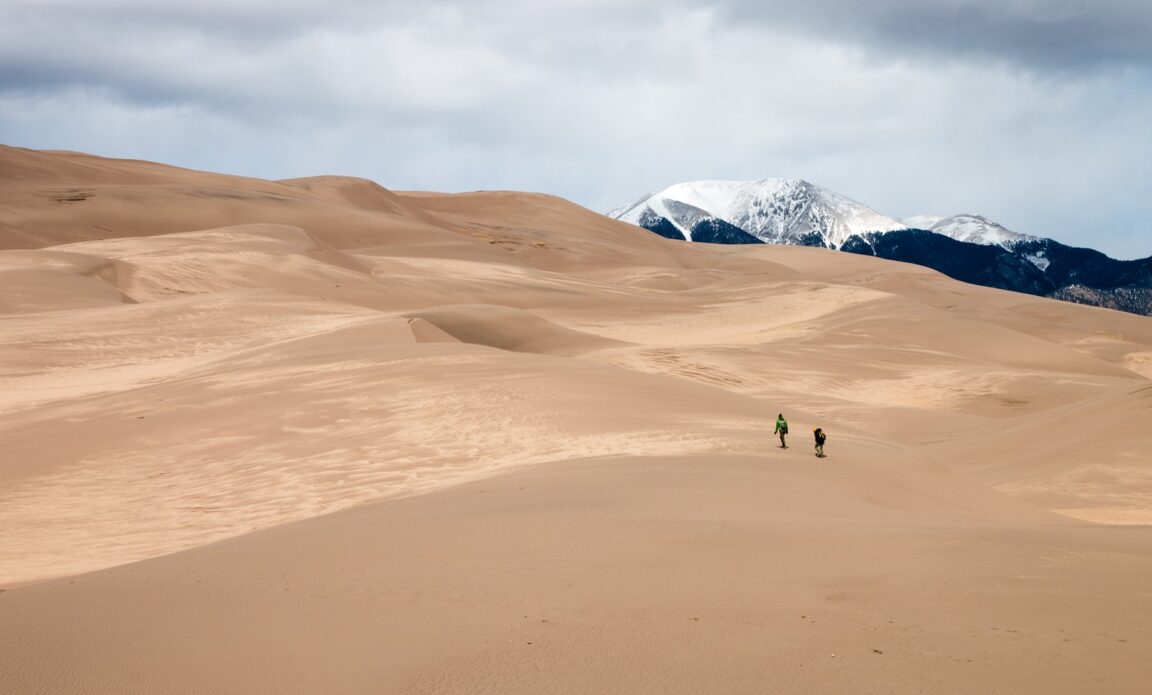
Start at the visitor centre for the film, the exhibits and the day’s conditions, then walk the dunes in the cool of the morning. If the creek is flowing, late morning belongs to the water’s edge, where children can play in the shallows while the sand is still tolerable. Take the hot middle of the day off the dunefield entirely. Return for the evening, when the light rakes across the ridges, the surface cools and the Sangre de Cristos turn pink above the sand. After dark, the park’s famously dark skies are the final act, with the dunes open around the clock.
Great Sand Dunes pairs naturally with the other red rock and high desert stops on a Colorado and Utah loop. Travellers building that wider trip should read our plain language guide to Arches National Park timed entry in 2026, our first timer’s route through Capitol Reef, its orchards and Hickman Bridge, and our drive along Rim Rock Drive at Colorado National Monument, which makes an elegant western bookend to a dunes day.
What to Carry Onto the Sand
Carry more water than the distance seems to justify, because altitude, wind and reflected heat all draw moisture out quietly. Closed shoes, sun protection and a hat are non negotiable in summer. There is no shade and no water on the dunefield, and weather can turn fast: NPS advises coming down off the dunes when storms approach, because lightning strikes the dunefield and exposed climbers are the tallest objects on it. Pets are allowed in the main day use areas on a leash, per NPS, but hot sand can blister paws, which is one more reason the midday start fails everyone in the party.
Frequently Asked Questions
How much does it cost to enter Great Sand Dunes?
The standard pass is $25 per private vehicle, valid for 7 days, according to the National Park Service. An annual park pass and America the Beautiful passes are also accepted. Confirm the current figure on the NPS fees page before travelling, as fees can change.
Can I use a snow sled or cardboard at Great Sand Dunes?
No, not successfully. Snow equipment and cardboard do not glide on dry sand. Rent a purpose built sand sled or sandboard from an outfitter outside the park before you arrive, because the park does not rent them.
When does Medano Creek flow?
In an average year it starts in April, peaks in late May and dries up by late June, per NPS. Heavy snow years extend it, dry years can prevent it reaching the main use area at all, so always check the park’s current creek forecast.
How tall is Star Dune and how long does the first ridge take?
Star Dune rises 750 feet from base to crest, per NPS, making it the tallest dune in North America. The top of the first ridge is about a mile in a straight line and takes an average person roughly an hour, climbing in zigzags along the ridgelines.
How hot does the sand get?
NPS warns that sand surface temperatures can reach over 150 degrees Fahrenheit on summer afternoons. Hike early or in the evening in summer, and wear closed shoes rather than sandals or bare feet.
Is Great Sand Dunes open at night?
Yes. The park is open 24 hours a day, seven days a week, per NPS, which makes evening dune walks and stargazing a realistic and rewarding part of a visit.
Featured image: Great Sand Dunes National Park and Preserve, Colorado. Photo: NPS Photo / Mackenzie Reed, National Park Service (nps.gov / NPGallery), public domain.