 Aiko Tanaka
Harar is a city a visitor walks, and the walk has a shape set down centuries ago: through one of the gates in the Jugol wall, along alleys too narrow for cars among 82 mosques and 102 shrines, into a traditional Harari house whose walls are hung with baskets like a gallery, and out again at dusk to watch the hyena men call wild hyenas in from the dark. The walled city, Harar Jugol, covers just 48 hectares on a plateau in eastern Ethiopia, holds 368 alleys inside walls raised between the 13th and 16th centuries, and was inscribed by UNESCO in 2006 as the fortified historic town of a city long considered the fourth holy city of Islam. Everything in this guide is inside or just outside that wall, because everything that makes Harar itself still is.
Quick Facts
- City: Harar, capital of the Harari Region in eastern Ethiopia, on a plateau at about 1,885 metres, roughly 525 kilometres east of Addis Ababa, per UNESCO
- World Heritage: Harar Jugol, the Fortified Historic Town, inscribed by UNESCO in 2006 under criteria (ii), (iii), (iv) and (v); the inscribed core is 48 hectares
- The Jugol wall: Built between the 13th and 16th centuries, pierced by five historic gates; the main Harar Gate is of more recent construction
- Inside the walls: 368 alleys, 82 mosques, three dating from the 10th century, and 102 shrines, per UNESCO and Visit Ethiopia
- Hyena feeding: Nightly after dark at sites outside the walls, including the Aw Ansar Ahmed shrine outside Argob Bari gate and outside Assum Bari gate, per Visit Ethiopia
- Museums: The Arthur Rimbaud Museum, in the house where the poet reputedly lived, and the Sherif Harar City Museum, in the mansion where Haile Selassie spent much of his childhood
- Getting there: The nearest airport is Dire Dawa, about 52 kilometres by road, with daily Ethiopian Airlines flights from Addis Ababa, per Visit Ethiopia
- Facts checked: November 19, 2026, against UNESCO and Visit Ethiopia, Ethiopia’s official tourism site
What is the Jugol, and why do its gates organise the whole city?
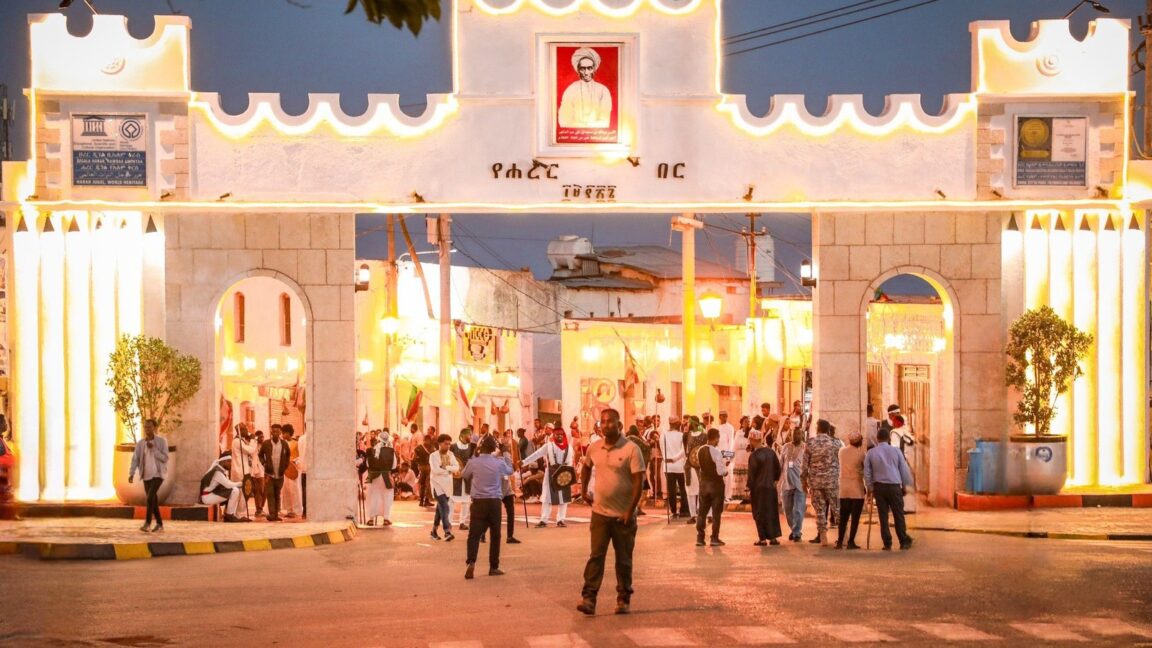
Jugol is the name of the wall and of the walled city inside it, and the two are the same fact. The UNESCO listing for Harar Jugol records that the walls surrounding the sacred city were built between the 13th and 16th centuries as a protective barrier, in the period when Harar served as capital of the Harari Kingdom from 1520 to 1568 and then as an independent emirate. The wall is pierced by five historic gates, and the city inside is organised as quarters named for them, Argob Bari, Assum Bari, Badro Bari, Suqutat Bari and Asmadin Bari, each gate historically closed at sunset and each road outside it running to a different market town or caravan route. The main gate a modern visitor enters, Harar Ber, is the exception that proves the system: UNESCO notes it is of recent construction, cut for the motor age, and the old town begins properly a few steps inside it, where the alleys narrow past the reach of any car. That narrowing is the point of the place. Inside the wall, the city was built for people, donkeys and porters, and it still works that way, which is why a licensed local guide, arranged through a hotel or the tourist information office as Visit Ethiopia advises, is worth more here than in almost any other Ethiopian city: the alleys are a maze by design, and half of what matters is behind unmarked doors.
What does a Harari house show that a museum cannot?
UNESCO and Visit Ethiopia agree on the strangest superlative in the listing: the most spectacular part of Harar’s heritage is domestic. The traditional Harari townhouse, the gey gar, is entered through a carved wooden door into a split level interior arranged around a main living room whose walls are built with niches, and the niches are filled, shelf upon shelf, with the household’s enamel plates, glasses and, above all, the flat polychrome baskets for which Harar is famous across Ethiopia. The house is at once a home, a storehouse and a display of family standing, and houses of this type, some of them built or remodelled by Indian merchants who settled here in the late 19th century, give the alleys their particular mixture of African and Islamic building traditions that the World Heritage inscription exists to protect. The Harar Community Centre Museum keeps a full traditional interior assembled as a facsimile, which is the reliable way to see the complete arrangement, while the Sherif Harar City Museum, set in the wide balconied mansion where the young Haile Selassie spent much of his childhood, holds the portable version of the same culture: antique Islamic manuscripts, Harari coins from the centuries when the city minted its own currency, costumes, instruments and household objects. A morning that pairs one museum with an hour of guided alley walking teaches the grammar of the city faster than a day of wandering alone.
Who was Rimbaud in Harar, and what is his house now?
The most unlikely resident in the city’s history is the French poet Arthur Rimbaud, who gave up poetry, crossed to the Horn of Africa and spent much of the 1880s in Harar working as a trader, dealing in coffee and other goods for a French commercial house. The Arthur Rimbaud Museum stands in the large, fresco ceilinged house where he is reputed to have lived, and its displays cover both the poet’s Ethiopian years and a collection of photographs of the city taken in the late 19th and early 20th centuries, which let a visitor compare the alleys outside the door with the same alleys a century and more ago. Rimbaud was not the first European drawn to the closed city. In 1855 the explorer Richard Burton entered Harar in disguise after the city had spent centuries refusing entry to outsiders, and his account introduced it to the outside world. The two visits frame the Harar story neatly: a city important enough, as the great trading emporium between the Ethiopian highlands and the ports of the Somali coast, that the world kept trying to get in.
Where does the coffee come in?
Harar’s wealth was built on trade, and its signature trade good is the one Ethiopia gave the world. The highlands around the city grow a coffee that carries the city’s name on sacks and menus everywhere coffee is sold seriously, and for centuries the beans moved through the Jugol’s gates on the caravan routes to the coast while the city’s merchants, Rimbaud’s employers among them, organised the business end of the trade. Coffee in Harar is not a souvenir theme; it is the historic economy still visible in the markets, where the Gidir Magala, the great market outside the walls, handles the produce of the region alongside the spice and textile trade of the alleys inside. Travellers crossing Ethiopia can set Harar against the capital in our Addis Ababa guide, where the coffee ceremony is an urban ritual, and against the highland trekking in our Simien Mountains trekking guide, the opposite pole of an Ethiopian itinerary from this walled and city bound one.
What actually happens at the hyena feeding?
It happens after dark, outside the walls, and it is exactly as strange as its reputation. Harar’s coexistence with the spotted hyenas of the surrounding hills is centuries old: the animals were tolerated as the city’s night cleaners, and in the modern era the relationship was formalised by the hyena men, who call the hyenas by name and feed them meat by hand, and famously from a stick held in the teeth. Visit Ethiopia lists two feeding sites, at the Aw Ansar Ahmed shrine outside Argob Bari gate and by the Christian slaughterhouse outside Assum Bari gate. Visitors watch from a few paces away as the animals come in out of the dark one by one, wary and unhurried, and the whole encounter is over in well under an hour. It is not a show with seating and tickets in any formal sense; it is a working tradition that visitors are permitted to witness, arranged through a guide or hotel, and it ends the Harar day the way the city has ended its days for generations, with the gates shut in spirit if no longer in fact and the hyenas on their rounds outside them. Festivals give the city other calendars: Shewal Eid, the Harari celebration that follows the fasting month of Ramadan and its six additional days of fasting, is unique to Harar and fills the alleys for a full day and night.
Frequently Asked Questions
Why is Harar called the fourth holy city of Islam?
The description, recorded by UNESCO, reflects the city’s centuries as a centre of Islamic scholarship in the Horn of Africa. Inside the walls stand 82 mosques, three of them dating from the 10th century, and 102 shrines, the densest sacred geography of any city in the region, in a town that was closed to outsiders for much of its history.
How do visitors reach Harar from Addis Ababa?
Harar lies about 525 kilometres east of the capital. The practical route is to fly with Ethiopian Airlines from Addis Ababa to Dire Dawa, which has daily flights, and continue about 52 kilometres by road to Harar, per Visit Ethiopia. The overland drive from Addis Ababa is a full day on a surfaced road through Adama and Awash.
Can visitors walk the old city without a guide?
They can, and many do, but the 368 alleys of the Jugol are a deliberate maze and the finest sights, the house interiors and small shrines, sit behind unmarked doors. Visit Ethiopia recommends exploring on foot with an experienced local guide, arranged through a hotel or the tourist information office, and in Harar that advice is worth taking.
When does the hyena feeding happen?
Nightly, after dark, at feeding sites outside the city walls, including outside Argob Bari and Assum Bari gates. A guide or hotel arranges attendance. The hyena men call the animals by name and feed them by hand, a tradition that formalised the city’s long coexistence with the hyenas that clean its streets at night.
How long does Harar need?
Two nights is the honest minimum: one full day inside the walls for the alleys, the house museums and the markets, and two evenings, because the hyena feeding happens after dark and a single cloudy or quiet night can be repeated. Harar pairs naturally with Dire Dawa on the journey in or out.
Featured image: Harar Gate, the main gate into the walled city of Harar Jugol, lit at dusk with its UNESCO World Heritage plaque. Photo from Visit Ethiopia (visitethiopia.et), Ethiopia’s official tourism site, used with credit.