 Aiko Tanaka
The Jordan Pass saves money for most first time visitors, but not for all of them, and the difference is arithmetic rather than opinion. The pass costs JD 70, JD 75 or JD 80 depending on whether it includes one, two or three days in Petra, it covers entry to more than 40 sites, and it waives the JD 40 single entry visa fee, but only when you buy it online before arrival and stay at least two whole nights in Jordan. Set against that, a visa on arrival costs JD 40 and a standalone Petra ticket costs JD 50 for one day, JD 55 for two days or JD 60 for three days for a visitor who spends at least one night in the country. A traveller who visits Petra for one day and stays two nights or more pays JD 90 without the pass and JD 70 with it, a saving of JD 20 before any other site is counted. A traveller who skips Petra, stays one night, or arrives through Aqaba, where entry is already visa free, can easily pay for a pass that returns less than it costs. This article works through each case in dinars, using the official prices checked on November 19, 2026.
Quick Facts
- Jordan Pass prices: JD 70 Wanderer (1 Petra day), JD 75 Explorer (2 consecutive Petra days), JD 80 Expert (3 consecutive Petra days), per jordanpass.jo
- Visa fee waived: JD 40, the single entry visa on arrival fee, and only for a single entry visa
- Waiver conditions: Buy before arrival and stay a minimum of two whole nights, counted as three days, in Jordan
- Standalone Petra tickets: JD 50 for 1 day, JD 55 for 2 days, JD 60 for 3 days, for visitors staying at least one night in Jordan; JD 90 for a day visitor with no night in Jordan
- What else the pass covers: More than 40 attractions, including Jerash, Wadi Rum and the Amman Citadel; Petra by Night and the RSCN nature reserves are not included
- Aqaba difference: Arrival through the Aqaba Special Economic Zone, by air, land or sea, is visa free for non restricted nationalities, so there is no JD 40 fee to waive
- Validity: The pass is sold for use within three months of purchase and its Petra days must be consecutive
- Prices checked: November 19, 2026, against jordanpass.jo and the Petra Development and Tourism Region Authority fees published at visitpetra.jo
What are the three pass tiers, and what really differs between them?
Almost nothing differs except Petra. All three tiers, sold only on the official site at jordanpass.jo, include the same list of more than 40 attractions and the same conditional visa fee waiver. The Wanderer at JD 70 includes one day in Petra, the Explorer at JD 75 includes two consecutive days, and the Expert at JD 80 includes three consecutive days. Because a standalone second Petra day costs only JD 5 more than a one day ticket, JD 55 against JD 50, the JD 5 step between pass tiers is exactly fair: you are never overpaying for extra Petra days, and you are never getting them free either. The real decision is therefore not which tier, but whether the bundle beats its parts for your itinerary. Note what the bundle excludes, because the exclusions are the famous extras: Petra by Night is a separate ticket, the Baptism Site and Mount Nebo are not covered, and the Royal Society for the Conservation of Nature reserves, including Wadi Mujib and Dana, charge their own entry. A traveller whose Jordan plan is Petra plus a Wadi Mujib canyon day should not count that second day as pass value.
When does the pass clearly save money?
The clearest case is the standard first trip: fly into Amman, stay three nights or more, spend one day in Petra and visit at least one other included site. Without the pass the bill is JD 40 for the visa plus JD 50 for Petra, JD 90 in total. With the Wanderer it is JD 70, and every additional included site, Jerash, the Citadel, a desert castle or the Wadi Rum protected area entry, is then effectively free. Two Petra days make the case stronger: JD 40 plus JD 55 is JD 95 against JD 75 for the Explorer. Our Petra visiting guide sets out why two days suits the site, since the Monastery trail and the Royal Tombs pull in opposite directions from the Treasury, and at pass prices the second day costs JD 5 either way you buy it. Add the Dead Sea coast, where our Dead Sea Jordan guide covers the resort day pass maths, and a week long circuit through Jerash, Petra and Wadi Rum can put the total saving past JD 40 a person. For couples and families the saving multiplies per person, although children under 12 enter Petra free on a standalone ticket, which narrows the pass advantage for young children to the sites list alone, and a child who needs a visa still benefits from the waiver if the conditions are met.
When does the pass stop saving you money?
Four situations break the maths. First, the short stay: the waiver requires a minimum of two whole nights in Jordan, so a one night dash to Petra pays JD 70 for the pass and still owes the JD 40 visa fee at the border, JD 110 against JD 90 for buying the parts separately. Second, the day visitor: a traveller entering and leaving the same day, often from Eilat or on a cruise call, faces the JD 90 non accommodated Petra ticket, gets no waiver without the nights, and should not buy a pass expecting it to fix that bill. Third, the Aqaba arrival: entry through King Hussein International Airport in Aqaba, the Wadi Araba crossing or the port is visa free under the Aqaba Special Economic Zone rules for non restricted nationalities, so the pass loses its JD 40 waiver value entirely and must justify itself on site entry alone, which for a Petra only trip means JD 70 against a JD 50 ticket. Fourth, the Petra free itinerary: a traveller coming only for the Dead Sea, diving in Aqaba or business in Amman, who never enters a major included site, is buying a bundle with nothing in it for them. There is also a border specific trap worth naming: no visas are issued at the King Hussein, or Allenby, Bridge crossing from the West Bank at all, pass or no pass, so that crossing always requires a visa arranged in advance.
Two smaller print items complete the picture. The pass waives only a single entry visa fee: a traveller who leaves Jordan and returns on the same trip pays for the second entry. And the waiver is checked against your actual stay, so a booking that shrinks from three nights to one after purchase can revive the fee at departure. The Jordanian dinar is pegged to the US dollar at about JD 1 to US$1.41, which at least makes the sums stable: JD 70 is about US$99, and the JD 20 saving on the standard trip is about US$28, real money at family scale and trivial money if it forces an itinerary change you did not want. Buy the pass for the trip you are actually taking, in the week before you fly, from the official site only, since unofficial sellers add fees to a product whose entire point is removing them.
How do you buy and use the pass without losing the waiver?
Buy it on jordanpass.jo before you board, save the QR code offline as well as in email, and show it at the visa desk on arrival so the officer waives the fee rather than charging it. The pass is then scanned at each included site, with Petra’s days counted consecutively from the first scan there, so plan the Petra block as one unbroken stretch rather than splitting it around a Wadi Rum night. Keep the passport you used at purchase with you, because the pass is personal. On departure by land, budget the separate JD 10 departure tax, which is paid in cash at land borders and is not part of the pass; by air it is normally inside the ticket price. If your routing mixes the zones, arriving through Aqaba and leaving through Amman for example, the conservative reading is to hold a pass and meet its two night condition, so the visa position is covered whichever rule the exit officer applies.
Frequently Asked Questions
Is the Jordan Pass a visa?
No. The official site states that the pass is not a visa. It is a sightseeing package that waives the JD 40 single entry visa fee when it is bought before arrival and the stay is at least two whole nights in Jordan. You still receive your visa or entry stamp at the border in the normal way.
How much is a visa on arrival in Jordan without the pass?
JD 40 for a single entry visa, per the Ministry of Tourism and Antiquities schedule checked on November 19, 2026. Double entry and multiple entry visas arranged through embassies cost more, at JD 60 and JD 120 on the same schedule, and the pass waives none of those.
Does the Jordan Pass cover Petra by Night?
No. Petra by Night is sold separately at the Petra Visitor Centre and requires a valid daytime ticket as well. The pass covers daytime entry for its stated number of consecutive Petra days only.
What if I arrive through Aqaba?
Arrival through the Aqaba Special Economic Zone is visa free for non restricted nationalities, so there is no JD 40 fee for a pass to waive. A pass can still pay on site entry alone if you will use several included attractions, but for a Petra only visit the standalone JD 50 ticket is cheaper than the JD 70 pass.
Can I buy the Jordan Pass after I land?
You can buy it online at any time, but a pass bought after arrival does not waive the visa fee, because buying before arrival is one of the waiver conditions. Bought late, it is only a sites bundle, and the maths in this article should be rerun on that basis.
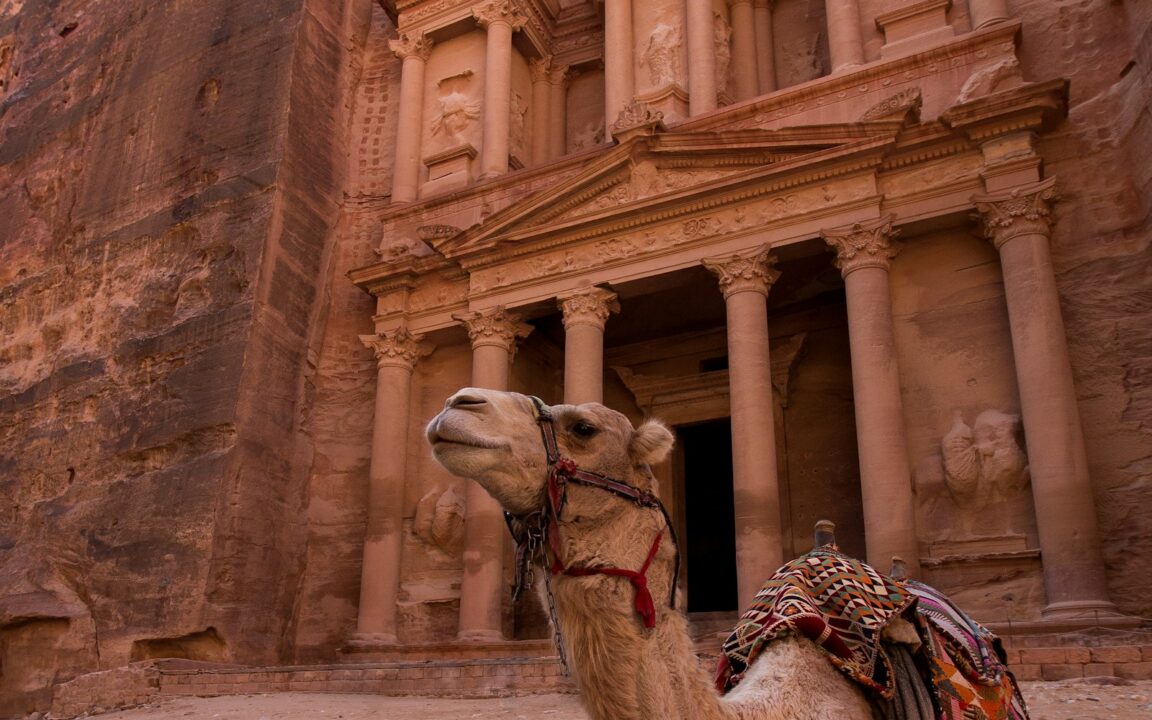
Featured image: The Treasury at Petra with a resting camel in the plaza in front of the facade. Photo via Unsplash, Unsplash License, used with credit.