 Omar Haddad
From 1 March 2026, a night in Kyoto costs a little more, and at the top end a lot more. Kyoto City has rewritten its accommodation tax into five tiers charged per person per night on the room only rate: 200 yen under 6,000 yen, 400 yen from 6,000 to under 20,000 yen, 1,000 yen from 20,000 to under 50,000 yen, 4,000 yen from 50,000 to under 100,000 yen, and 10,000 yen at 100,000 yen and above. Most visitors will pay 400 or 1,000 yen a night and barely notice. Guests in luxury ryokan and top floor suites will see the sharpest rise in Japan, from the old flat top rate of 1,000 yen to as much as 10,000 yen per person per night. This guide sets out the tiers, the date rule that decides which table applies to your stay, and how hotels and ryokan actually collect the money.
Quick Facts
- What changed: Kyoto City revised its accommodation tax for stays from 1 March 2026, moving from three tiers to five
- New tiers, per person per night: 200 yen under 6,000 yen; 400 yen from 6,000 to under 20,000 yen; 1,000 yen from 20,000 to under 50,000 yen; 4,000 yen from 50,000 to under 100,000 yen; 10,000 yen at 100,000 yen and above
- Basis: The room only charge per person per night, meaning the room rate plus service charge, excluding meals and excluding consumption tax
- Date rule: The rate is set by the date of the stay, not the date you booked. A night on or after 1 March 2026 uses the new tiers even if you reserved in 2025
- Who collects: The property collects the tax from the guest, at check in or check out, and remits it to the city. It is usually charged separately from the prepaid room rate
- Who pays: Every overnight guest in Kyoto City, in hotels, ryokan, guesthouses and licensed rentals alike
- City projection: Kyoto City projects about 12.6 billion yen a year from the revised tax, directed to tourism promotion and to measures that balance visitor numbers with residents daily life
What exactly changed on 1 March 2026?
Kyoto has charged an accommodation tax on every overnight stay since 1 October 2018, so the tax itself is not new. What changed is the shape of the ladder. Until 28 February 2026 the city ran three bands, topping out at 1,000 yen per person per night for the most expensive rooms. From 1 March 2026 there are five bands. The bottom band is unchanged at 200 yen. The band from 6,000 yen, which previously sat at 200 yen in most summaries of the old three tier table, is now 400 yen. The middle band, from 20,000 to under 50,000 yen, doubled from 500 to 1,000 yen. Above that, the city split the old top band in two and raised it hard: 4,000 yen from 50,000 to under 100,000 yen, four times the old top rate, and 10,000 yen at 100,000 yen and above, ten times the old top rate.
The direction of travel is deliberate and the city says so in its own language: the increase follows ability to pay. A backpacker in a 5,000 yen bed pays exactly what they paid before the revision. A couple in a 120,000 yen a night ryokan suite pays 20,000 yen a night in tax between them. Kyoto’s assembly passed the amending ordinance in February 2025, and the consent of the Minister for Internal Affairs and Communications, which Japanese local tax law requires, arrived on 3 October 2025, clearing the way for the March 2026 start.
One trap deserves emphasis because booking sites still get it wrong. A large share of English language guides and hotel pages continue to print the old three tier table, or describe the new rates in the future tense as if March 2026 had not happened. It has. For any stay happening now, the five tier table in the Quick Facts above is the one the front desk will apply.
How is the tax calculated on your room?
Three definitions do all the work. First, the tax is per person, per night. A room shared by two guests generates two tax charges each night, each based on that guest’s share of the room only charge. Second, the band is set by the room only charge: the accommodation fee itself, including any service charge, but excluding meals and excluding consumption tax. A half board ryokan rate that bundles dinner and breakfast is therefore not taxed on the full sticker price; the property separates the lodging element from the meal element to find the band. Third, the amount is a fixed sum, not a percentage. Once your room only charge lands in a band, the tax is that band’s flat figure, whether your rate sits at the bottom or the top of the band.
Worked examples make the cliff edges visible. A business hotel room at 18,000 yen a night for one guest sits in the 400 yen band. The same room at 21,000 yen after a seasonal rise crosses into the 1,000 yen band, so a modest rate increase can more than double the tax line. A luxury room at 55,000 yen per person carries 4,000 yen a night, and a top suite at 110,000 yen per person carries 10,000 yen a night, which over a three night stay for two people adds 60,000 yen. None of this is hidden, but it is frequently missing from the headline price on booking platforms, which is why the tax so often arrives as a surprise at the desk.
How do hotels and ryokan collect it, and when do you pay?
The city does not collect the tax from guests directly. Every property acts as the collector: it adds the tax to your bill and remits it to Kyoto City. In practice that means one of three moments. Many hotels ask for the tax in cash or by card at check in. Others add it to the final bill at check out. Prepaid bookings, where the room was paid to an online platform months earlier, are the most common source of confusion, because the platform price usually excludes the accommodation tax and the property collects it separately on arrival. Treat any Kyoto booking as room rate paid, city tax still to come, unless your confirmation states in writing that the tax is included.
Ryokan follow the same rule with one extra wrinkle. Because a classic ryokan price is quoted per person and bundles meals, guests sometimes assume the quoted figure is all inclusive. It is not, for tax purposes. The inn calculates the lodging portion of your per person rate, finds the band, and charges the flat tax per person per night on top. School groups and certain educational stays have historically had exemption routes in Japanese accommodation tax systems, but ordinary leisure guests, Japanese and international alike, pay. There is no tourist exemption and no refund scheme for foreign visitors; this is a local tax, not a sales tax.
If your stay straddles the change, the date rule cuts cleanly through it: each night is taxed under the table in force for that night. That mattered most in the first week of March 2026, and the same principle governs any future revision. Booking date, payment date and the date you received a confirmation email are all irrelevant to the calculation.
For wider trip planning, the tax is a small but real line in a Kyoto budget alongside the costs in our first time in Tokyo itinerary if the capital is also on your route, and the seasonal packing advice in our guide to what to pack for Japan in spring if you are travelling in cherry blossom season, when Kyoto room rates, and therefore tax bands, run highest.
What does the money pay for, and how does Kyoto compare?
Kyoto City projects roughly 12.6 billion yen a year from the revised tax, a substantial rise driven almost entirely by the two new top bands. The city directs the revenue toward tourism promotion and toward measures that reconcile a very large visitor economy with the daily life of residents: the same tension that has produced debates about bus crowding, short term rentals and behaviour in the Gion district. Whether the money achieves that balance is a judgement travellers can make on the ground; the mechanism, at least, is transparent, since the tax is hypothecated in the city’s presentation rather than disappearing into general funds.
Kyoto is not alone, but it is now the outlier at the top. Other Japanese destinations charge accommodation taxes at far lower levels, commonly 100 to 200 yen a night in places such as Tokyo and Osaka under their current systems. Kyoto’s 10,000 yen ceiling is, by design, a luxury levy: it touches only rooms whose room only charge reaches six figures per person per night, a small slice of the city’s room stock that includes its most famous ryokan and international luxury hotels. For the overwhelming majority of stays, the honest summary is simpler: budget an extra 400 to 1,000 yen per person per night, expect to pay it at the property, and do not let an out of date guide tell you the old rates still apply.
Frequently Asked Questions
How much is Kyoto’s lodging tax per night in 2026?
Per person per night, on the room only charge: 200 yen under 6,000 yen, 400 yen from 6,000 to under 20,000 yen, 1,000 yen from 20,000 to under 50,000 yen, 4,000 yen from 50,000 to under 100,000 yen, and 10,000 yen at 100,000 yen and above. These tiers apply to stays from 1 March 2026.
I booked before March 2026. Do the old rates apply?
No. Kyoto City sets the amount by the date of the stay, not the booking date. Any night on or after 1 March 2026 is taxed under the new five tier table, whenever the reservation was made.
Is the tax included in my booking platform price?
Usually not. The property collects the accommodation tax separately, at check in or check out, even on prepaid bookings. Assume it is still to pay unless your confirmation explicitly states the tax is included.
Does the tax apply to ryokan and rentals, or only hotels?
It applies to every overnight stay in Kyoto City: hotels, ryokan, guesthouses and licensed private rentals alike. On a ryokan rate that bundles meals, the band is calculated on the lodging portion only, excluding meals and consumption tax.
Do children or foreign tourists get an exemption?
There is no general exemption for foreign visitors and no tourist refund. The tax is charged per guest per night by the property under Kyoto City’s ordinance.
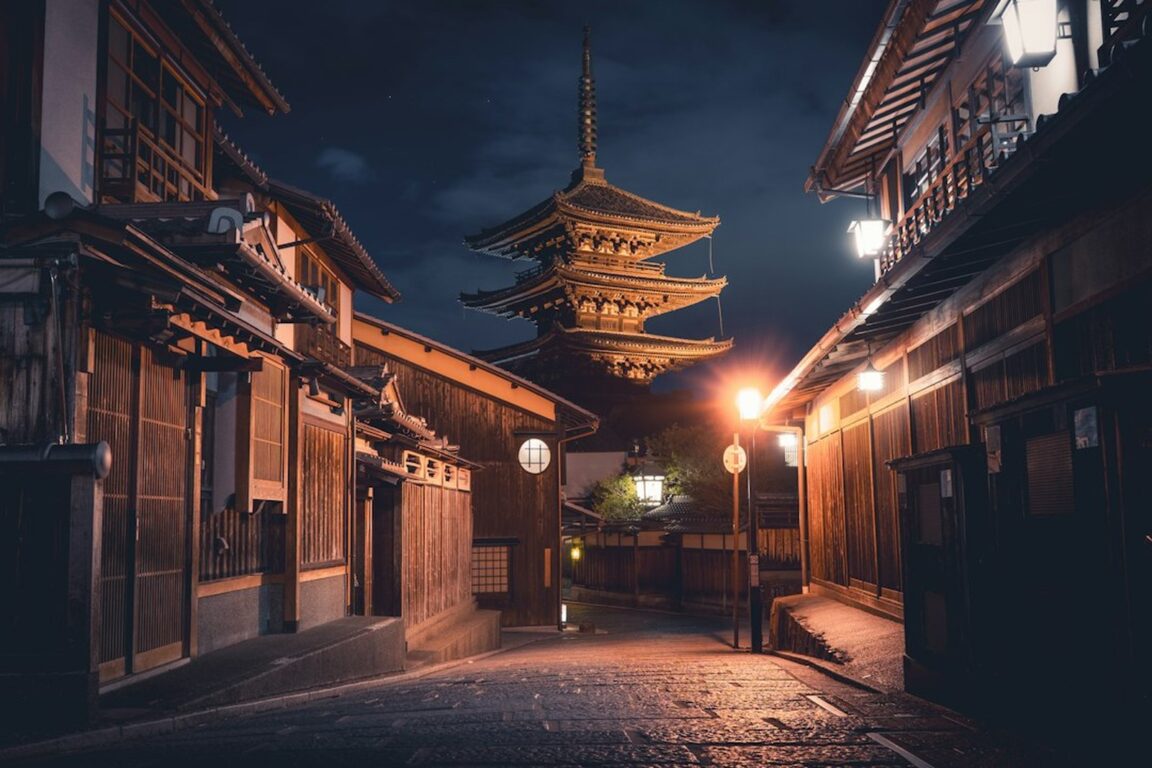
Photo: Yasaka Pagoda and a traditional wooden street in Higashiyama, Kyoto, at night. Photo by Tobias Reich on Unsplash, Unsplash License.