 Thandiwe Nkosi
Pack waterproof trousers, not just a waterproof jacket, plan every Highland drive inside a daylight window that shrinks to about seven and a half hours by 30 November, carry your own light for any bothy night, and keep one warm, dry pub layer that never goes walking, and a November trip to Scotland works. Miss any one of those four decisions and the month finds the gap quickly, because November in Scotland is cold, wet and dark at both ends of the day in a way that September and October only hint at.
This guide resolves the three questions the trip actually turns on. First, the waterproof trouser case, stated plainly below. Second, the daylight maths for Highland driving, with the real sunrise and sunset times for Edinburgh and Inverness across the month. Third, the layering system that covers a wet hill day, a long train day and a warm pub evening out of one bag, without anything in that bag doing only one job.
Quick Facts
- The month: November. Scotland is on GMT all month, and daylight shrinks by roughly an hour and three quarters in Edinburgh between 1 and 30 November.
- Edinburgh daylight: Sunrise 7:19am and sunset 4:32pm on 1 November, giving 9 hours 13 minutes of daylight. By 19 November it is 7:57am to 3:59pm, about 8 hours. By 30 November it is about 8:18am to 3:45pm, just 7 hours 27 minutes.
- Inverness daylight: Shorter still. On 19 November sunrise is about 8:08am and sunset about 3:58pm, a day of 7 hours 50 minutes, and by 30 November the day is down to roughly 7 hours 8 minutes.
- The temperatures to pack for: Met Office 1991 to 2020 station averages put Edinburgh in November at a 10 degrees Celsius average high and 4 degrees at night, with 74mm of rain across about 13 rain days. Inverness averages a 9 degree high, 3 degrees at night and 67mm of rain.
- The waterproof verdict: Jacket and trousers, both, every day. November 2025 made the point nationally: provisional Met Office figures recorded 179.3mm of rain in Scotland that month, above the long term average.
- The bothy rule: Most bothies maintained by the Mountain Bothies Association have no electricity, no running water and no toilet. Your headtorch, fuel and water plan are part of the packing list, not extras.
- The midges verdict: Gone. Midge activity ends by mid to late October, so November weight goes on warmth and waterproofing instead of repellent and head nets.
- The one bag logic: Three walking outfits that layer over each other, one train day outfit built from the same pieces, one pub outfit kept dry in its own bag, and nothing that only works in dry weather.
Do you really need waterproof trousers in Scotland in November?
Yes, and November is the month where this stops being a debate. The standard failure goes like this: a good waterproof jacket keeps the top half dry, rain runs off the jacket hem, and walking trousers absorb it from the thigh down. On a city street that means damp legs. On a boggy Highland path in wind driven rain it means wet, cold legs for the rest of the day, and in single figure temperatures wet legs are how a pleasant walk turns into a genuine warmth problem.
Waterproof overtrousers solve it for very little weight. Look for a pair with sealed seams, a waist that fits over your walking trousers, and ankle zips wide enough to pull on over boots without sitting down on wet ground. Full length side zips are better still on train and town days, because you can add or remove the layer standing on a platform. Pack them in the top of the daypack, not the bottom of the case, because the moment you need them is the moment the rain has already started.
The same logic covers the rest of the waterproof system. The jacket needs a real hood that fits over a hat, sealed seams and enough length to overlap the top of the overtrousers so rain cannot run between them. Boots should be waterproof, broken in and grippy on wet stone and wet boardwalk. Inside the pack, dry bags are not optional organisation, they are the second waterproof system: one for the pub outfit, one for sleep clothes if you are bothying, one for electronics and documents. Our Scottish Highlands autumn packing guide sets out the same shell system for the earlier, milder end of the season, and November simply turns every dial on it further.
How much daylight do you actually get for Highland driving?
Less than most visitors plan for, and it shrinks while you are there. Edinburgh starts November with 9 hours 13 minutes of daylight and ends it with 7 hours 27 minutes. Inverness, the usual gateway to the Highlands, is shorter at both ends of the month, down to roughly 7 hours 8 minutes by 30 November. Civil twilight buys you a little usable light at each end, but on an overcast Highland day, which is the default in November, the light feels shorter than the table says, and glens lose the sun well before official sunset.
Turn that into driving rules. First, schedule any long or unfamiliar Highland drive to finish at least an hour before sunset, which by late November means being parked by about 2:45pm if you are based near Inverness. Second, put the scenic driving in the middle of the day and the indoor things, distilleries, museums, long lunches and the pub, at the edges. Third, never plan a single track road, a ferry connection or a bothy walk in as an after dark arrival: in November, after dark comes at tea time. A headtorch belongs in the car and in the daypack for the walk back from a viewpoint car park, not just in the bothy kit.
If your trip mixes city and Highlands, use the city days for the dark hours. Edinburgh and Glasgow carry their evenings well, with lit streets, late opening and restaurants built for exactly this season. Save the daylight budget for the glens. The contrast with early autumn is sharp, and our September Scotland packing guide shows the other end of it, when the same trip had long evenings to spare.
What does the layer system look like, layer by layer?
Base, warmth, shell, in that order, every day. The base layer should be merino wool or a synthetic equivalent, never cotton, because cotton holds sweat and rain against the skin and chills you the moment you stop moving. Pack three base tops and rotate them, with one kept dry for evenings. In November, add thermal leggings under walking trousers on hill days: they cost almost no space and they are the difference between comfortable and cold on a windy ridge or a long platform wait. Pack two warmth layers rather than one thick one, a lighter fleece for active days and a proper insulated jacket for stops, evenings and train stations. Two thin layers trap more warmth, dry faster and give you a spare when one gets wet.
Hands, head and feet decide comfort out of proportion to their size. Pack a warm hat, a buff or neck gaiter, two pairs of gloves, one waterproof pair for walking and one warm dry pair for evenings, and wool or wool blend socks in numbers that assume one pair gets wet every day. A small pack towel earns its place for drying boots liners, wiping a bothy sleeping platform and dealing with the general damp that November puts on everything.
What changes on a train day?
Train days are the trap in a November itinerary, because a heated carriage feels like a day off from the weather and the platforms at each end are not. Dress for the platforms, not the carriage. The working formula is the same base and fleece, the insulated jacket instead of the shell while you are under cover, and the shell and overtrousers packed at the top of the bag for the walk at the far end. Rural Highland stations can be unstaffed, unsheltered and dark by mid afternoon in late November, so the headtorch and the warm dry gloves matter more on a train day, not less.
Keep one complete change accessible rather than buried in a checked or racked case: base top, socks and the pub layer. If the walking kit gets soaked on the way to the station, you can change in the carriage and arrive as a person rather than a puddle. A plastic dry bag doubles as the laundry bag for the wet set, so the damp stays sealed away from everything else for the rest of the journey. International visitors should also settle entry paperwork before the packing, and our UK Electronic Travel Authorisation guide explains who needs one.
What is the pub warmth layer, and why does it get its own bag?
The pub layer is the one outfit that never walks. In November the evening plan in most Highland towns is a warm room, a fire if you are lucky, food and a drink, and arriving in hill kit that smells of the hill and steams gently by the radiator is nobody’s best evening. The outfit itself is simple: a clean merino or smart knit top, the better pair of trousers or a skirt with thermal tights, and shoes that are not the walking boots. None of it needs to be formal. Scottish pubs in November are full of walkers, and the standard is clean and dry, not dressed up.
What matters is the discipline, not the clothes. The pub set lives in its own dry bag from the moment you pack at home, it comes out only in the evening, and it goes back in the dry bag before bed. That one habit guarantees that however wet the trip gets, and in November it will get wet, you always have one completely dry, warm change. It is also your emergency layer: if everything else is soaked through on the last day, the pub set is the dry core that gets you home comfortable.
What extra kit does a bothy night need in November?
Light, above all. The Mountain Bothies Association maintains around a hundred simple shelters across Scotland, northern England and Wales, and most have no electricity, no running water and no toilets. They cannot be booked and space is never guaranteed. In November, with darkness falling before 4pm, a bothy evening is long, and everything in it runs on what you carried in: a headtorch with spare batteries, a candle or small lantern if you use one safely, your own fuel for the stove or fire, a sleeping bag rated for well below the forecast temperature, a sleeping mat, food, and a water plan based on the nearest burn, treated or filtered.
Follow the Bothy Code, which is the condition the whole network survives on: keep groups small, carry out all rubbish, use fuel sparingly, make certain any fire is fully out, leave the building clean and tidy, and leave dry kindling for the next party if you can. Never treat a bothy as a guaranteed bed. In November weather, carry the tent or the fallback plan that a full or unreachable bothy demands, and tell someone your route and return time, because phone signal in the glens is unreliable at exactly the moments you would want it.
What can you leave at home in November?
More than you think. Midge repellent and head nets are dead weight by November. Sunglasses earn a place only for low winter sun while driving, and even then they live in the car, not the pack. Shorts, sandals and anything cotton can stay home. One pair of walking trousers plus the thermal leggings and overtrousers covers every lower body situation the month offers, and a second pair is the pub pair, not a third walking option. The weight you save goes where November wants it: the second warmth layer, the spare gloves, the extra socks and the dry bags.
Frequently Asked Questions
Is November a bad time to visit Scotland?
No, but it is an honest one. You get short days, average Edinburgh highs of about 10 degrees Celsius, regular rain and very few other visitors. Travellers who pack for the conditions and plan drives inside the daylight get quiet glens, warm pubs and low season prices. Travellers who pack for September get wet.
Are waterproof trousers really necessary for a city break?
For Edinburgh or Glasgow alone, they are strongly recommended rather than essential, and they weigh so little that the case for leaving them is weak. The moment the trip includes a Highland day, a coastal walk or a bothy, they become essential. Rain in November rarely falls straight down.
How early does it get dark in the Highlands in late November?
Very early. Inverness sunset is about 3:39pm by 30 November, with a total day of roughly 7 hours 8 minutes, and glens lose direct sun earlier than the official sunset. Plan to finish driving and walking by mid afternoon and treat anything after 4pm as night.
What sleeping bag does a November bothy night need?
One rated comfortably below the lowest temperature you could plausibly meet, used with an insulated sleeping mat, because bothies are unheated stone or timber shelters and most have no facilities at all. Stone floors and sleeping platforms pull heat from below, so the mat matters as much as the bag. Check the Mountain Bothies Association guidance and the Bothy Code before you go.
Can one carry on sized bag really do a week in November?
Yes, if the bag is built on rotation rather than variety: three base tops, two warmth layers, one walking trouser set with thermals and overtrousers, one protected pub outfit, and socks and gloves in wet weather numbers. Bulky knitwear is what breaks carry on packing in November, so choose one warm knit as the pub top and wear the insulated jacket to travel.
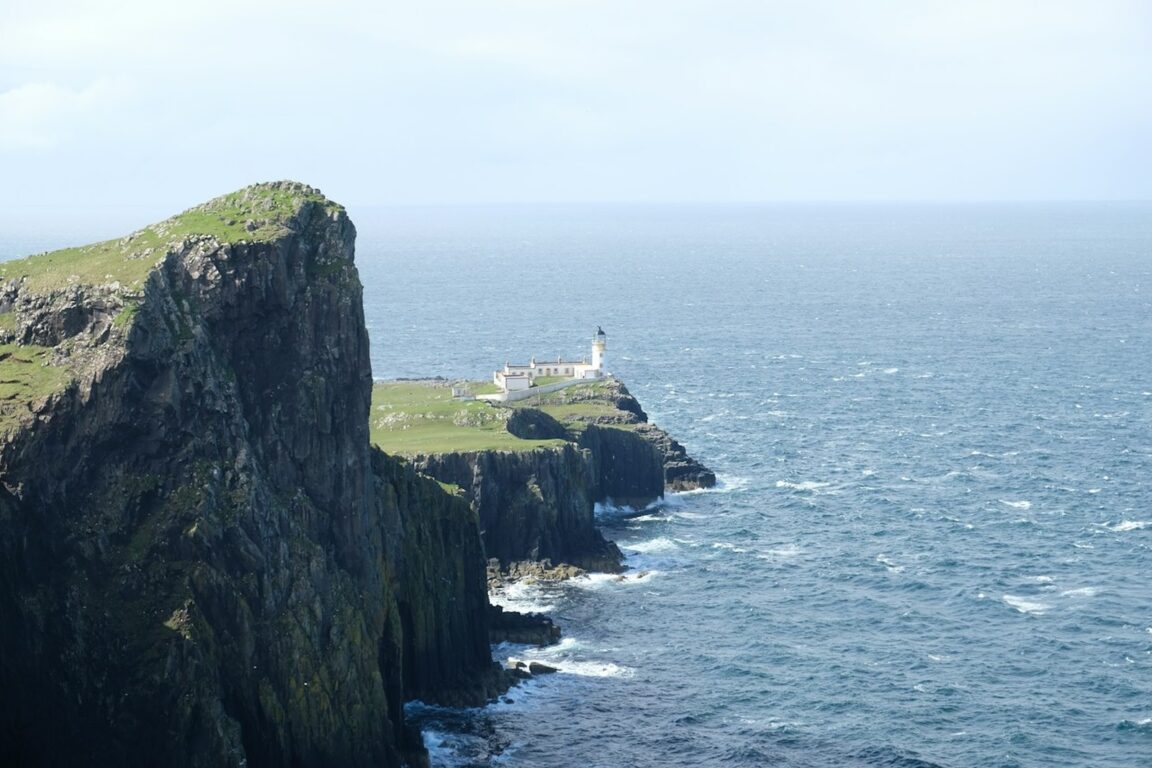
Featured image: Neist Point Lighthouse on the Isle of Skye, Scotland, by Mathijs Jager on Unsplash, Unsplash License, used with credit.