 Hana Kim
Strasbourg runs not one Christmas market but eight, spread across the Grande Ile, and for 2026 they all open on Friday 27 November and close for good on Thursday 24 December. The historic Christkindelsmarik fills Place Broglie, the 30 metre Grand Sapin towers over Place Kleber, chalets ring the cathedral, and the alternative Marche OFF trades from containers on Place Grimmeissen. Entry is free, stalls generally run from late morning to 21:00, and nothing reopens after Christmas Eve, so this is a trip to book early, base on the island or a short tram ride from it, and time around weekday mornings if crowds worry you.
Quick Facts
- 2026 dates: Friday 27 November to Thursday 24 December 2026, confirmed on the official Strasbourg Capitale de Noel site, noel.strasbourg.eu
- Opening day hours: 14:00 to 21:00 on 27 November
- Standard hours: Daily from 11:30 to 21:00, with later closing at 22:00 on Friday 11, Saturday 12, Friday 18 and Saturday 19 December
- Christmas Eve: Stalls close at 18:00 on 24 December and do not reopen on 25 December or before New Year
- Number of markets: 8 official markets across the Grande Ile, with around 300 chalets in total
- The historic market: The Christkindelsmarik on Place Broglie, dating to 1570 and among the oldest Christmas markets in Europe
- The tree: The Grand Sapin on Place Kleber stands about 30 metres tall, with a light and music show every hour from 16:00 to 21:00, and stays lit until 5 January
- Entry: Free to all markets
- Getting there: Direct TGV from Paris Gare de l’Est takes about 1 hour 46 minutes; SNCF lists advance fares on the route from 16 euros
- Driving: The Grande Ile is closed to motor traffic during market hours; park and ride costs 4.20 euros a day including tram travel
When do the Strasbourg Christmas markets run in 2026?
The city has confirmed the 2026 season as Friday 27 November to Thursday 24 December. That is 28 days, all of them in Advent, and the hard stop matters more here than at most European markets. Many cities trade between Christmas and New Year. Strasbourg does not. The chalets close at 18:00 on Christmas Eve and are taken down, so a trip planned for the quiet week after Christmas will find the lights and the great tree but no stalls at all.
Opening day starts late, at 14:00, so arriving on the first morning means waiting for the shutters to lift. The busiest pattern is predictable: Friday evenings and weekends are the densest, Wednesday afternoons draw school holiday crowds, and Monday and Tuesday mornings soon after opening are the calmest windows of the week. If your dates are flexible, a Sunday night arrival with market days on Monday and Tuesday gives you the same chalets with a fraction of the Saturday pressure.
How are the eight markets split across the Grande Ile?
The Grande Ile is the island old town enclosed by the River Ill, a UNESCO listed centre small enough to cross on foot in about 15 minutes. The eight markets sit on its squares, and each has a distinct job. Walking them in a loose loop, rather than treating the market as one site, is the single best planning decision you can make.
Christkindelsmarik, Place Broglie. The original market, held here since the 19th century and tracing its origins to 1570. Expect the longest runs of traditional chalets: ornaments, candles, wooden toys and Alsatian food. For 2026 the city is adding a new entrance arch decorated with traditional Christmas symbols, and the town hall facade beside the square has been dressed by designer Victor Weinsanto.
Au pied du Grand Sapin, Place Kleber. The market at the foot of the great tree, home to the Village du Partage, where around 110 local associations run chalets for charitable causes. The city information chalet here lends wheelchairs and walkers free of charge against an ID document, which makes it the natural first stop for visitors with access needs.
Autour de la Cathedrale. Chalets spread from Place de la Cathedrale to Place du Chateau and along Rue des Hallebardes and Rue Gutenberg, in the shadow of the cathedral’s pink sandstone west front. This is the most photographed and, at midday, the most crowded of the eight.
Le marche du Carre d’Or, Place du Temple Neuf. A smaller craft focused market a few steps from the cathedral, beside the jewellers’ quarter of Rue des Orfevres. It runs calmer than the cathedral squares and suits gift shopping.
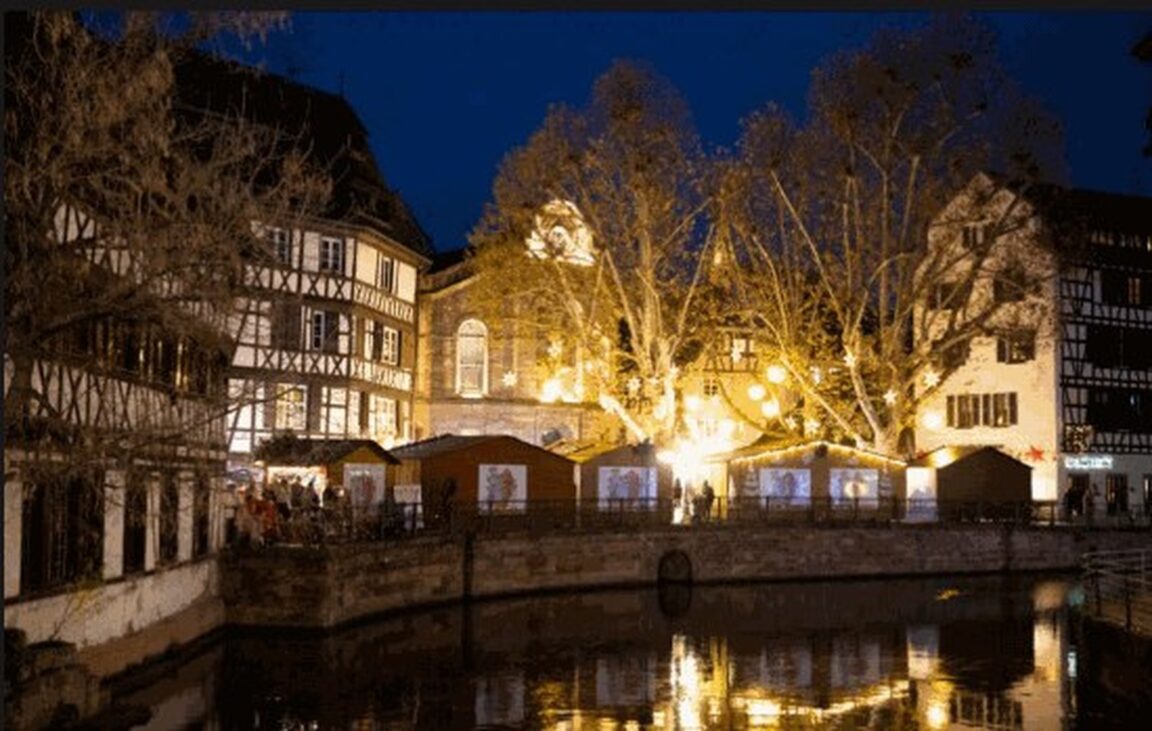
La Petite France, Place Benjamin Zix and Place Saint Thomas. Chalets along the canals in the tanners’ quarter, among half timbered houses. For 2026 the city has programmed fire installations by the Compagnie Carabosse in Petite France at nightfall, which makes this the market to save for after dark.
Le quai des saveurs et des savoir faire, Terrasse Rohan and Place du Marche aux Poissons. The food market by the river, the place to graze rather than shop. A new ice rink also opens for 2026 in the courtyard of the Palais Rohan beside it, running into early January.
Les Irreductibles Petits Producteurs d’Alsace, Square Louise Weiss. Small Alsatian producers only: jams, honey, chocolate, hot apple juice and wine from growers you can talk to. It sits next to the Advent Village and is the easiest market to shop for food gifts that travel well.
Le marche OFF, Place Grimmeissen. The alternative market, covered in the next section.
What is the Marche OFF, and who is it for?
The Marche OFF on Place Grimmeissen, at the far edge of Petite France, is Strasbourg’s deliberate counterweight to the main squares. The city created it in 2015 for social and solidarity economy groups, and it trades from shipping containers and geodesic domes rather than chalets. Expect vintage furniture, customised and second hand clothing, used books and toys, upcycled gifts and organic food, with upcycling workshops through the season.
It suits repeat visitors, anyone shopping on a budget, and anyone who wants a quieter hour. The OFF market also hosts a Safe Zone lending noise cancelling headphones, blankets and stress balls to visitors who need calm, plus a free parents’ space with a changing table, all on request. It runs the same dates as the other markets, 27 November to 24 December, so build it into a Petite France afternoon rather than treating it as a separate trip. Tuesday evenings bring a music aperitif with local labels and Alsace producers, listed by the organisers from 18:00 to 20:00.
What should you eat and drink at the markets?
Start with vin chaud, hot wine mulled with spices. Strasbourg pours both the red version found across Europe and a white vin chaud made with Alsatian wine, which is lighter and the more local choice. You will pay a small refundable deposit on the mug at many stalls; return it or keep it as the cheapest souvenir in the city.
The baking is the real draw. Bredle, also spelled bredele, are the small Alsatian Christmas biscuits sold by the bag in dozens of varieties, from butter and almond to aniseed. Pain d’epices, spiced gingerbread, travels well and keeps for weeks. For something hot and savoury, look for tarte flambee, the thin Alsatian flatbread with creme fraiche, onions and lardons, plus spaetzle, pretzels and choucroute near the food squares. The Quai des Saveurs by the Palais Rohan and the producers on Square Louise Weiss are the two stops where food is the whole point.
For a sit down meal, step off the squares into a winstub, the traditional Alsatian wine tavern. The markets are built for grazing, not dinner, and a winstub table also gives you an hour out of the cold and the crowds.
When should you book, and how does the TGV surge work?
Book earlier than feels necessary. Strasbourg in December is one of the most demand heavy short break markets in Europe, and two bookings drive everything else: the train and the room. SNCF Connect lists advance fares between Paris and Strasbourg from 16 euros, with the fastest direct TGV inoui services covering the route from Paris Gare de l’Est in about 1 hour 46 minutes and the Strasbourg to Paris direction showing a fastest time of 1 hour 43 minutes. Those headline fares sell first, and weekend trains in December fill from the front of the timetable backwards. The practical rule is to book the TGV the day your hotel is confirmed, choose midweek departures if you can, and treat a Friday afternoon arrival train as the one most likely to be full and expensive.
From Strasbourg station, the first chalets are about a ten minute walk, and tram lines A, C, D and F stop near the market squares. If you are combining capitals, our first time in Paris itinerary pairs naturally with a two night Strasbourg add on by TGV. Drivers should not aim for the centre at all: access controls operate at the bridges onto the Grande Ile, motor traffic is prohibited there during market hours, and the city directs cars to park and ride sites at 4.20 euros a day including tram travel for the car’s passengers. There is no luggage storage inside the market grounds, so leave bags at your hotel before you start.
Where should you base yourself?
On the Grande Ile if the budget allows. Staying on the island means walking to all eight markets, returning to your room to drop bags and warm up, and seeing the Grand Sapin show at 16:00 without a transport plan. The trade off is price: island rooms in December are the most expensive in the city and the first to sell out.
The station district, a ten minute walk west, is the value alternative and the smartest base for a short TGV trip, since you can drop bags within minutes of arriving. Petite France, on the island’s western edge, is the most atmospheric base and puts the Benjamin Zix chalets and the Marche OFF on your doorstep. Wherever you stay, book a cancellable rate early rather than waiting for prices to fall. In Strasbourg in December, they rarely do. If you are touring several market cities in one trip, the pacing in our 3 days in Vienna itinerary shows how to give each city enough nights instead of collecting squares at a sprint.
What does a Strasbourg market trip cost?
The markets themselves are free, which makes this a trip whose cost is set by transport, the room and how much you graze. A realistic daily pattern on the ground is a vin chaud and a bag of bredle at one market, a tarte flambee standing at another, and a winstub dinner in the evening. Food gifts from Square Louise Weiss producers are the spending category most visitors underestimate, because jams, honey and gingerbread are easy to carry and hard to leave behind.
The two costs worth controlling are the ones that move: TGV fares, which rise steeply as December trains fill, and Grande Ile hotel rates at weekends. Travelling Monday to Wednesday, booking the train at advance fares and basing near the station instead of on the island can cut the total for a two night trip dramatically without changing a single thing you do at the markets.
Frequently Asked Questions
When are the Strasbourg Christmas markets in 2026?
They run from Friday 27 November to Thursday 24 December 2026, opening at 14:00 on the first day and closing at 18:00 on Christmas Eve. No chalets open on 25 December or between Christmas and New Year.
How many Christmas markets are there in Strasbourg?
Eight official markets, all on or beside the Grande Ile: Place Broglie, Place Kleber, the cathedral squares, Place du Temple Neuf, Petite France, the Palais Rohan terrace, Square Louise Weiss and Place Grimmeissen. Together they hold around 300 chalets.
How tall is the Christmas tree on Place Kleber?
The Grand Sapin stands about 30 metres tall. It is lit daily from 27 November to 5 January, with a light and music show every hour from 16:00 to 21:00 and a light only show later in the evening, so it remains worth seeing even after the stalls close on 24 December.
How long is the train from Paris to Strasbourg?
Direct TGV services from Paris Gare de l’Est take about 1 hour 46 minutes. SNCF lists advance fares on the route from 16 euros, but December weekend trains sell out, so book as soon as your dates are fixed.
What is the Marche OFF?
The alternative market on Place Grimmeissen, created by the city in 2015 for social and solidarity economy sellers. It trades in vintage, second hand and upcycled goods and organic food from containers and domes, and it is the calmest of the eight markets.
Can you visit Strasbourg’s markets after Christmas?
No. The markets end on 24 December. The Grand Sapin stays lit until 5 January and the Palais Rohan ice rink runs into early January, but if the chalets are the point of your trip, travel before Christmas Eve.
Photo credit: Strasbourg Capitale de Noel, the City of Strasbourg’s official Christmas site (noel.strasbourg.eu), showing the Christmas market chalets on Place Benjamin Zix in Petite France. Image via noel.strasbourg.eu.