 Wei Chen
Imsouane is a small Atlantic fishing village about 90 kilometres north of Agadir with two surf breaks and almost nothing else competing for your attention, and that is the whole appeal. On the south side of the harbour, The Bay wraps northwest swell around the point into a sheltered, south facing curve where a soft right hand wave peels for 150 to 300 metres on a typical day, and far longer on the best days, at its best from low to mid tide. On the north side of the same headland, the Cathedral is a faster, more powerful right hand point break over rock and sand that prefers mid to high tide and intermediate to advanced surfers. Choose by tide, not by ambition: Bay in the morning around low water, Cathedral later as the tide pushes in, and a slow village evening in between. Everything in Imsouane runs on that tide table, including lunch.
Quick Facts
- The Bay: Right hand point break over sand and rock beside the harbour, best at low to mid tide, suited to beginners, improvers and longboarders.
- Ride length: Typically 150 to 300 metres at The Bay, with rides of over two minutes at low tide; on the best days the wave can run several hundred metres further.
- The Cathedral: Right hand point break north of the harbour under rocky cliffs, faster and more powerful, best from mid tide to high tide, for intermediate to advanced surfers, with a rocky bottom at the take off.
- Season: The main surf season runs October to April on northwest swells; smaller, gentler surf is common from May to October.
- Water and wetsuit: Sea temperatures sit around 17 to 20 degrees Celsius through the year; a 3/2 mm wetsuit is the standard, with a 4/3 mm welcome for winter mornings.
- Getting there: About 90 kilometres and 1.5 to 2 hours by road from Agadir, and a similar distance and time from Essaouira; there is no direct public bus into the village.
- Village scale: A working fishing port with surf houses, small cafes and board rental, and no real nightlife; evenings are sunset, mint tea and dinner.
- One honest change: In early 2024, homes and businesses near the bay were demolished under a tourism redevelopment plan. The village remains, new steps lead down to The Bay, and surf houses have reopened, but the waterfront looks rawer than older photos suggest.
The Bay or the Cathedral, how do the two breaks actually differ?
They share a headland and nothing else. The Bay is what happens when Atlantic swell loses its temper on the way in: the wave wraps around the harbour wall, straightens into lines, and peels slowly along a gently sloping bottom of sand and rock. Because the bay faces south, it is sheltered from the north wind that roughens much of this coast in the afternoon, which is one reason the wave stays clean and readable for so long. A ride here is measured in trim and patience rather than turns. You take off near the point, settle into the wall, and walk the board or hold a line while the wave carries you across the whole curve of the bay, past swimmers, past the harbour mouth, until it softens into shorebreak near the village. Spot guides put the usual ride at 150 to 300 metres, and local operators describe rides of over two minutes at low tide, with the longest days running far beyond that.
The Cathedral, named for the tall cliffs that close around it like an amphitheatre, faces the open ocean and takes the swell first. It is a right hand point break with a faster wall, a more committing take off and rock underfoot, and it rewards surfers who can already read a set, paddle with intent and handle a steeper drop. Where The Bay forgives a late pop up, the Cathedral charges for one. The practical split for a visiting surfer is simple. If you are learning, improving or longboarding, The Bay is your wave on almost any day it breaks. If you are a confident intermediate or better and the swell has size, the Cathedral is where Imsouane shows its other face, and it is also the better spectator spot, with a cliff path above the beach for watching a bigger swell arrive.
Why does the tide matter so much in Imsouane?
Because the two breaks work on opposite halves of the tide, and the village day organises itself around that fact. The Bay is at its longest and cleanest from low tide through mid tide; at high tide the wave fattens, shortens and can stop breaking altogether over the deeper water. The Cathedral prefers the push, working best from mid tide toward high tide, when there is enough water over the rock at the take off. A well built Imsouane day therefore has a natural shape: surf The Bay on the dropping or low tide, eat and rest through the middle of the day, then check the Cathedral as the tide fills in, or take a second, mellower Bay session if the Cathedral is beyond your level or your energy.
That shape is also a pacing gift, if you let it be one. The mistake visitors make is to surf both tides hard, every day, because the waves are there. Shoulders give out around day three, pop ups slow down, and the long Bay rides that were the point of the trip become a paddle battle. The slower rhythm the village is famous for is not a marketing line; it is load management. One main session a day, timed to the best tide for your break, plus an optional short second session, will put more good waves under you in a week than doubling up daily. Check the tide table the night before, write the session time on the plan, and build meals, a harbour walk and a nap around it rather than around the clock.
What fitness do you actually need for the long right?
The Bay is gentle on the ride and demanding on the return. Every long ride ends with a long paddle or a long walk back up the beach to the take off, and a two hour session can mean repeating that cycle a dozen times. You do not need to be an athlete, but you do need a base: comfortable swimming, the shoulder endurance to paddle in bursts for a session, and enough pop up speed to stand before the soft take off steepens. A few weeks of preparation pays off visibly here. Swimming twice a week, press ups and burpees for the pop up, and any rowing or paddle work you can get all transfer directly. If you are starting from zero, book a lesson for the first two or three days rather than renting a board and hoping; the schools work The Bay daily, know where the inside section is safest, and will put you on a board with enough volume to catch the wave early, which is the entire game on a slow point break.
At the Cathedral, add judgement to fitness. Watch a full set from the cliff or the beach before entering, count the interval, note where the rocks show at the take off, and leave the point to experienced surfers when a strong swell is running. Currents strengthen on bigger days, and the exit over rock at lower water is unforgiving in bare feet. Booties are a sensible, unglamorous purchase for anyone planning Cathedral sessions.
How do you get to Imsouane, and what does the transfer involve?
Agadir is the practical gateway, with Agadir Al Massira airport and the coast road north. The village sits about 90 kilometres away, and the drive takes roughly 1.5 to 2 hours depending on traffic and stops, through Tamri and down the cliff road into the bay. A private transfer is the simplest option with boards and luggage and takes about 1.5 hours door to door. Shared grand taxis cover the route in about the same time once full, and shuttle services aimed at surfers run scheduled trips. Local buses between Agadir and Essaouira pass the Imsouane junction, leaving a short taxi ride for the last stretch, which is the budget route and the slowest. From Essaouira, roughly 90 to 96 kilometres south, the picture is the same: shuttle, grand taxi or private transfer at about 1.5 to 2 hours, and no direct public bus.
However you arrive, arrive in daylight if you can. The final descent is a winding cliff road, the village is small and easy to read by day, and a daylight arrival lets you walk both breaks, check the tide board and rent or reserve a board before your first morning session. If your trip combines Imsouane with the rest of the coast, our guide to Essaouira covers the natural northern partner town, and a Marrakech start or finish pairs well too, following the pattern of our 2 days in Marrakech itinerary. For a packing list built for this coastline in the cooler months, see what to pack for Morocco in winter, and if a second surf base is on your list, compare the gentler school scene in our Weligama surf and yoga guide.
When is the best time of year to surf Imsouane?
The headline season is October to April, when northwest Atlantic swells arrive consistently and both breaks work most often, with the biggest and most powerful surf in the midwinter months. That is the window for the Cathedral at its best and for The Bay at full length. It is also the busiest window at The Bay take off, because a wave this forgiving attracts every surf school and longboarder on the coast. From May to October the swell drops, the water stays mild, and The Bay becomes a smaller, quieter classroom, which suits beginners and anyone who values space over size. There is no bad month to be in the village itself; there are only months that match or mismatch the waves you came for. Choose winter for the wave as advertised, and late spring or early autumn for the wave as a gentle habit.
What is the village like between sessions?
Small, salty and early to bed. Imsouane is a working fishing port first: boats go out, the catch comes in, and the cafes near the harbour serve grilled fish that was swimming that morning. Surf houses and guesthouses provide most beds, board rental is available in the village for anyone not travelling with a board, and evenings run to sunset from the cliffs, mint tea, dinner and informal music rather than bars. Travellers should also know the recent history honestly. In early 2024, buildings near the bay were demolished as part of a tourism redevelopment, a change widely reported at the time and still visible in the raw edges around the waterfront. The village, the harbour and the wave are all still there, new steps reach The Bay, and surf businesses are operating, but anyone arriving with a five year old photo in mind should expect a place mid rebuild, with the welcome intact and the polish still to come.
Practical respect goes a long way here. Away from the beach, cover shoulders and knees, as you would anywhere in Morocco. In the water, the etiquette is the universal one, sharpened by a single take off zone at The Bay: do not drop in, do not paddle through the line of riders, give the fishing boats room near the harbour, and share the peak. The longest wave in Africa is long enough for everyone, provided nobody treats it as private property.
Frequently Asked Questions
Is Imsouane good for beginner surfers?
Yes, at The Bay, in the right conditions. The wave is slow, the bottom is mostly forgiving, the inside section suits first lessons, and schools operate in the village. Beginners should still take lessons, surf at low to mid tide, and stay off the Cathedral, which is a rocky point break for confident surfers.
How long is the wave at The Bay, really?
Spot guides put a typical ride at 150 to 300 metres, lasting over two minutes at low tide on a good day. Claims of 800 metres or more describe the very best days, when the sections link from the point to the far end of the bay, and should be read as a ceiling rather than a promise.
Which airport is best for Imsouane?
Agadir Al Massira, about 90 kilometres and 1.5 to 2 hours by road. Essaouira Mogador airport is a workable alternative at a similar road distance, and Marrakech is a longer transfer of roughly four hours, better suited to a trip that includes the city.
What wetsuit do you need in Imsouane?
A 3/2 mm full suit covers most of the year, with water around 17 to 20 degrees Celsius. In midwinter, early sessions can justify a 4/3 mm, and in high summer some surfers use a shorty, but plan on the 3/2 mm as the default and rent locally if you travel light.
Can you surf both breaks in one day?
Yes, and the tide almost designs the day for you: The Bay from low to mid tide, the Cathedral from mid to high tide. Whether you should surf both is a fitness question. One strong session surfed well beats two tired ones, especially across a full week.
Is there anything to do in Imsouane besides surfing?
Harbour life, fish lunches, cliff walks, sunset viewpoints and day trips toward Essaouira or the Timlaline dunes for sandboarding fill the gaps, but the honest answer is that Imsouane is a one rhythm village. Bring a book, a board and no schedule beyond the tide table, and it gives back exactly the slowness it is known for.
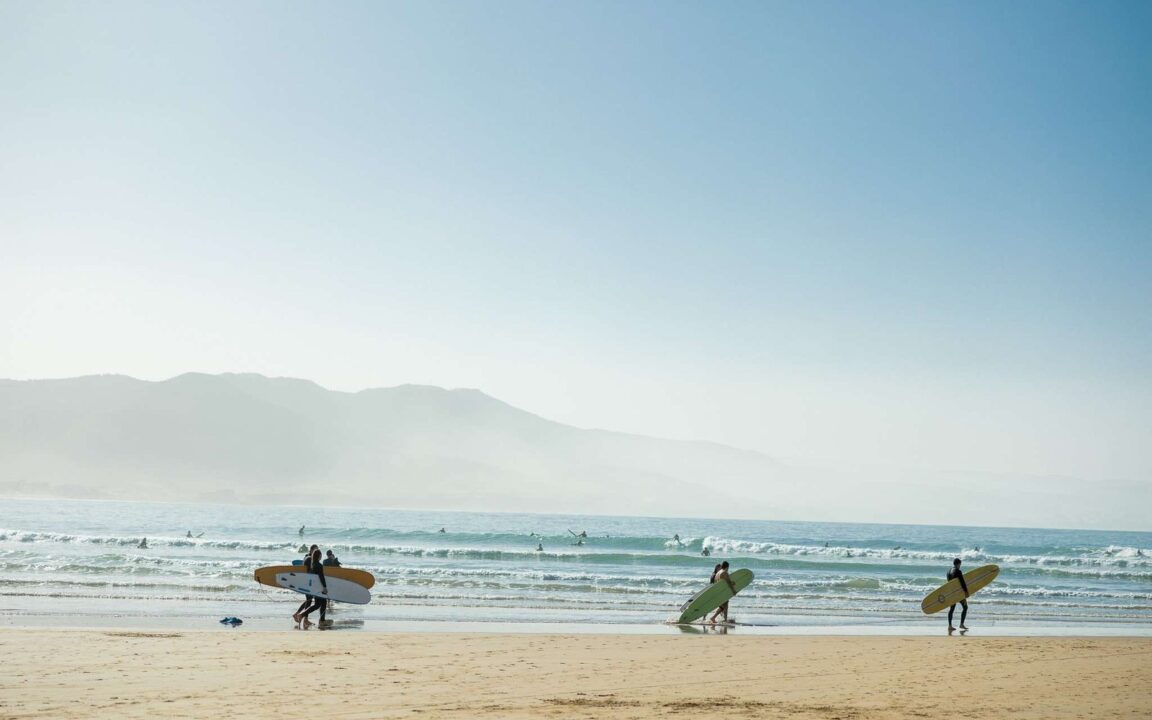
Photo: Natalia Laczynska via Unsplash, showing surfers carrying longboards into the surf at Imsouane, Morocco, under the Unsplash License.