 Omar Haddad
Istanbul Airport can now take off and land aircraft on three runways at the same time, independently, and for a connecting passenger that technical sentence translates into something simple: more movements per hour, denser departure banks, and more recovery options when a flight runs late. The system, Triple Independent Runway Operations, launched on April 17, 2025, made Istanbul the first airport in Europe to run it, and lifted the airport’s hourly air traffic capacity from 120 to 148 aircraft movements, according to operator iGA. In September 2026 the airport added a fourth main runway, its first east west runway, taking it to six runways in total. None of this shortens the walk inside one of the world’s largest terminal buildings, and this explainer separates what the runway revolution changes for connections, taxi times and misconnection risk from what it does not.
Quick Facts
- System: Triple Independent Runway Operations, simultaneous independent takeoffs and landings on three runways
- Launch: April 17, 2025, the first implementation in Europe, per iGA Istanbul Airport
- Capacity effect: Hourly air traffic capacity up from 120 to 148 aircraft movements, an increase of 28 movements per hour
- Preparation: Programme began in 2022 with the State Airports Authority (DHMI), the civil aviation authority, Turkish Airlines and Eurocontrol; 500 air traffic controllers completed 4,500 hours of training
- Supporting system: Airport Collaborative Decision Making (A-CDM), improving slot allocation and movement predictability
- Latest expansion: A fourth main runway, 2,820 metres long and 45 metres wide, the airport’s first east west runway, opened on September 18, 2026, at an investment of 890 million euros, for six runways in total
- Passenger caveat: The terminal is a single, very large building; gate to gate walking time, not runway capacity, is still the tight connection’s weak point
- Facts checked: November 21, 2026, against iGA Istanbul Airport’s official announcement and industry reporting of the fourth runway opening
What does triple independent runway operations actually mean?
It means the three main runways no longer take turns. At most large airports, parallel runways are dependent: a departure waits for an arrival on the neighbouring strip, because the two traffic streams are treated as one interlocked system. Independent operations certify each runway to run its own stream at the same moment, arrivals and departures simultaneously, which is why iGA’s announcement of the April 17, 2025 launch describes simultaneous takeoff and landing operations on three independent runways, opened with the transport minister giving the first command from the tower to three Turkish Airlines flights departing together. The certification burden sits in the tower and the airspace design rather than on the concrete: the project, led on the air traffic side by DHMI, rebuilt approach procedures, put a dedicated controller on each runway’s final approach where one had overseen the pattern before, and ran 500 controllers through 4,500 hours of scenario training before a single live triple movement. ICAO, the international standards body, does not yet publish a ready made triple operations template, so Istanbul’s system was built as a risk assessed local procedure with Eurocontrol at the table, which is part of why aviation bodies treat the launch as a European first worth studying rather than a routine upgrade.
What changes for a passenger connecting through Istanbul?
Three things, in descending order of importance. First, bank density: Turkish Airlines builds its hub around waves of arrivals feeding waves of departures, and 28 extra movements an hour lets those waves run tighter and fuller, which in practice means more one stop combinations sold through Istanbul and, on many city pairs, a later last departure of the day. Second, recovery: when weather or a late inbound aircraft breaks a bank, spare runway capacity is what lets an airport re sequence departures instead of letting delays cascade into the evening, so the system’s real passenger dividend shows up on bad days, as shorter knock on delays and more rebooking options onto later flights the same day. Third, predictability: the A-CDM layer iGA runs alongside the runways shares one agreed timeline for every turnaround among airport, airlines and controllers, improving slot allocation and making departure times more honest earlier, which is the information a connecting passenger actually consumes. What does not change is equally worth stating. The minimum connection times airlines file for Istanbul are set by terminal processing and walking reality, not by runway throughput, so a legal connection has not become a shorter one; and the airport’s own transfer guidance still routes international to international passengers through transfer security inside the single terminal. Travellers with a long layover rather than a tight one are better served by the city than the terminal, and our Istanbul food guide is the right companion for anyone turning a stop into a day.
What about taxi times, the airport’s oldest complaint?
Taxi time is where runway geography, not runway count, does the work, and Istanbul’s layout made it famous: a vast airfield, a single enormous terminal, and, until recently, main runways all aligned north south, so aircraft landing at the far end could face a long taxi to the gate. Triple operations help at the margin, because digitally optimised taxi routing is part of the new operating system iGA describes, and because departures no longer queue behind arrival streams for the same pavement. The structural fix arrived on September 18, 2026, when the airport opened its fourth main runway, a 2,820 metre by 45 metre concrete strip built for 890 million euros on an east west alignment, the airport’s first, taking the total to four main and two auxiliary runways. Officials presented the new runway as departure focused, which frees the north south runways for landings and shortens routes for domestic and eastbound departures in particular. A passenger will not feel a named minute saving on any given flight; what the combination of triple operations and the fourth runway buys is an airfield whose ground movements stop being the bottleneck that its flight schedule had outgrown.
Why did Istanbul need this capacity before other European hubs?
Because its growth model depends on transfer volume in a way point to point airports’ models do not. Istanbul was built to be the connecting hub between Europe, Asia, Africa and the Middle East, a role measured by how many itineraries can be threaded through it inside a few banked hours, and iGA frames the runway programme explicitly as a step toward handling 200 million passengers a year at full build out. Runway throughput is the hard ceiling on that model: terminal space can be extended and gates added, but an airport that can only move 120 aircraft an hour cannot schedule a 148 an hour bank, whatever its shops look like. The September 2026 runway opening, arriving days after Istanbul topped global hub connectivity rankings for the first time, underlines the sequence: demand first, then pavement, then procedure, each chasing the last. Passengers passing through on the ground can see the older city the hub serves in our Topkapi Palace visitor guide, a reminder that the mega hub exists to feed, and be fed by, one of the world’s great destination cities.
Frequently Asked Questions
When did Istanbul Airport start triple runway operations?
On April 17, 2025, when iGA Istanbul Airport became the first airport in Europe to implement Triple Runway Operations, launched with the simultaneous takeoff of three scheduled Turkish Airlines flights on the transport minister’s command from the control tower.
How much capacity did triple operations add?
Hourly air traffic capacity rose from 120 to 148 aircraft movements, an increase of 28 movements per hour, according to iGA. The operator links the gain to shorter waiting times for airlines, fewer delays for passengers and lower emissions from reduced holding and queueing.
Does triple runway operations make short connections safer?
Indirectly. It does not shorten the filed minimum connection times, which are governed by terminal walking distances and transfer security inside the single terminal building. It does improve the odds on the day: denser departure banks mean more same day alternatives if a first flight arrives late, and better recovery when disruption hits.
How many runways does Istanbul Airport have now?
Six in total: four main runways and two auxiliary runways. The fourth main runway opened on September 18, 2026. It is 2,820 metres long and 45 metres wide, cost 890 million euros, and is the airport’s first east west runway, presented as departure focused.
Why did 500 controllers need training for a runway change?
Because the change was procedural, not physical. Independent triple operations require new approach designs, a dedicated controller for each runway’s final approach, new radar and coordination routines, and rehearsed failure cases. iGA reports 500 air traffic controllers completed 4,500 hours of training on scenarios built for the system before launch.
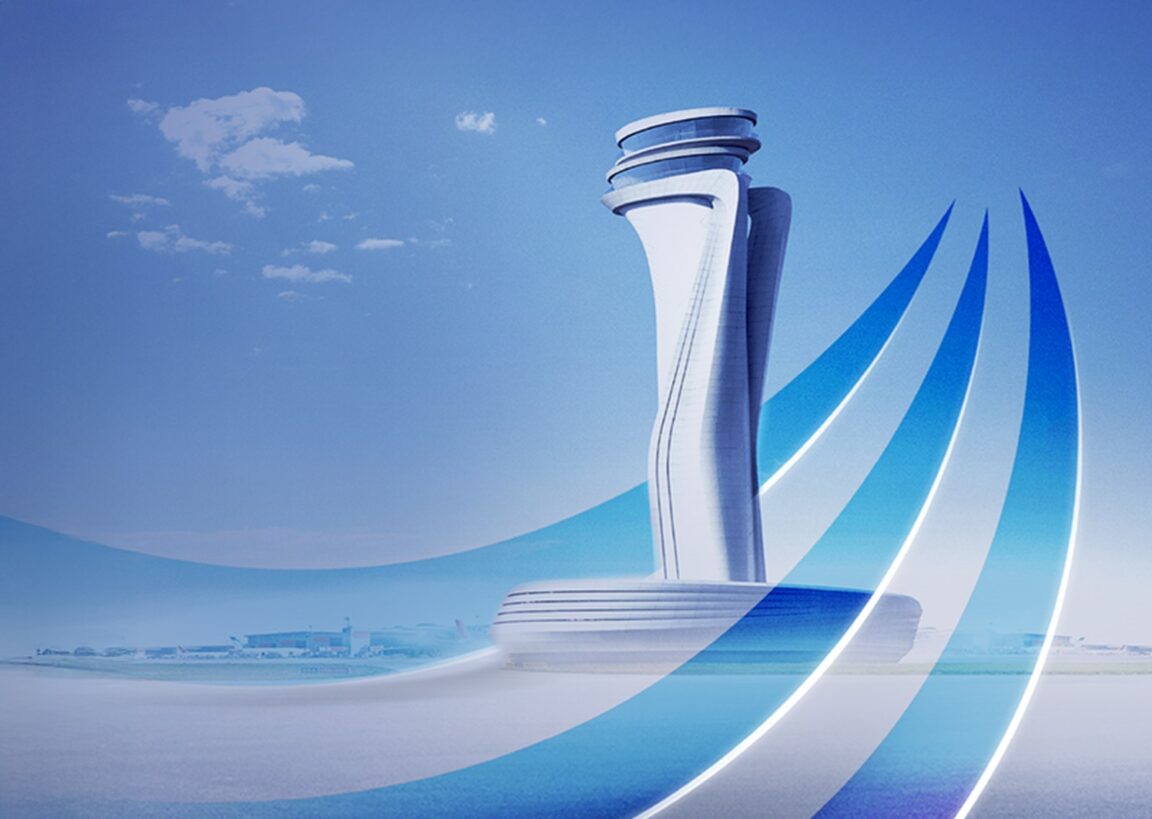
Featured image: Istanbul Airport’s tulip inspired air traffic control tower above the airfield, from the airport operator’s official site. Photo from iGA Istanbul Airport (istairport.com), used with credit. Native 800 x 569, upscaled to exactly 1600px wide JPG.