 Jordan Ellis
Ocracoke Island works on ferry time. There is no bridge and no causeway: every car, bicycle and grocery truck arrives by boat, and the village at the island’s southern end runs at the pace that creates. Come for a white 1823 lighthouse you cannot climb, a harbour called Silver Lake ringed by porches and seafood shacks, a small British war cemetery kept as a piece of England, wild ponies behind a fence, and a lifeguarded ocean beach you reach the way locals prefer, by bike or golf cart. This guide explains the three ferry routes, the car-light rhythm once you land, and how to order a first visit.
Quick Facts
Where: The southernmost inhabited island of North Carolina’s Outer Banks, in Hyde County, about 16 miles long.
Access: Ferry only, plus a small airstrip. No road connection to the mainland or to Hatteras Island.
Ferries: Hatteras to Ocracoke (free, about 70 minutes, first come), Cedar Island to Ocracoke (about 2 hours 15 minutes, reservations recommended) and Swan Quarter to Ocracoke (about 2 hours 40 minutes, reservations recommended), all run by the North Carolina Ferry Division.
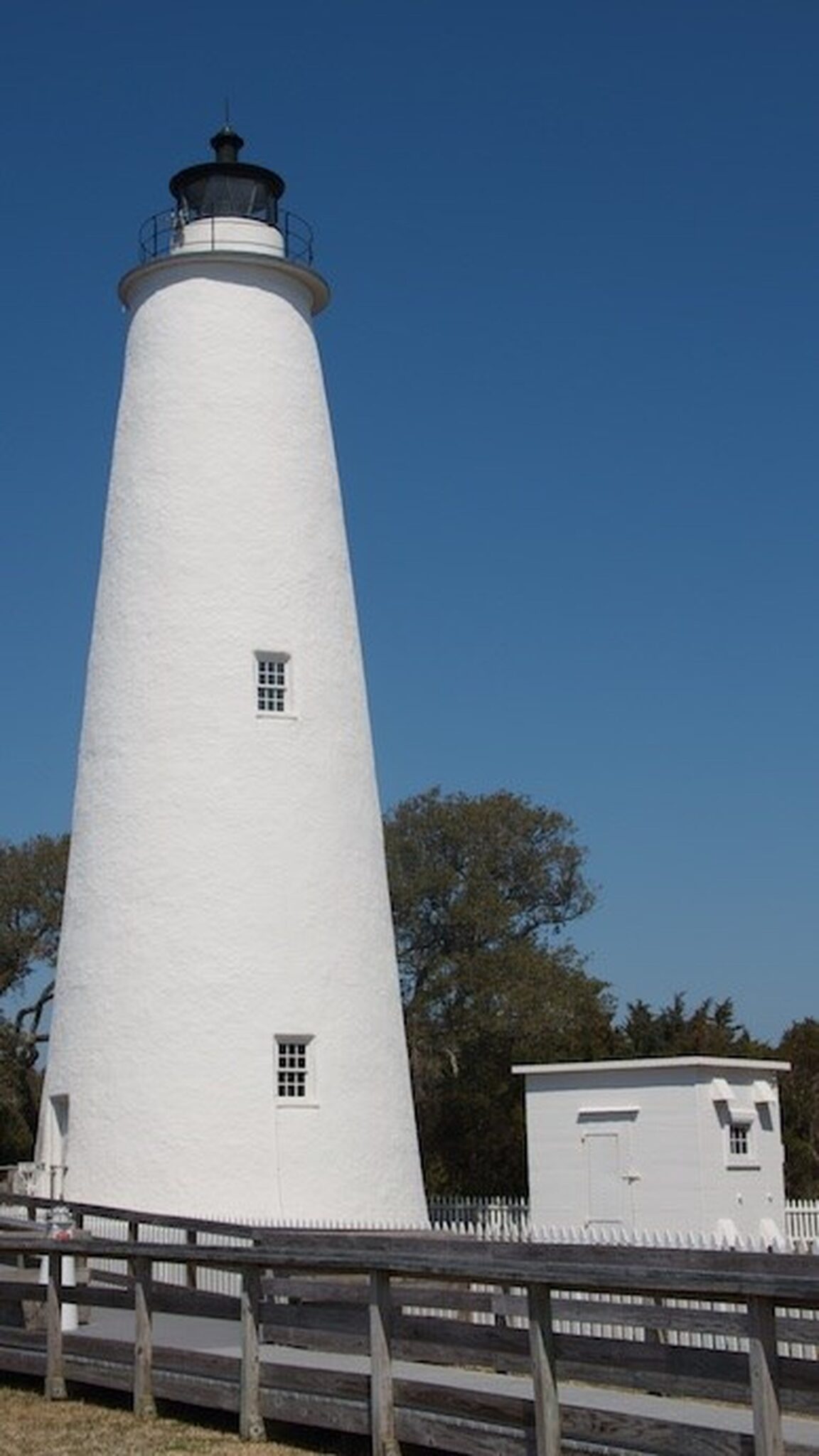
Signature sight: Ocracoke Lighthouse, built in 1823, about 75 feet tall, the oldest operating lighthouse in North Carolina. Grounds open, tower not open for climbing.
Getting around: The village is compact and flat. Walking, bicycles and rented golf carts cover most visitor needs.
Beach: Ocracoke’s ocean beach, part of Cape Hatteras National Seashore, has a lifeguarded area in season near the village end of the island.
Facts checked: 21 November 2026, against the National Park Service and North Carolina Ferry Division information.
Which ferry should you take to Ocracoke?
The right ferry depends on where your trip starts. Travellers already driving the Outer Banks take the Hatteras route: it leaves from the terminal at the southern tip of Hatteras Island, crosses Hatteras Inlet in about 70 minutes, costs nothing, and takes no reservations, which makes the queue itself the system. In summer, arrive early in the day and treat a wait as part of the trip rather than a failure of it.
Travellers coming from mainland North Carolina skip the long drive up and down the Banks by using the two Pamlico Sound routes. Cedar Island to Ocracoke takes about 2 hours 15 minutes and Swan Quarter to Ocracoke about 2 hours 40 minutes. Both charge a one-way vehicle fare, listed by the Ferry Division at $15 for a vehicle under 20 feet, with higher tiers for longer vehicles, and both reward a reservation, which must be claimed at the terminal at least 30 minutes before departure. In the main season a seasonal passenger-only ferry, the Ocracoke Express, has also linked Hatteras and Ocracoke village directly for walk-on travellers, at a $15 round trip in 2026, with bicycles carried for a small extra charge. Check the current season dates before building a plan around it.
One planning rule covers all three routes: weather and water conditions can change schedules on the day. Build slack into any plan that ends with a flight or a fixed booking on the mainland, and check the Ferry Division’s current schedule the morning you travel.
Why does the village feel car-light?
Because for most of its history it had no choice. Ocracoke village, which began as Pilot Town in the 1730s, when pilots settled here to guide ships through Ocracoke Inlet, wraps around Silver Lake, a sheltered harbour that is still the island’s front room. The streets are narrow, sandy in places, and shaded by live oaks and cedars, and the distances are short enough that a bicycle genuinely replaces a car for village life. Golf carts, rented by the hour or day from village outfitters, handle the middle ground: groceries, a run to the beach parking, grandparents who are not cycling.
The practical effect for visitors is a change of tempo. Park the car where you are staying, if you brought one at all, and let the village set the schedule: coffee on a porch, a slow loop past the lighthouse, lunch when the boats come in, the beach in the long afternoon, and dinner within walking distance. Travellers who enjoy islands that ration the automobile tend to love Ocracoke. A similar ferry-set rhythm, in fresh water rather than salt, is the appeal of Washington Island, Wisconsin, and of Beaver Island in Lake Michigan.
What should you see first in the village?
Start with the lighthouse. The Ocracoke Light Station stands on Lighthouse Road in the village, a plain white brick tower completed in 1823 after Congress authorised $20,000 for its construction in 1822. It stands about 75 feet tall, narrowing from 25 feet across at the base to 12 feet at the top, with walls five feet thick at the bottom. The National Park Service, which now preserves the station, notes that it is the oldest operating lighthouse in North Carolina and among the oldest still working in the United States. Its light, equal to 8,000 candlepower, can be seen about 14 miles at sea. The tower is not open for climbing, and parking at the site is only a handful of spaces, which is one more reason to walk or cycle from the village centre. The double keepers’ quarters and the small outbuildings still stand around it, and the base of the tower opens for limited hours in summer.
Then walk the village lanes. Howard’s Pub, the island’s best known gathering place, covers the social centre of gravity: a big, memorabilia-filled pub and raw bar that functions as Ocracoke’s living room, where ferry gossip, fishing news and dinner all happen in the same room. Around Silver Lake, galleries, bookshops, coffee stands and seafood counters fill the converted houses, and the working harbour keeps the scene honest. Fishing boats and the ferries themselves provide the movement.
What is the British Cemetery, and why is it here?
On a quiet village lane, behind a picket fence, four graves sit in a plot that is formally British soil in spirit and upkeep. In May 1942 the British armed trawler HMS Bedfordshire was torpedoed by a German U-boat off the Outer Banks, and the bodies of four of her crew washed ashore on Ocracoke. Islanders buried them here, and the plot, the British Cemetery, has been tended ever since, with an annual ceremony that draws the Royal Navy, the US Coast Guard and the village together. It is a small site that asks for a quiet five minutes rather than a tour, and it explains more about Ocracoke’s war, when this remote island sat on a dangerous shipping lane, than any plaque could.
The island’s older maritime story is darker still. Blackbeard, the pirate Edward Teach, used Ocracoke Inlet as an anchorage and was killed here in November 1718, at the inlet that still bears the marks of that era in local names and stories. Springer’s Point, a maritime forest preserve near the village, is the shaded walk most often tied to his last anchorage, and it doubles as one of the island’s best short nature walks.
How do the beach and the ponies fit into a day?
The ocean beach runs the length of the island’s Atlantic side, wide, dune-backed and far less built up than the beaches of the northern Banks, because Cape Hatteras National Seashore protects it. The lifeguarded section in season sits at the village end, reached by a short bike or cart ride along the highway, with a parking area for those who drive. Beyond the guarded stretch, the beach empties quickly. Swimmers should respect the same Atlantic rules as anywhere on the Banks: rip currents are the real hazard, and the guarded area is the sensible default for families.
On the sound side of the highway, the island’s Banker ponies live in a large fenced pasture maintained by the National Park Service. The herd descends, by local account and long tradition, from horses that reached the island centuries ago, and the Park Service manages them as a contained herd for their safety and the marsh’s. You watch from the fence and boardwalk rather than entering, and early morning, when the ponies graze close, is the best viewing time.
Where do you sleep and eat on Ocracoke?
Lodging is village scale: small inns and hotels around Silver Lake, rental cottages on the lanes, bed and breakfasts in old island houses, and the National Park Service campground on the ocean side, which has 136 sites behind the dunes and is itself reached only by the same ferries. Book summer stays early. The island’s capacity is fixed by its size and its boats, and July and August fill accordingly.
Eating follows the harbour. Expect she-crab soup, shrimp and oysters when the season allows, fish tacos from food trucks, and at least one long evening at Howard’s Pub. Ocracoke fig cake, made from the island’s fig trees, is the local sweet to look for in bakeries and at the island’s summer fig festival season. Restaurants keep island hours and island seasons, so in the quiet months confirm who is open before you count on dinner.
When is the best time to visit Ocracoke?
Late spring and early autumn are the sweet spots: warm water, open businesses, working ferries on full schedules and thinner queues at Hatteras. Summer brings the full island, the lifeguards, the passenger ferry and the crowds the boats can carry. Winter is genuinely quiet, with reduced ferry schedules and many businesses closed, which suits travellers who want the village to themselves and pack for Atlantic wind. Hurricane season deserves respect anywhere on the Outer Banks. Ocracoke was badly flooded by Hurricane Dorian in 2019, and evacuation orders, when they come, run through the same ferries, so late summer and autumn trips should stay flexible.
Frequently Asked Questions
Can you drive to Ocracoke Island?
No. There is no bridge or road. Vehicles arrive on the North Carolina ferries from Hatteras, Cedar Island or Swan Quarter, and the Hatteras crossing is free and first come, first served.
How long is the ferry ride to Ocracoke?
About 70 minutes from Hatteras, about 2 hours 15 minutes from Cedar Island and about 2 hours 40 minutes from Swan Quarter, weather permitting.
Can you climb the Ocracoke Lighthouse?
No. The 1823 lighthouse is not open for climbing, though the grounds and station buildings can be visited, and the base opens for limited hours in summer, according to the National Park Service.
Do you need a car on Ocracoke?
Not for a village-based stay. The village is flat and compact, bicycles and golf carts are widely rented, and the lifeguarded beach is a short ride away. A car helps for island-wide exploring and for the campground.
What is the British Cemetery on Ocracoke?
The burial plot of four British sailors from HMS Bedfordshire, torpedoed off the Outer Banks in 1942, whose bodies came ashore on the island. Villagers buried them and the site is still ceremonially tended.
Is there a lifeguarded beach on Ocracoke?
Yes. The Cape Hatteras National Seashore beach at Ocracoke has a lifeguarded area in season, near the village end of the island.
Image: Ocracoke Lighthouse, Ocracoke Island. Photo: National Park Service (nps.gov), via Cape Hatteras National Seashore. Prices and schedules checked 21 November 2026.