 Maya Chen
Start with the set, not the stalls: in George Town, the classic kopitiam breakfast is charcoal toasted bread spread with kaya and a slab of cold butter, two half boiled eggs cracked into a saucer with soy sauce and white pepper, and a cup of Hainanese kopi, and the whole ritual is best decoded before 9 in the morning in the heritage streets around Chulia Street and Campbell Street. Penang is famous for its hawker canon of char kway teow, laksa and nasi kandar, but the kopitiam morning is a separate culture with its own order, its own vocabulary and its own rules, and it rewards travellers who learn it on day one.
Quick Facts
- Where: The heritage core of George Town, Penang, Malaysia, centred on Lebuh Chulia (Chulia Street), Lebuh Campbell and Lebuh Carnarvon
- The classic set: Kaya toast, two half boiled eggs, and kopi or teh, ordered as one breakfast
- The charcoal benchmark: Toh Soon Cafe, 184 Lebuh Campbell, serving since 1950, open Monday to Saturday 8am to 5pm, closed Sunday, per Visit Penang
- Best arrival time: Before 9am for short queues and the full toast menu
- How to pay: Cash is still king in the oldest shops, so carry small ringgit notes
- Dress and seating: Casual, shared tables, and a queue that moves faster than it looks
What exactly is a kopitiam, and how is it different from a hawker centre?
A kopitiam is a traditional coffee shop, usually Hainanese run, where the drinks stall is the business and everything else orbits around it. The word blends kopi, the Malay word for coffee, with tiam, the Hokkien word for shop. In George Town the format settled more than a century ago: marble topped tables, a drinks maker working a long spouted kettle, bread toasted to order, and independent food stalls renting space around the edges selling noodles, nasi lemak and dim sum. A hawker centre, by contrast, is a collection of cooked food stalls where drinks are an afterthought. If your morning goal is toast, eggs and coffee made with ceremony, you want a kopitiam. If your goal is a full plate of noodles, you want the hawker centre, ideally later in the day.
The Hainanese connection matters. Hainanese cooks who worked in British colonial kitchens adapted Western breakfast into something local: bread crisped over fire, eggs timed to a silky midpoint, coffee roasted dark with margarine and sugar in the traditional style, and kaya, a slow cooked jam of coconut milk, eggs, sugar and pandan, standing in for marmalade. That hybrid is now so rooted in Penang life that ordering it correctly is a small act of cultural literacy.
How do you order kaya toast like you mean it?
Order the set by its parts. Ask for roti bakar, toasted bread, with kaya and butter, and specify thin crisp toast if that is your preference, because some shops offer a thicker steamed bread, roti kukus, as the soft alternative. The toast should arrive in neat fingers, the butter still cold enough to hold its shape against the warm bread, the kaya glossy and pandan fragrant. At Toh Soon Cafe on Lebuh Campbell, the bread is grilled over charcoal and both the bread and the kaya are made in house, which is why the queue forms down the alley off Campbell Street from opening time. Visit Penang lists the cafe as serving since 1950, open Monday to Saturday from 8am to 5pm and closed on Sunday, and names its must try plate plainly: charcoal grilled kaya toast with soft half boiled eggs from kampung, or free range, chickens and a cup of Hainanese kopi.
Charcoal is the dividing line between a good kopitiam and a nostalgic theme cafe. Charcoal heat is uneven in a useful way: it blisters edges, leaves a faint smoke note and crisps without drying the crumb. Electric toasters produce uniform colour and no aroma. When you walk the circuit, look through the doorway first. If you can see a charcoal brazier and a cook fanning it, sit down. If the toast arrives suspiciously perfect and pale, you are in the wrong shop.
What is the correct way to eat half boiled eggs?
The eggs arrive in a covered cup of hot water or already cracked into a small saucer, the whites just set into a trembling custard and the yolks fully runny. Add a dash of light soy sauce and a shake of white pepper, stir once with the spoon so the yolk ribbons through the white, then either drink it in two spoonfuls or dip your toast fingers straight in. Dipping is not a tourist invention; it is the standard local move, and it turns the egg into a sauce for the sweet kaya. Order two eggs per person. One egg is a garnish; two eggs are breakfast.
Timing is the skill. An egg left a minute too long firms at the edges and loses the silk. In a busy kopitiam the eggs are pulled in batches all morning, so a fresh order at peak hour is usually perfectly timed. If your eggs arrive firm, it is not a disaster, but it is information: the shop is coasting.
How do you decode the kopi menu without pointing at the board?
The drinks vocabulary is a compact code, and learning six words unlocks the whole board. Kopi on its own means coffee with condensed milk, sweet and strong. Kopi O is black coffee with sugar and no milk. Kopi C uses evaporated milk and sugar and tastes lighter and cleaner. Add peng for iced, kosong for no sugar, and kaw for extra strong. Teh follows the same code for tea. A kopi O kosong peng, iced black coffee with no sugar, is the order of someone who has done this before, and it cuts through the richness of butter and kaya better than any milky drink.
One hybrid deserves its own sentence: cham, a mix of coffee and tea in one cup, sounds like a compromise and drinks like a discovery, malty and rounded. Order it once during your stay, ideally at a second kopitiam on the circuit, so you can compare houses. Kopitiam loyalty in George Town is fierce precisely because every shop roasts, brews and sweetens slightly differently.
What does a sensible Chulia Street morning circuit look like?
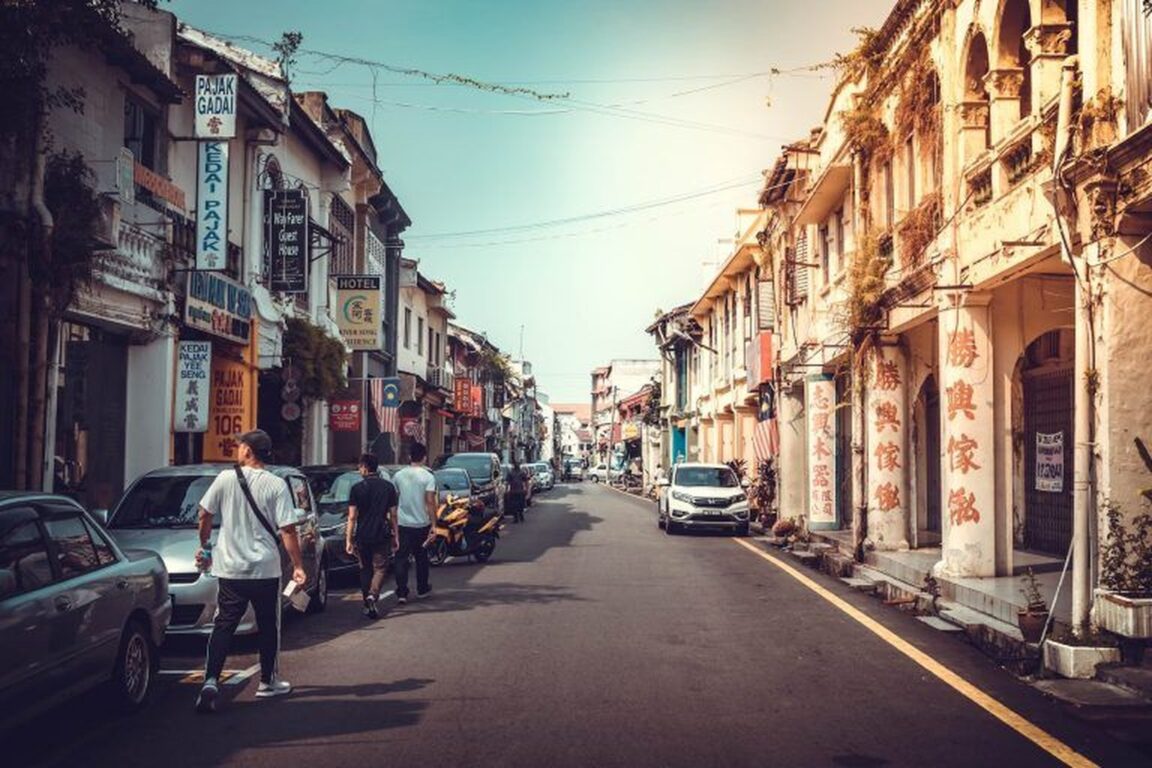
Build the morning as a slow loop, not a single sitting. Start near Chulia Street, Lebuh Chulia on the street signs, which runs through the middle of the heritage zone and holds a dense run of old coffee shops, bakeries and morning stalls. Have your first set early, toast and eggs and a hot kopi, then walk it off through the side streets: Campbell Street for Toh Soon and its charcoal queue, Carnarvon Street for another round of drinks and a small plate from a stall, perhaps nasi lemak wrapped in banana leaf, which Toh Soon also lists among its specialties alongside butter and sugar toast.
The point of a circuit rather than a single famous stop is comparison. Penang regulars judge a kopitiam on three things: the toast fire, the egg timing and the kopi roast. You cannot judge any of them from one data point. Two shops in one morning, three across a stay, and you will have a favourite and the vocabulary to defend it. For a wider frame on how Malaysian mornings differ by city, compare this ritual with the hawker breakfasts in our 3 days in Kuala Lumpur itinerary, where the capital runs the same kopi code at a faster tempo.
Which old coffee shops still toast over charcoal?
Toh Soon Cafe is the documented benchmark: charcoal grilled bread, house made kaya, kampung chicken eggs, and a family run that passes from the founder to his son, per Visit Penang. Beyond that single verified name, treat charcoal claims as something to verify with your eyes at the door rather than from a list, because shops change fuel and ownership without updating anyone. The honest method is the circuit method: look for the brazier, the fan and the stack of un sliced loaves waiting for the grill. George Town still has working charcoal corners, but they cluster in the morning hours and sell out of the good bread early, which is another reason the circuit starts before 9am.
What you should not do is confuse the kopitiam morning with the city wider food fame. The char kway teow queues and the laksa pilgrimages are lunch and dinner business. Travellers who try to compress everything into one heroic food day end up eating the wrong meal at the wrong hour in the wrong kind of shop. Our Hanoi food guide makes the same argument for Vietnam: every food city has a breakfast culture that stands apart from its greatest hits, and it is always the first one worth learning.
What should you know before you sit down?
Share tables without ceremony, order drinks first because the drinks stall owns the table, and pay each stall separately in cash. Photograph the toast, not the queue. Expect the oldest rooms to be hot, loud and entirely unbothered by your presence, which is the surest sign you chose well. And on Sundays, remember the benchmark is shut: Toh Soon closes on Sunday, so build your charcoal morning for a weekday or Saturday and give Sunday to the city other breakfasts.
Frequently Asked Questions
What is kaya, exactly?
Kaya is a slow cooked coconut jam made from coconut milk, eggs, sugar and pandan leaf, spread thick on toast with butter. Good kaya is glossy, fragrant and just sweet enough to need the salt of the butter beside it.
What time do George Town kopitiams open and close?
The morning trade starts early across the heritage zone, and the documented benchmark, Toh Soon Cafe at 184 Lebuh Campbell, opens Monday to Saturday at 8am and closes at 5pm, closed Sunday, per Visit Penang. Arrive before 9am for the shortest queues.
Is the kopitiam breakfast the same as Penang hawker food?
No. Hawker food is the cooked stall canon of noodles, rice and soups. The kopitiam breakfast is a Hainanese coffee shop ritual of charcoal toast, half boiled eggs and coded coffee orders, and locals treat the two as different meals at different hours.
How much should I budget for a kopitiam breakfast?
Visit Penang places Toh Soon in its lowest price band, and kopitiam sets across George Town remain among the cheapest sit down breakfasts in the city. Carry small cash notes, pay each stall separately, and expect coffee, toast and eggs together to cost a fraction of a hotel breakfast.
Can I get the toast set without eggs or coffee?
Yes. Every element orders separately: toast on its own, eggs on their own, and teh or cham in place of kopi. The set is a custom, not a fixed menu, and shops will happily build the version you ask for.