 James Wolfe
Half a day is enough for the Art Institute of Chicago if the visit runs in the right order: start in the Modern Wing while energy is highest, cross to the Impressionist galleries before the midday crowds peak, and finish in the Thorne Miniature Rooms, the quietest and strangest pleasure in the building. The museum at 111 South Michigan Avenue holds one of the strongest encyclopedic collections in the United States, and its scale is the main risk for a first visit. Wandering without a sequence turns four good hours into tired feet and half remembered rooms. This guide sets out a route that protects the highlights, explains what each wing does best, and leaves room for one or two personal detours. Practical details, including hours, tickets and current exhibitions, sit on the museum official visitor pages at artic.edu/visit, and they are worth a check on the morning of a visit because galleries rotate and some rooms close for reinstallation.
Quick Facts
- Address: 111 South Michigan Avenue, Chicago, with the Modern Wing entrance on Monroe Street
- Best first stop: The Modern Wing, for twentieth century art in calm morning light
- Most famous rooms: The Impressionist galleries, home to works by Monet, Renoir, Caillebotte and Seurat
- Quiet finale: The Thorne Miniature Rooms, 68 tiny period interiors on the lower level
- Signature exterior: Edward Kemeys bronze lions, on the Michigan Avenue steps since 1894
- Time needed: Three to four hours for this route, a full day for the whole museum
- Planning base: Pair the visit with our guide to where to stay in Chicago for first timers
Start at the Lions, Then Head Straight to the Modern Wing
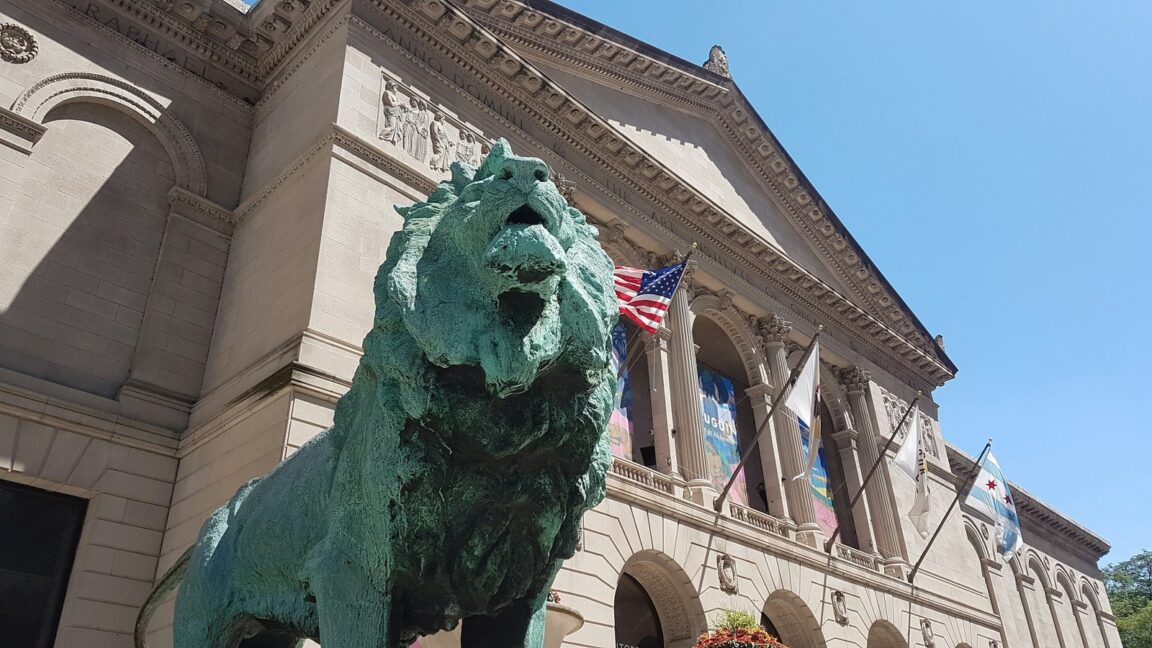
The two bronze lions outside the Michigan Avenue entrance are the museum public face, and they reward a minute before going inside. Modeled by Edward Kemeys and unveiled in 1894, the pair are not identical: the museum own account, at artic.edu, describes the north lion as on the prowl and the south lion in an attitude of defiance. Each weighs more than two tons. Photograph them early, because the steps fill with groups by late morning, then resist the pull of the grand staircase galleries and make for the Modern Wing, the 2009 Renzo Piano addition reached through the museum interior or from Monroe Street.
The logic is simple. The Modern Wing holds the art that benefits most from fresh eyes: European modernism, American art of the twentieth century, and contemporary galleries where single works need slow looking. Morning light through the wing glass roof is also the best light of the day in these rooms. Starting here means the most demanding art gets the visitor best hour, and the route then flows back toward the older building and its crowd pleasing nineteenth century rooms as the day warms up.
The Modern Wing Order That Works
European Art Before 1950
Begin with the European modern galleries, where the story runs from early modernism toward abstraction. These rooms explain, in objects, how painting broke with the nineteenth century: colour loosens, perspective flattens, and subject matter turns inward. Visitors who know little modern art should move slowly here rather than quickly later, because the Impressionist rooms across the building will suddenly make more sense as the before picture to this after picture. Give this section a full half hour and pick three works to stand with properly instead of glancing at thirty.
American Art and the Icons
The American galleries hold two of the most reproduced paintings in the country: Grant Wood American Gothic and Edward Hopper Nighthawks. Both draw small crowds, and both repay patience, because seeing them at real scale changes them. American Gothic is smaller and sterner than its parodies suggest, and Nighthawks glows with a stillness that reproductions flatten. The museum collection pages at artic.edu/collection list what is currently on view, which matters because even famous works occasionally travel on loan. If one icon is away, the surrounding American rooms, strong on modernism between the wars, fill the gap without effort.
Contemporary Galleries and the Griffin Court
Finish the wing in the contemporary galleries, then pause in Griffin Court, the wing airy central hall. This is the natural halfway break of the visit: sit, look at the route so far, and decide what the second half must include. Visitors building a wider city trip can line this museum day up with our first time Chicago three day itinerary, which places the Art Institute alongside the river and Millennium Park without doubling back.
The Impressionist Galleries, Without the Crush
Cross back into the main building for the nineteenth century European galleries, the museum most visited rooms. The collection of Impressionist and Post Impressionist painting here is among the finest outside Paris: multiple Monet series paintings, Renoir, Degas, Caillebotte vast Paris Street; Rainy Day, and Seurat A Sunday on La Grande Jatte, the pointillist canvas that anchors the rooms. By arriving at these galleries after the Modern Wing, the visit reaches them late morning rather than at opening, when entry crowds surge straight here. The rooms are still busy, but the flow has thinned into something workable.
Look in a deliberate order. Start with the early landscapes and Monet series works, haystacks and poplars and Rouen Cathedral among them, which show Impressionism as an investigation of light rather than a style of prettiness. Move to the figure painters, Renoir and Degas, then stand back for Caillebotte, whose rain soaked Paris boulevard is one of the great urban paintings of the century. End with Seurat and the Post Impressionists, Van Gogh and Gauguin and Toulouse Lautrec around them, where the movement breaks open into modern art, which is exactly where this route began in the Modern Wing. The circle closes, and the collection argument becomes clear.
The Thorne Miniature Rooms: The Quiet Finale
End on the lower level in the Thorne Miniature Rooms, 68 miniature interiors made in the 1930s under the direction of Narcissa Niblack Thorne. Each room recreates a European or American interior from a specific period at a scale of one inch to one foot: a French salon, a Shaker room, a Victorian parlour, a New Mexico adobe. The craftsmanship is exact, furniture, textiles and tiny books all made to scale, and the viewing experience, peering through glass into lit little worlds, slows visitors down in a way no grand gallery does. After hours of monumental painting, the miniatures reset the eye. They are also, reliably, the least crowded beloved thing in the museum, which makes them a peaceful final stop before the shop and the lions again.
If Time Remains: Three Worthy Detours
With an extra hour, choose one detour rather than three half ones. The arms and armor galleries suit visitors drawn to objects and craft. The Asian art galleries, running from Chinese bronzes to Japanese prints, reward anyone who has walked the museum narrative of the West and wants its counterpoint. The photography galleries rotate often and suit a shorter attention span at the end of a visit. What matters is choosing by interest, not by proximity: a detour chosen well is remembered, while corridor wandering at the tired end of a museum day is not.
Practical Shape of the Visit
Buy tickets in advance where possible, arrive near opening, and give this route three to four unhurried hours. The museum is at its fullest on free admission occasions and weekend afternoons, so a weekday morning is the connoisseur choice. Millennium Park and the Chicago Cultural Center sit within a few minutes walk, and the Loop elevated trains pass nearby, which makes the Art Institute one of the easiest major museums in America to fold into a city day. End as the route began, on the Michigan Avenue steps between the lions, which have guarded the building since 1894 and remain the city most affectionate meeting point.
Frequently Asked Questions
How long does a first visit to the Art Institute of Chicago take?
Three to four hours covers this route well: the Modern Wing, the Impressionist galleries and the Thorne Miniature Rooms. A full exploration of the museum takes a day or more, so first time visitors should choose a route rather than attempt everything.
Which entrance should first time visitors use?
Either works. The Michigan Avenue entrance passes the famous lions and suits visitors starting with the historic building, while the Monroe Street Modern Wing entrance suits this route, which begins with twentieth century art. Both are described on the museum visitor pages at artic.edu/visit.
Are American Gothic and Nighthawks always on view?
Not always. Major works occasionally travel on loan or rest for conservation. The museum collection search at artic.edu/collection shows current on view status, so check the specific works that matter most before travelling across the city for them.
What are the Thorne Miniature Rooms?
They are 68 miniature period interiors, made in the 1930s at a scale of one inch to one foot, recreating European and American rooms across several centuries. They sit on the lower level and are one of the museum most distinctive and least crowded attractions.
When is the museum least crowded?
Weekday mornings near opening are generally calmest, and the Modern Wing is quieter early in the day. The Impressionist galleries are busiest from late morning onward and on free admission days, so the route in this guide reaches them after the Modern Wing rather than first.
Image: One of the bronze lions by Edward Kemeys guarding the Michigan Avenue entrance of the Art Institute of Chicago. Photo by Kim Tiu via Unsplash.