 James Wolfe
Bornholm is Denmark’s Baltic outlier, a granite island closer to Sweden than to Copenhagen, and the way to plan it is by coast: the ruined fortress of Hammershus and the cliffs of the north, the four medieval round churches of the interior, the herring smokehouses of the harbour towns, and the white sand of Dueodde in the south. Most visitors arrive by fast ferry from Ystad in Sweden, a crossing of about 80 minutes into Ronne, or on the short flight from Copenhagen. Give the island at least two days, because its pleasures are spread evenly around its shores and none of them asks for more than an hour or two at a time. Start north, where the island keeps its drama, and work clockwise.
Quick Facts
- Where: Bornholm, a Danish island in the Baltic Sea, reached by ferry from Ystad in Sweden, Koge in Denmark and Sassnitz in Germany, or by air from Copenhagen.
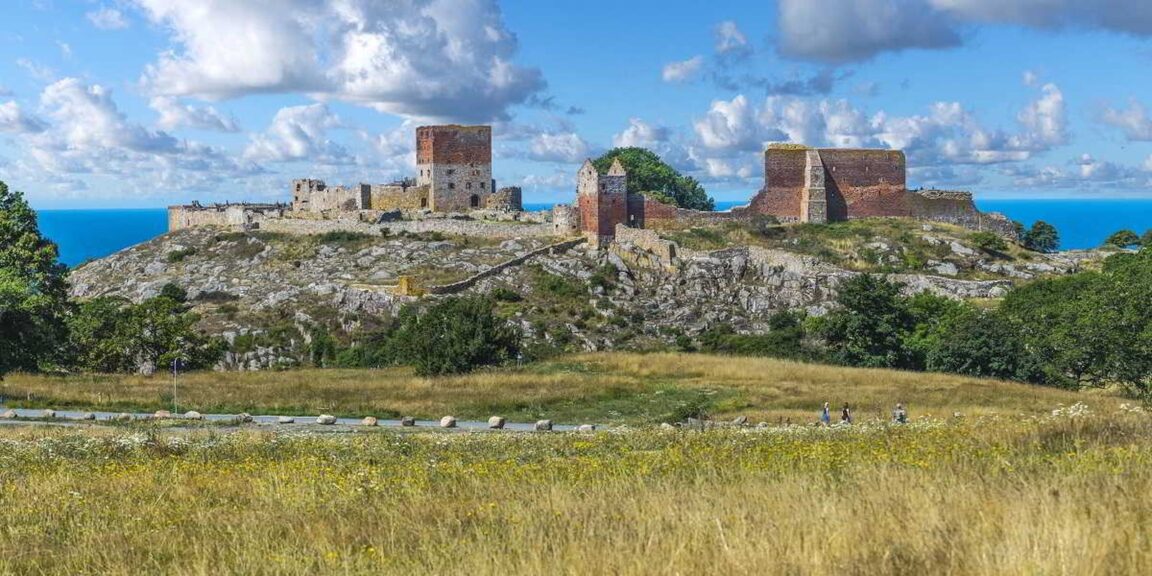
- The headline sight: Hammershus, the largest castle ruins in northern Europe, built around 1250 on the granite slopes of Hammeren and free to visit all year, per the island’s official visitor site.
- The churches: four round churches from the twelfth century, built as places of worship and defence, most with three levels: chapel below, stores in the middle, lookout and defence platform on top.
- The food signature: smoked herring from the island’s smokehouses, whose tall white chimneys mark the harbour towns; the best known stand in Svaneke, Allinge and Hasle.
- The wild interior: Almindingen, Bornholm’s largest forest and Denmark’s third largest at about 2,400 hectares, holding the island’s highest point, Rytterknaegten, at 162 metres.
- The beach: Dueodde on the southern tip, a wide white sand beach backed by dunes and pines, watched over by a 47 metre lighthouse.
- The day trip: Christianso, the largest of the Ertholmene islets about 20 kilometres offshore, a protected fortress island reached by ferry from Gudhjem.
Hammershus: why does the north coast ruin dominate the island?
Because nothing else in Denmark looks like it. Hammershus was raised around 1250 on the steep granite of Hammeren, the island’s northern headland, and its walls, towers and gatehouses still spread across the knoll some 70 metres above the Baltic. The official visitor site calls it Bornholm’s most famous attraction, and it is also the largest castle ruin in northern Europe, a fortress that guarded the island for centuries before being abandoned and quarried by locals until it was protected in the nineteenth century. The site is free to enter all year round, and the visitor centre at its foot explains the stronghold before you climb. On a clear day the Swedish coast, roughly 40 kilometres away, is visible from the walls. Below the castle, the cliff path passes the rock formations nicknamed the Camel Heads and the Lion’s Head, and the twin lakes of Opalso, a flooded granite quarry with emerald water, and Hammerso, the island’s largest lake at about 10 hectares, sit just inland. Go in the morning, when the light is on the walls and the tour groups have not yet arrived from Ronne.
The round churches: how do you visit four fortresses that are also churches?
Treat them as a circuit through the island’s green interior, because each of the four has a distinct character. They were built in the twelfth century with walls thick enough to withstand attack, narrow stairs, and upper floors designed for storing supplies and watching for raiders, which is why they look like small whitewashed towers with conical roofs rather than village churches. Osterlars is the largest and oldest of the four and the one to enter if you only enter one, with its central pillar and medieval frescoes. Olsker is the tallest and most elegant, Nylars carries notable frescoes of its own, and Ny Kirke, the smallest, has two floors rather than three. The churches still serve their parishes, so visits fit around services, and a modest circuit linking all four makes a fine half day by car or a full, satisfying day by bicycle on the island’s quiet lanes.
What else does the interior hold?
Almindingen forest, which covers the island’s centre. It is largely planted woodland, threaded with lakes and marked trails, and it hides two earlier castle ruins, Lilleborg and Gamleborg, deep among the trees. Ekkodalen, the echo valley, runs along its southern edge, and the island’s highest point, Rytterknaegten at 162 metres, rises inside it with a tower for the view. The forest is the island’s cool, quiet counterweight to its coasts, and the NaturBornholm centre near Aakirkeby is the place to decode the geology that makes Bornholm, uniquely in Denmark, an island of exposed granite.
The smokehouses of Hasle, Svaneke and Allinge: what should you order?
Smoked herring, golden from the alder smoke, served the Bornholm way. The island’s smokehouses, called rogerier, announce themselves by their tall white chimneys clustered above the harbours, and the tradition is said to have arrived with Scottish fishermen who called at Christianso before spreading through Gudhjem and across the island. The classic plate is the smoked herring on rye bread with radish, chives and a raw egg yolk, a combination locals call Sol over Gudhjem, sun over Gudhjem, and it is both lunch and a small ceremony. Hasle, on the west coast, keeps one of the island’s best regarded working smokehouses with a museum chimney beside it; Svaneke, the island’s prettiest harbour town, pairs its smokehouse with a brewery, glassworks and sweet shops along its sloping main street; Allinge, under the north coast cliffs, is the practical stop after Hammershus. Smokehouses are seasonal creatures, so in the off season months many close, and the island’s official site warns winter visitors to plan fish expectations accordingly.
The south coast and Dueodde: when is the beach the point?
In summer, unapologetically. Dueodde’s sand is famously fine and white, the beach wide enough to absorb the island’s holiday crowds, and the walk in through pine forest and dunes is part of the ritual. The 47 metre lighthouse behind the dunes can be climbed for the panorama. The south coast towns run at a gentler register than the north: Nexo, the island’s second town and a working fishing port, and small Snogebaek with its own smokehouse and harbour ice cream. Readers who like an island that mixes working harbours with heritage should also see our guide to Sitka, Alaska, where Russian domes meet a totem park, another small port town layered with older stories.
How should you sequence two days on Bornholm?
Day one belongs to the north: Hammershus and the Hammeren headland in the morning, lunch at the Allinge or Hasle smokehouse, then one or two round churches on the drive back through the interior, ending with an evening in Svaneke if you are based on the east coast. Day two turns south and inward: Almindingen and Ekkodalen in the cool of the morning, Dueodde beach for the afternoon, and a harbour dinner in Nexo or Gudhjem. Keep Christianso for a third day, since the ferry from Gudhjem and the fortress island’s car free lanes deserve an unhurried day of their own. Cyclists can compress the island happily, since the coastal cycle path rings Bornholm at about 81 kilometres and the distances between sights are short. For another small town that organises itself around food and a working waterfront, see our weekend guide to Winthrop, Washington, in the Methow Valley, a very different landscape built on the same pleasures of a main street, a river and a good lunch.
Frequently asked questions about Bornholm
How do you get to Bornholm from Copenhagen?
The classic route is train from Copenhagen to Ystad in Sweden, then the fast ferry to Ronne, which takes about 80 minutes on the water. There are also direct flights from Copenhagen to Ronne airport, and longer ferry routes from Koge and from Sassnitz in Germany.
Is Hammershus free to visit?
Yes. The ruins are open and free of charge all year round, per the island’s official visitor site. The visitor centre beside the site now charges for parking, so drivers should budget for that rather than for entry.
How many days does Bornholm need?
Two full days cover the north coast, the round churches, the forest and the south beach at a civilised pace. Three days add Christianso and the art museum and cliffs at Helligdomsklipperne on the east coast without rushing.
What is the best season for Bornholm?
June to August brings the full ferry timetable, open smokehouses and swimming weather. Late spring and early autumn are quieter and still good for hiking and the round churches, while winter is a locals’ island: Hammershus stays open and atmospheric, but many restaurants and smokehouses close.