 Wei Chen
Kaiping’s diaolou are not in one place, and that is the whole planning problem. The fortified tower houses built by returned emigrants stand in separate village clusters across the Guangdong countryside south of Guangzhou: Zili Village in its rice fields, the Majianglong cluster in its bamboo groves, and the Li Garden estate near Zili, where one family’s mansions wrap around canals and pavilions. UNESCO inscribed Kaiping Diaolou and Villages on the World Heritage List in 2007, covering four village groups and twenty towers that represent some 1,833 diaolou across Kaiping. A day trip works, but only in the right order: Zili first for the classic towers in open fields, Majianglong second for the shaded counterpoint, and the Li Garden last, because its garden light and furnished interiors reward a slower end to the day. This guide gives that sequence, the transport logic between clusters, and the honest limits of doing it in one day.
Quick Facts
- Where: Kaiping, a county level city under Jiangmen in Guangdong province, southwest of the Pearl River Delta and roughly two hours by road from Guangzhou.
- What a diaolou is: a fortified multi storey tower house, built mainly in the 1920s and 1930s with money sent home by Kaiping emigrants, fusing Chinese village building with Western styles the builders had seen abroad.
- World Heritage: inscribed by UNESCO in 2007 under criteria (ii), (iii) and (iv). The listed property has four village groups: Sanmenli, Zili, Jinjiangli and the Majianglong cluster, with twenty inscribed towers.
- The wider landscape: about 1,833 diaolou survive across the Kaiping countryside, most of them outside the ticketed clusters and still standing in working villages.
- Stop one: Zili Village, founded in 1837, holds a celebrated group of towers among lotus ponds and rice fields, including the five storey Mingshi Lou of 1925.
- Stop two: the Majianglong cluster, villages of the Huang and Guan families under Baizu Mountain facing the Tanjiang River, with more than 100 traditional dwellings, towers and villas scattered through bamboo and old forest, according to the Kaiping city government.
- Stop three: the Li Garden, or Liyuan, a garden villa estate built in the twentieth century by Xie Weili, an overseas Chinese from the United States, laid out in large garden, small garden and villa areas linked by bridges and corridors.
- Tickets: each cluster is ticketed separately by the Kaiping Diaolou Cultural Tourism Zone, and combination tickets covering several sites are sold at the gates. Prices and opening hours change by season, so confirm both on the tourism zone’s current notices before travelling.
- Nearest station: Kaiping South, on the high speed line from Guangzhou South, with taxis and ride hailing covering the final leg to the clusters.
Why start the day at Zili Village?
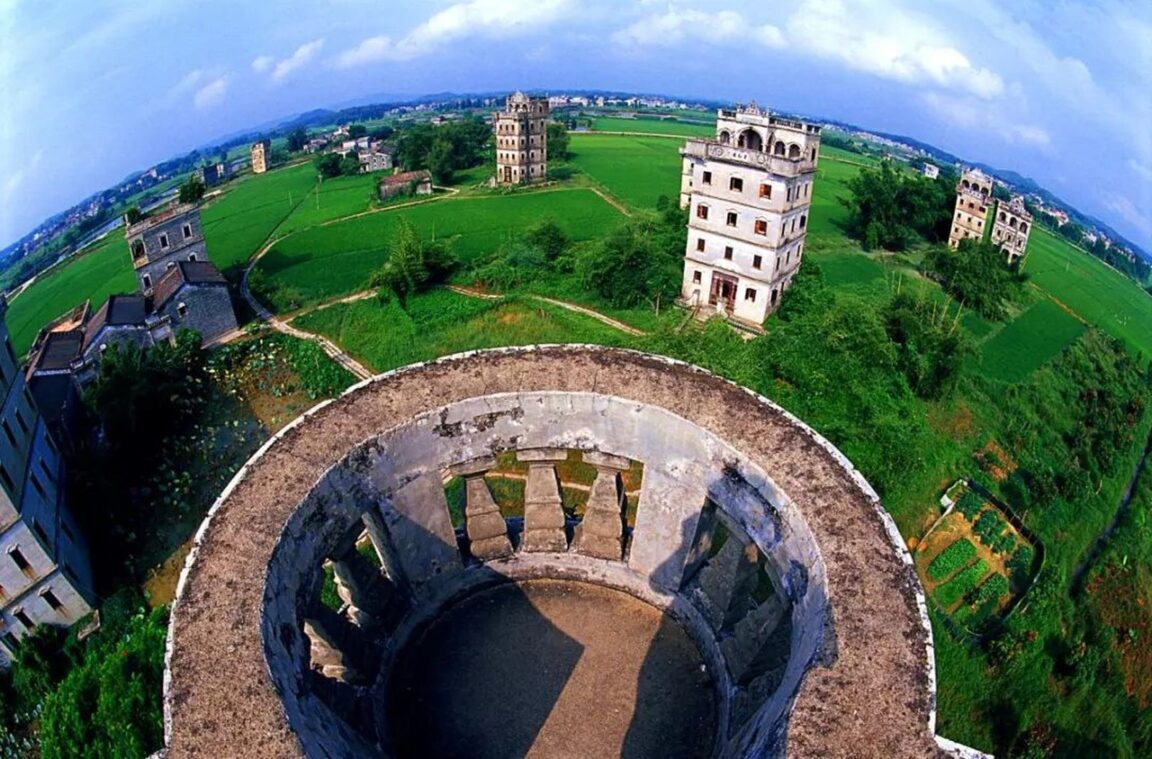
Zili is the cluster that explains all the others, and it is at its best before the tour groups arrive. Founded in 1837 and made up of three Fang family hamlets, the village sets its towers in a working landscape of rice fields and lotus ponds rather than behind a fence, so the first lesson lands immediately: a diaolou was a village house with a defensive job, not a castle. Families built upward because the countryside was rich and raided, and the tower held the household, its grain and its valuables behind thick walls, small windows and an iron door, with the best rooms at the top.
The tower to enter is Mingshi Lou, built in 1925 by Fang Runwen, an overseas Chinese living in Chicago. The Kaiping city government calls it the most exquisite of the Zili towers: five storeys, furnished rooms that show how a remittance household actually lived, and a roof crowned by a six cornered pavilion in glazed tiles from which the whole village, its ponds and its other towers spread out below. That rooftop panorama is the single best orientation in Kaiping. From it you can read the village layout, count the towers and understand why the builders mixed their references so freely, with Greek style columns, Roman arches, Islamic domes and Chinese roof tiles appearing on neighbouring buildings, sometimes on the same one. Allow two hours at Zili, walk the field paths between towers rather than only the paved loop, and climb Mingshi Lou before the midday queues form on its narrow stairs.
What makes Majianglong different?
Majianglong is the same architecture in a different mood, and the contrast is the reason to include it. Where Zili stands open under the sky, the Majianglong villages hide in bamboo. The cluster, built by the Huang and Guan families in the late Qing dynasty and early Republic, backs onto Baizu Mountain and faces the Tanjiang River, and its towers rise out of dense groves along shaded lanes. The city government counts more than 100 traditional dwellings, tower buildings and cottage style villas in the villages. Towers here appear one at a time as you round a bend, their upper floors and watch terraces poking above the bamboo, and the walk between them is as much the attraction as any single interior.
Give Majianglong ninety minutes, wear shoes that cope with damp stone paths, and expect a quieter visit than Zili even in high season. If the day runs short, this is the stop that can be trimmed to an hour without breaking the route. Zili and the Li Garden cannot.
Why does the Li Garden close the day?
Because it changes the question from defence to display. The Li Garden, built in the twentieth century by Xie Weili, an overseas Chinese who had lived in the United States, is a private garden estate: canals, bridges, pavilions and a group of villas and towers arranged as a residence to be enjoyed, not a stronghold to be shut. The city government’s account divides the layout into three self contained areas, a large garden, a small garden and the villa area, separated by artificial rivers and walls and connected by bridge pavilions and corridors. Its best known building, Panli Lou, was built in 1926 and stands three and a half storeys high behind yellow walls and green tiles, with cornices and arches that carry the same East meets West language as the towers, softened into a garden setting.
Late afternoon suits it. The light drops across the canals, the tour buses thin, and the furnished villa interiors read as the domestic end of the emigrant story you started at Zili: money earned in Chicago or San Francisco, sent home across an ocean, and turned into concrete, coloured glass and garden water in a Guangdong village. The qiaopi remittance letters that carried that money are themselves recognised by UNESCO’s Memory of the World register, and the Li Garden is where their destination becomes tangible. Allow ninety minutes to two hours, and do not rush the villa rooms, which hold the furniture, photographs and imported fittings that make these buildings biographies rather than monuments.
How do you move between the clusters?
By road, with the legs planned before you arrive. The clusters are separate villages, not gates of one park, and the day only works if transport is settled in advance. Most day trippers come from Guangzhou: the high speed train from Guangzhou South to Kaiping South takes about an hour, and from Kaiping South a taxi or ride hailing car covers the final stretch to Zili. Driving the expressway from Guangzhou takes roughly two hours. Between Zili, the Li Garden and Majianglong, distances are short but public buses are timed for local life rather than a three stop itinerary, and the official sightseeing shuttles that have linked sites in the tourism zone run to schedules that change by season. The reliable pattern is to hire a car and driver for the day, or chain ride hailing pickups with generous buffers, and to agree the order Zili, Majianglong, Li Garden before setting off.
Two cautions belong in every plan. First, each cluster keeps its own opening hours and last entry, and towers can close for maintenance on individual days, so check the tourism zone’s notices the day before rather than building the route on old listings. Second, the one day version is a highlights route, not the whole heritage site: Jinjiangli, home to the nine storey Ruishi Lou, the tallest diaolou in Kaiping, and Sanmenli, with the Ming dynasty Yinglong Lou, the earliest surviving tower, both sit outside this sequence. Travellers with two days should give them the second morning rather than squeezing a fourth stop into day one and short changing all of them. Entry formalities for China itself are covered in our explainer on China’s visa free entry extension, and the capital’s very different tower free heritage makes a useful contrast in our guide to visiting the Forbidden City.
What should you look for inside a diaolou?
Read each tower in three layers. The base is defensive: thick walls, a heavy iron door, small high windows and, on communal towers, a flood refuge and watch function for the whole village. The middle floors are domestic: bedrooms, ancestral altars and kitchens arranged in a recognisably Chinese plan. The top is expressive: arcaded terraces, corner turrets nicknamed swallow’s nests for their firing positions, domes, pediments and stucco copied from buildings the owner had seen in North America, Australia or Southeast Asia, finished with imported cement, steel and coloured glass. UNESCO inscribed the diaolou precisely for this fusion, and for the completeness of villages that were built quickly, used briefly and left largely unaltered when their families’ lives moved overseas again. Knowing the three layers turns a row of similar towers into twenty individual decisions.
Frequently Asked Questions
Can you visit Kaiping’s diaolou in one day from Guangzhou?
Yes, with an early start. Take a morning high speed train from Guangzhou South to Kaiping South or drive the expressway, then visit Zili, Majianglong and the Li Garden in that order with a hired car or planned ride hailing between clusters. It is a full day, and a second day adds Jinjiangli and Sanmenli comfortably.
Which diaolou cluster should you see if you only have time for one?
Zili Village. Its towers stand in open rice fields and lotus ponds, and the furnished Mingshi Lou of 1925, with its rooftop pavilion, explains both the defensive purpose and the emigrant wealth behind the diaolou better than any single building elsewhere.
How many diaolou are there in Kaiping?
About 1,833 survive across the Kaiping countryside. UNESCO’s 2007 World Heritage listing covers four village groups, Sanmenli, Zili, Jinjiangli and the Majianglong cluster, with twenty inscribed towers representing the wider landscape.
Is the Li Garden part of the World Heritage listing?
The Li Garden belongs to the Kaiping Diaolou Cultural Tourism Zone alongside the listed clusters, and it is an emigrant garden estate rather than one of the four inscribed village groups. It is included in this route because it completes the story, showing how returned overseas Chinese built for pleasure as well as defence.
What is the best order for Zili, Majianglong and the Li Garden?
Zili first, in the morning, for clear views and the Mingshi Lou climb before queues build. Majianglong second, when its bamboo shade is most welcome. The Li Garden last, for late light on the canals and a slower look at the furnished villas.
Do the clusters share one ticket?
Each cluster is ticketed separately, and combination tickets covering several sites in the tourism zone are sold at the gates. Prices, hours and last entry times change by season, so confirm the current details on the tourism zone’s official notices before you travel.
Photo: Kaiping Municipal Government, via kaiping.gov.cn, the Kaiping city official website, used with credit.