 Wei Chen
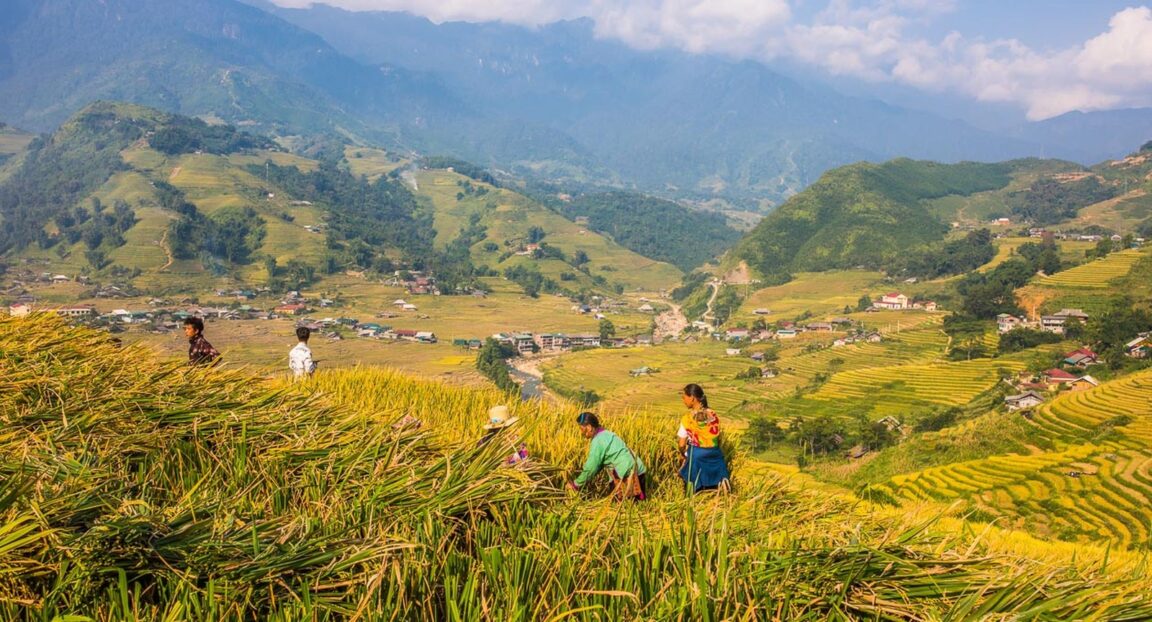
Sapa is worth more than the terrace viewpoint on the road out of town. The trip that repays planning walks down into the Muong Hoa valley, through the Black Hmong villages of Y Linh Ho and Lao Chai to the Giay village of Ta Van, following the Muong Hoa stream past terraces that climb both walls of the valley. Add one honest decision about Fansipan, the 3,143 metre peak above the town: the Sun World cable car turns a two day climb into a half day ride, at a real price and with a real weather risk. And if your dates include a Sunday, the region’s biggest market is not in Sapa at all. It is at Bac Ha, about 100 kilometres east, and it takes the whole morning to do properly. This guide sequences those three pieces so they support each other instead of competing for the same tired legs.
Quick Facts
- Base: Sapa town, Lao Cai province, in Vietnam’s northern highlands near the Chinese border, reached from Hanoi by overnight train to Lao Cai or by expressway bus.
- The valley: the Muong Hoa valley runs southeast of town, with a stream of about 15 kilometres passing the villages of Y Linh Ho, Lao Chai and Ta Van.
- The classic walk: Sapa to Ta Van through Y Linh Ho and Lao Chai is roughly 12 kilometres, mostly downhill, and usually walked in five to seven hours with stops.
- Fansipan: the summit marker reads 3,143 metres; a 2019 survey measured 3,147.3 metres. It is the highest peak in Vietnam and Indochina.
- Cable car: the Sun World Fansipan Legend cable car runs 6,292.5 metres, climbs 1,410 metres and holds two Guinness World Records for a non stop three rope cable car.
- Cable car price: 850,000 dong return for adults and 550,000 dong for children between 1 metre and 1.4 metres tall, with children under 1 metre free, on the operator’s current published pricing. The Muong Hoa mountain train and the summit funicular are charged separately.
- Market day: Bac Ha market runs on Sundays only, from early morning until around 1pm, about 100 kilometres and roughly two and a half hours by road from Sapa.
- Seasons: Vietnam’s national tourism authority points to September to November for clear autumn skies and March to May for mild spring weather.
How should you walk the Muong Hoa valley?
Walk it in one direction, downhill, and arrange a ride back. The standard route leaves Sapa on the valley road, drops to Y Linh Ho, a Black Hmong village below the first big terrace walls, then follows the stream to Lao Chai, the largest Black Hmong village on the route, and ends at Ta Van, a Giay village with the valley’s deepest stock of family homestays. The walking is on a mix of road, concrete path and field tracks between terrace walls. After rain those tracks are mud, and the descent that looks gentle on a map is slippery in trainers. Boots or trail shoes with grip are the right call in any month.
Hire a local guide in town rather than following a coach group. The route is not formally waymarked, side paths branch to individual hamlets, and a guide from the valley communities turns a scenic walk into an intelligible one: which terraces belong to which family, when the rice was planted, and why the carved boulders of the ancient rock field near the valley floor matter. Those boulders, scattered along the route, carry carvings recorded by researchers since the 1920s, and they are easy to walk straight past without someone pointing at the right stone. Village entry checkpoints on the route collect small fees, so carry small notes in dong rather than relying on card payment anywhere in the valley.
Decide in advance whether Ta Van is your finish or your bed. Staying the night in a homestay splits the valley into two humane days, gives you the terraces in early morning light before day walkers arrive, and puts money directly into a village household. Walking out and riding back to Sapa the same day keeps hotel comforts but compresses the best light into the middle of the day, when the terraces photograph flattest. Neither is wrong. What does not work is starting after lunch: the route has little shade, the last stretch into Ta Van is exposed, and you will be negotiating the ride back in fading light.
Which villages repay the slowest pace?
Lao Chai repays an hour, not a photo stop. It is a working Black Hmong village strung along the stream, and the indigo dyed cloth, the embroidery cooperatives and the school run give it a daily rhythm that has nothing to do with visitors. Buy textiles here rather than in town if you buy them at all: the price conversation happens with the maker, and the range of hand stitched work is wider than the market stalls in Sapa. Ta Van, by contrast, is where the valley exhales. The Giay village sits where the terraces widen, its homestays face the stream, and the evening routine of cooking, bathing in the river shallows in summer and planning the next field day is the closest a short trip gets to valley life at its own speed.
Cat Cat, the Hmong village about two to three kilometres below town, is a different proposition: paved, ticketed and busy, with a waterfall and an old French era hydroelectric station at its base. With only an afternoon free it is a reasonable walk, but as a substitute for the Muong Hoa valley it is not. If your time forces a choice, choose the valley every time.
Is the Fansipan cable car worth it?
For most visitors, yes, once, in clear weather, and the honesty is in the conditions. The cable car, opened in February 2016 and operated by Sun World Fansipan Legend, crosses the Muong Hoa valley in a single 6,292.5 metre span and climbs 1,410 metres in about 15 to 20 minutes. From the top station a climb of roughly 600 steps, or a paid summit funicular, reaches the summit marker and the temple complex near the top. The whole journey from town has three legs: the Muong Hoa mountain train from Sun Plaza in the town centre to the cable car station, or a short taxi ride; the cable car itself; then the steps or funicular. Each leg beyond the cable car is ticketed separately, which is why the headline 850,000 dong is never the final bill for the full town to summit trip.
The clock matters more than the price. On the operator’s published schedule, weekday ascents start at 8am and last boarding can be as early as 2.30pm, with the last cabin down between about 4pm and 5pm depending on the day. This is a morning attraction. It is also a weather gamble: the summit sits more than 1,600 metres above Sapa town, cloud that is decorative in the valley is a whiteout at the top, and the operator warns the summit runs far colder than town, dropping below freezing in winter months. Check the summit camera and the day’s operating notice before buying, dress for a different climate, and keep a second morning in reserve if the peak is the point of your trip. Travellers with altitude sensitivity should also note that the ride gains its height in minutes, with no acclimatisation built in.
The trek remains the other answer: climbing Fansipan on foot from Tram Ton Pass is a guided one to two day undertaking requiring a licensed guide and park arrangements, and it earns the summit in a way the cabin does not. Never stack it directly against the Muong Hoa walk and expect to enjoy the second.
Practical preparation for either version starts before Sapa. Our guide to Vietnam’s 90 day e-Visa covers the entry paperwork most visitors now use, and our Hanoi in four days itinerary shows how to give the capital its due on the way north instead of treating it as a transit corridor.
How do market days change the plan?
The highland markets run on a weekly wheel, and the wheel decides your itinerary more than any hotel does. Bac Ha, the largest and best known, trades on Sunday. Flower Hmong traders, named for the saturated embroidery of their dress, dominate its cloth and clothing sections, and the market’s real business runs from livestock pens and horse trading to forged tools, seed, tobacco and the food stalls that feed the traders themselves. It is a working market that visitors watch from the edges, and it rewards exactly that posture: arrive early, walk the livestock and produce sections before the textile lanes, eat what the stalls are cooking for locals, and photograph people only with permission.
Getting there is the commitment. Bac Ha lies about 100 kilometres from Sapa, roughly two and a half hours each way on mountain roads, so a Sunday at Bac Ha means leaving before dawn and writing off the rest of the day for anything strenuous. Shared minibus tours and private cars both run the route; a private car earns its premium on the return leg, when you can leave as the market thins around midday rather than on a group’s schedule. Can Cau market, further north near the Chinese border, trades on Saturdays and is smaller and less visited, a genuine alternative if your Sunday is already claimed. Sapa’s own town market trades daily and is useful for supplies, but it is not a substitute for either.
Sequence the stay around these fixed points: the Muong Hoa walk on day one, Fansipan on the first clear morning after it, and Bac Ha on the Sunday wherever it falls. Travellers with no Sunday in their dates should give the freed day to a homestay night in Ta Van instead.
When do the terraces look their best?
The valley has three distinct faces. In late spring the flooded terraces mirror the sky during transplanting. Through summer the rice grows deep green, with the heaviest rain and the muddiest paths. In September and into October the crop ripens hamlet by hamlet into gold, the harvest window most photographs are taken in, and homestays and guides for those weeks book out first. Winter is the quiet season: bare terraces, cold mist and the fewest visitors.
Frequently Asked Questions
How long does the Muong Hoa valley walk take?
The classic Sapa to Ta Van route through Y Linh Ho and Lao Chai is roughly 12 kilometres and takes most walkers five to seven hours including village stops and lunch. It is mostly downhill, and a car or motorbike ride back from Ta Van is easily arranged.
How much is the Fansipan cable car in 2026?
The operator’s published return price is 850,000 dong for adults and 550,000 dong for children from 1 metre to 1.4 metres tall, with children under 1 metre free. The Muong Hoa mountain train from town and the summit funicular cost extra, and prices can change for holidays, so check the operator’s site before you go.
What day is Bac Ha market?
Sunday. Trading starts early in the morning and thins by around 1pm. It is about 100 kilometres and roughly two and a half hours by road from Sapa, so plan it as a full day trip with a pre dawn start.
Do I need a guide for the Muong Hoa valley?
The route is not formally waymarked and side paths branch to smaller hamlets, so a local guide is strongly recommended. Guiding also supports valley households directly, and a good guide explains the terrace farming, textiles and carved rock field that are easy to miss alone.
When is the best time to visit Sapa?
Vietnam’s national tourism authority highlights September to November for clear skies and the golden harvest, and March to May for mild spring weather. Summer brings lush green terraces with heavy rain, and winter is cold and misty with the fewest visitors.
Can I climb Fansipan on foot instead?
Yes. The climb from Tram Ton Pass takes one to two days with a licensed guide and park arrangements. It is a demanding mountain trek, best kept separate from the Muong Hoa valley walk rather than stacked on the following day.
Photo: Vietnam National Authority of Tourism, via vietnam.travel, the official Vietnam tourism website, used with credit.