 Jordan Ellis
Beaufort, South Carolina earns its own nights rather than a pause between Charleston and Savannah. The case is built street by street: a historic district called the Point, where antebellum houses stand behind wide porches and live oaks; a working waterfront park on the Beaufort River where the day ends with shrimp boats and sunset; and, a short drive across the marsh on St. Helena Island, the Penn Center, one of the most significant African American historic sites in the United States and the natural starting point for Gullah-Geechee tours led by local guides. Add the Reconstruction Era National Historical Park visitor center on Craven Street, a Bay Street dining strip that takes shrimp and grits seriously, and a town scale that lets you walk almost everything, and Beaufort stops being a stopover. This guide builds the visit in the order a traveller basing here would actually use it: the Point first, then the history, then the water, then the table.
Quick Facts
- Where: On Port Royal Island in the South Carolina Lowcountry, roughly an hour’s drive from Savannah and about ninety minutes from Charleston
- Historic core: The Point, Beaufort’s old residential district of antebellum houses, wide porches and oak lined streets
- Reconstruction Era visitor center: 706 Craven Street, open daily 9 a.m. to 5 p.m., no admission fee
- Penn Center, St. Helena Island: York W. Bailey Museum open Tuesday to Saturday, 10 a.m. to 4 p.m., with docent tours at 10 a.m., 12 p.m. and 3 p.m.
- Waterfront: Henry C. Chambers Waterfront Park on the Beaufort River, along Bay Street
- Order to eat: Shrimp and grits, she-crab soup and a Lowcountry boil, the local combination of shrimp, sausage, corn and potatoes
- Best base logic: Stay in or beside the historic district and walk; drive only for St. Helena Island and Hunting Island
Why does the Point make the case for staying?
Beaufort was founded in 1711, making it one of South Carolina’s oldest towns, and its residential heart, the Point, preserves the wealth that sea island cotton built before the Civil War in the most legible form in the Lowcountry: large houses set in gardens, raised on high foundations against the tides, fronted by the wide shaded porches that give this guide its shorthand for the town. Streets such as Craven, Bay and the lanes running down toward the river are best read on foot and slowly. The architecture is the attraction, but so is the continuity: these are lived in streets, not a museum quarter, and the etiquette follows from that. Admire from the pavement, photograph from the street, and let the porches stay private.
The Point also explains Beaufort’s unusual Civil War story. Union forces occupied the town early in the war, in November 1861, and held it throughout, which is why so much of the building stock survived intact while other Southern towns burned. That occupation turned Beaufort into an unlikely centre of emancipation history, a thread the town now interprets formally through the Reconstruction Era National Historical Park, and it is the reason a walking day here moves naturally from beautiful houses to some of the most important ground in American history. Travellers who like small towns whose history is still legible in the street plan will find a useful comparison in our guide to Lewisburg, West Virginia, another small town that rewards walking its old streets in order.
Where does the Reconstruction story get told?
Start at the Reconstruction Era National Historical Park visitor center at 706 Craven Street, in the old firehouse in the heart of the historic district. It is open daily from 9 a.m. to 5 p.m. and charges no admission fee, which makes it the easiest first stop in town: rangers orient visitors to the park’s sites, which interpret the period after the Civil War when formerly enslaved people in the Sea Islands built schools, bought land and voted, years before most of the South. Beaufort’s chapter of that story began with the Port Royal Experiment during the occupation, and the visitor center gives the context that makes the rest of the town, including the Point’s beautiful houses, read honestly rather than decoratively.
Then cross the river and the marsh to St. Helena Island for the Penn Center, founded in 1862 as one of the first schools for formerly enslaved people in the South and now a campus of historic buildings at the centre of Gullah-Geechee cultural preservation. Its York W. Bailey Museum is open Tuesday to Saturday from 10 a.m. to 4 p.m., with docent tours at 10 a.m., 12 p.m. and 3 p.m., and the tours are the right way to do it: the buildings and grounds carry far more meaning with the school’s story, and its later civil rights era history, told in sequence. Plan the island as a half day, not a detour, and note the closed days before you set the itinerary, because the museum’s Tuesday to Saturday pattern catches out travellers who save it for a Sunday or Monday.
How do Gullah-Geechee tours fit into a visit?
The Lowcountry’s Gullah-Geechee culture, the language, foodways, craft and faith traditions of the descendants of West and Central Africans enslaved on the sea island plantations, is not background colour in Beaufort; it is one of the main reasons to come. The respectful way in is through tours and interpretation led by local Gullah-Geechee guides, whose narration connects the Penn Center and St. Helena’s praise houses and family compounds to the rice and cotton landscape that produced them, and who speak about their own community rather than performing it. Book a locally led tour early in the stay if you can: the context changes how you hear the language in a restaurant, how you read a sweetgrass basket at a market stall, and how the shrimp and grits on your plate got there. The Penn Center is the anchor, but leave time on St. Helena simply to drive its oak shaded roads slowly, because the island’s rural landscape is itself part of the heritage the tours describe.
What do the waterfront and the evenings add?
Henry C. Chambers Waterfront Park gives Beaufort something many prettier towns lack: a front porch of its own. The park runs along the Beaufort River below Bay Street, with lawns, swings and a marina, and it organises the town’s evenings. The pattern that works is simple: a late afternoon walk through the Point while the light is on the houses, dinner on or just off Bay Street, then the waterfront for sunset over the river and the Woods Memorial Bridge. The river here is tidal and serious, with a range that transforms the marsh twice a day, and watching the water move through the grass at low tide is the Lowcountry’s essential spectacle, free and twice daily. Travellers with a spare half day can add Hunting Island State Park, a short drive east, for the beach and its lighthouse; it is the natural counterweight to two days of history, and its wild, undeveloped shoreline shows what the sea islands looked like before any of the towns.
What should you eat, and where does the shrimp and grits trail lead?
Lowcountry cooking is the region’s other archive. Shrimp and grits is the dish to order first and judge places by: local shrimp over stone ground grits, the sauce varying from a light butter and lemon treatment to a deep gravy with sausage or tasso. She-crab soup, rich with crab roe and a touch of sherry, is the classic starter. The Lowcountry boil, called Frogmore stew locally after a St. Helena community, piles shrimp, smoked sausage, corn and potatoes together and belongs to a group and an outdoor table. Bay Street and its side streets hold the town’s dining rooms within a few walkable blocks, so the trail is an easy one to walk: a different kitchen each night, the waterfront a few steps away for the walk afterwards. Food travellers building a Southern trip around regional dishes will find a kindred approach in our Santa Fe chile food guide, which treats one ingredient the way Beaufort treats shrimp.
How many days does Beaufort need?
Two nights is the minimum that does the town justice: one day for the Point, the visitor center and the waterfront, one for St. Helena Island and the Penn Center, with evenings on Bay Street. Three nights adds Hunting Island or a boat trip into the estuary without rushing the history. That arithmetic is exactly why Beaufort outperforms its stopover reputation. Savannah, an hour south, is the grander city, but Beaufort offers the Lowcountry at walking scale, with the Reconstruction story told where it happened and a community, Gullah-Geechee St. Helena, that is a destination in its own right. Base here, day trip if you must, and let the bigger city be the excursion for once.
Frequently Asked Questions
Is Beaufort, South Carolina worth more than a day trip from Savannah?
Yes. The Point’s historic streets, the Reconstruction Era sites and an evening on the waterfront fill one day, and St. Helena Island and the Penn Center need another. Basing in Beaufort for two or three nights reverses the usual trip in a way most travellers prefer once they try it.
What are the Penn Center museum hours and tour times?
The York W. Bailey Museum at the Penn Center on St. Helena Island is open Tuesday to Saturday, 10 a.m. to 4 p.m., with docent tours at 10 a.m., 12 p.m. and 3 p.m. It is closed on Sundays and Mondays, so schedule the island day accordingly.
Where is the Reconstruction Era visitor center and what does it cost?
At 706 Craven Street in Beaufort’s historic district. It is open daily from 9 a.m. to 5 p.m. and admission is free, making it the natural first stop for orientation.
What is the Point in Beaufort?
The Point is Beaufort’s historic residential district, a walkable quarter of antebellum houses with wide porches, set among live oaks near the river. It survived because Union forces occupied Beaufort from 1861 and held it through the Civil War.
What food is Beaufort known for?
Lowcountry dishes: shrimp and grits above all, she-crab soup, and the Lowcountry boil known locally as Frogmore stew, made with shrimp, sausage, corn and potatoes. Bay Street’s restaurants serve all three within a short walk of the waterfront.
How do I experience Gullah-Geechee culture respectfully?
Go through the Penn Center on St. Helena Island and take tours led by local Gullah-Geechee guides, who interpret their own community’s history, language and traditions. Book early in your stay, because the context enriches everything else you will see and eat in the Lowcountry.
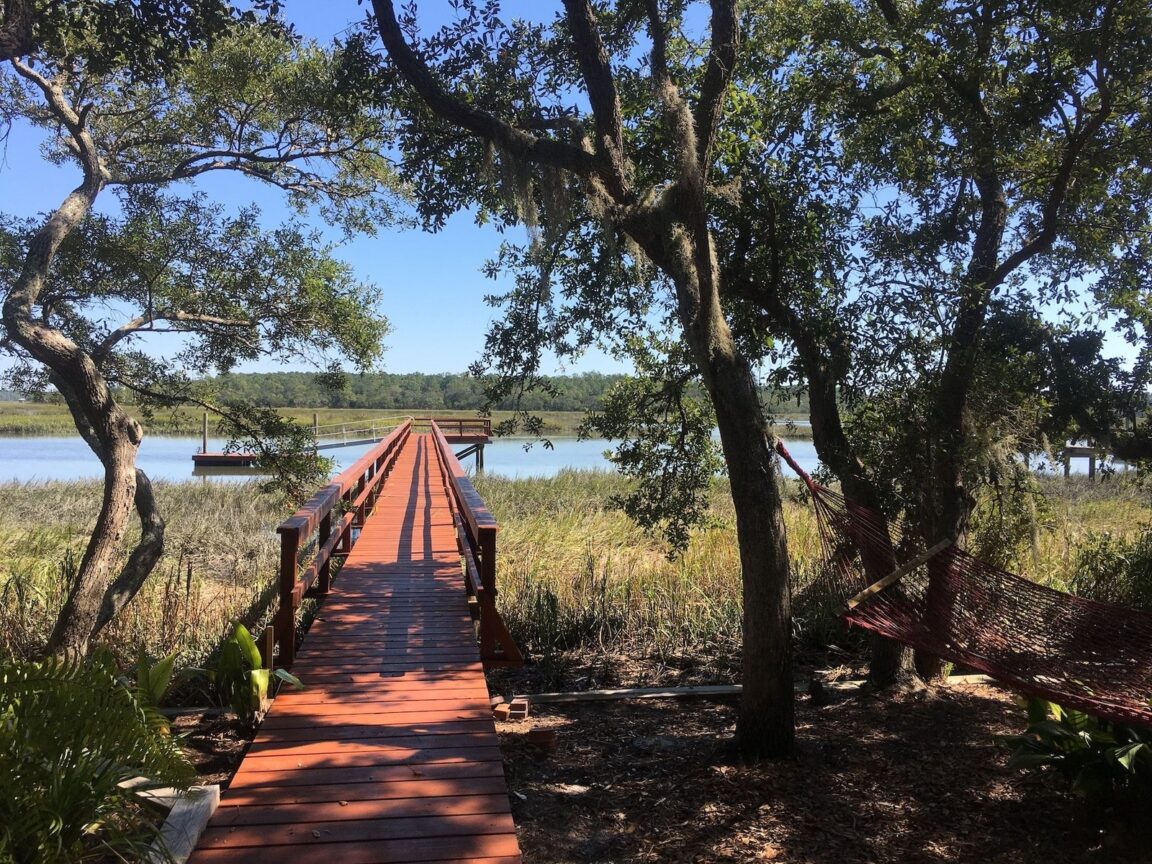
Image credit: A dock over the tidal marsh at Beaufort, South Carolina. Photo by Dennis Derringer, via Unsplash, Unsplash License. Hours checked against the National Park Service and the Penn Center on 25 November 2026.