 Thandiwe Nkosi
Chintheche is the deliberate choice on Lake Malawi’s western shore: a string of fishing villages and small lodges along a broad white sand beach in Nkhata Bay District, roughly 40 kilometres south of Nkhata Bay town, chosen by travellers who want the lake’s clear water and village life without the backpacker density of Cape Maclear in the south. The pattern of a Chintheche day is set by the lake itself. Mornings are calm, and that is when to swim, snorkel and take boats out; the afternoon wind gets up across the water and the lake turns choppy, which is when the beach, the villages and the mission history along the shore road earn their place. This guide covers how to order that day, what the Bandawe Mission stop actually is, how trips with local boatmen work, and the health and visa facts to settle before travelling, checked against Malawi’s official sources and the lodges that operate on this shore.
Quick Facts
- Where: Chintheche, on the western shore of Lake Malawi in Nkhata Bay District, northern Malawi, about 40 km south of Nkhata Bay town, 90 km from Mzuzu and 350 km north of Lilongwe, per the shore’s long established lodge listings.
- What it is: A beach village strip of small lodges, campsites and fishing villages, regularly counted among the finest beaches on Lake Malawi for its white sand and clear water.
- The morning rule: Swim, snorkel and boat in the morning calm. The wind builds across the lake most afternoons and the water roughens.
- Best season: The dry season, May to October, for settled weather, calm mornings and the clearest water.
- The history stop: Bandawe Mission, a short drive south, one of the earliest Livingstonia Mission stations in Malawi, with its church and missionary graves.
- Health note: The US Centers for Disease Control and Prevention identifies Lake Malawi among the places where travellers acquire schistosomiasis, also called bilharzia. Read the health section and take a travel clinician’s advice before swimming.
- Getting there: Road transfer from Lilongwe or Mzuzu. The shore’s lodges list about 1.5 hours from Mzuzu and around 5 hours from Lilongwe by road.
Why Choose Chintheche Over the Cape
Lake Malawi’s two famous shores pull different crowds. Cape Maclear, inside Lake Malawi National Park at the southern end, has the national park islands, the dive schools and a busy traveller scene. Chintheche, hours north, has a longer, quieter beach, a working fishing economy in plain view, and lodges spaced along the sand rather than clustered in one village strip. The choice is deliberate rather than second best: travellers who come here tend to be staying longer, swimming from their own beach, walking to neighbouring villages and using the shore as a base for the north, including Nkhata Bay’s harbour and craft market to the north and the Bandawe Mission to the south.
The beach itself justifies the drive. The sand is pale and soft, the shore shelves gently, and the water in the dry season is the clear, warm, blue green that gives Lake Malawi its aquarium reputation. The lake holds more fish species than any other lake on earth, most famously its cichlids, and the rocky patches along the Chintheche shore are where snorkellers go looking for them. What Chintheche does not have is a party strip or a long menu of restaurants; evenings here are lodge dinners, fires on the beach and the sound of the lake, which is the point.
The Morning Calm Rule, and How a Chintheche Day Orders Itself
The single most useful piece of local knowledge is the wind. Lake Malawi’s surface is typically at its calmest in the morning, and on most days a wind builds from late morning into the afternoon, raising a chop that makes small boat work uncomfortable and swimming less pleasant. Local boatmen plan around it instinctively, and visitors should copy them. Put every water activity in the first half of the day: the snorkel trip to the rocks, the dhow or motorboat run along the shore, the kayak paddle and the long swim. Breakfast early, be on the water by eight, and be back on the sand before the breeze freshens.
The afternoon then belongs to the shore. This is the time for the village walk, the cycle along the beach road, the Bandawe Mission visit and the slow hours in the shade, and it ends with the fishing fleet going out at dusk, the boats’ lights appearing across the water after dark in the pattern that gave Lake Malawi its old name, the Lake of Stars. Travellers who reverse the order, sleeping late and boating at three in the afternoon, meet a different and rougher lake and usually conclude, wrongly, that Chintheche is windy. It is, in the afternoons, by design of the place; the mornings are the compensation, and they are generous.
Bandawe Mission and the Village Stops Along the Beach Road
A short drive south of Chintheche, the Bandawe Mission is one of the most significant small historical sites on the northern lakeshore. It was an early station of the Livingstonia Mission, the Scottish mission founded in the spirit of David Livingstone, and it is associated with Dr Robert Laws, the mission’s defining figure, whose first attempt at a lakeshore station was made here before the mission’s centre of gravity settled at Bandawe and later at Livingstonia in the hills above the lake. What remains and rewards a visit is the mission church and the graves of missionaries who died at the station in its hard early years, a quiet, moving record of what establishing the mission cost. The church remains a living congregation’s building rather than a museum; visits are informal, and leaving a small donation to the congregation is the customary courtesy recorded by Malawi travel guides.
Between the lodges, the beach road runs through fishing villages whose life is the shore’s real texture: nets drying and being mended on the sand, dugout canoes drawn up under the trees, fish laid out to dry, and children swimming at the village beaches. Lodge run village visits, including calls on the local chief, are the structured way in, and Chintheche’s established lodges list them among their included activities, alongside mountain bike rides through the villages. On foot or by bicycle, the etiquette is the standard one for rural Malawi and worth stating: greet people, ask before photographing anyone, dress modestly away from the beach itself, and buy something, however small, from the stalls and carvers whose work you stop to admire.
Boats, Snorkelling and Booking With Local Boatmen
The water activities at Chintheche are arranged at village scale. Lodges keep kayaks and snorkelling gear, and boat trips, from short runs along the shore to longer excursions, are crewed by local boatmen who know the rocks, the weather and the morning rule by inheritance. The established lodge activity lists for this shore include kayaking, snorkelling, village visits and boating as core offers, with day trips to Nkhata Bay and the Bandawe Mission arranged on request. The practical way to book is through your lodge on arrival, agreeing the trip, the price, the departure time and the life jacket question before money changes hands, and taking the boatman’s weather call as final: if he says the afternoon is not for the water, he is right.
Two seasonal details belong in the plan. Fishing on the lake observes a closed season during the main breeding period, which lodge information for this shore gives as October and November, when fishing is restricted; visitors arranging fishing trips in those months should expect limits and ask locally what is permitted. And the lake’s clarity, the thing snorkellers come for, is at its best in the dry season months, roughly August to December on Malawi Tourism’s published pattern, with the settled mornings of May to October the most reliable all round window.
Health, Visas and the Facts to Settle Before You Go
Lake Malawi’s one serious health caveat has a name: schistosomiasis, or bilharzia, a parasitic infection acquired through skin contact with infested fresh water. The US Centers for Disease Control and Prevention identifies Lake Malawi specifically among the settings where travellers have acquired it, and clear looking water is not evidence of safety. This guide’s position is the standard, honest one: many visitors swim in Lake Malawi every year, the lodges can tell you where local practice swims, and the decision should be made with the CDC’s warning in front of you and, ideally, a travel health consultation before the trip, with testing after exposure commonly timed at six to eight weeks where a clinician advises it. A lodge pool, where one exists, is the zero exposure alternative.
Malawi’s entry rules changed at the start of 2026, with the government eVisa system distinguishing travellers who need approval before departure from those eligible for a visa on arrival, and official pages listing differing single entry fees, so the only safe procedure is to check your own nationality’s position on the official eVisa portal, evisa.gov.mw, before travelling and to work through our Malawi eVisa guide and our Lilongwe arrival briefing alongside it. Malaria is present in Malawi, including the lakeshore, so prophylaxis advice and a net at night are part of the same pre trip conversation with a clinician.
Frequently Asked Questions
Where is Chintheche?
On Lake Malawi’s western shore in Nkhata Bay District, northern Malawi, about 40 km south of Nkhata Bay town, 90 km from Mzuzu and 350 km north of Lilongwe, per the shore’s lodge listings.
When is the best time to visit Chintheche?
The dry season, May to October, for calm mornings, settled weather and clear water. The rains run roughly from November to April, and the lake’s fishing closed season falls in the October to November breeding period.
Why swim in the morning at Chintheche?
Because the lake is calmest then. A wind builds across Lake Malawi on most afternoons, raising a chop that makes boating and swimming less pleasant. Local boatmen schedule water activities in the morning for exactly this reason.
What is the Bandawe Mission?
One of the earliest Livingstonia Mission stations in Malawi, a short drive south of Chintheche, associated with Dr Robert Laws. Its church and missionary graves survive; it remains a living congregation, visits are informal, and a small donation is customary.
Is it safe to swim in Lake Malawi?
The CDC identifies Lake Malawi among places where travellers acquire schistosomiasis (bilharzia), which is caught through skin contact with infested fresh water. Take travel health advice before deciding, and ask locally; testing after exposure is commonly timed at six to eight weeks where a clinician advises it.
How do I book boat and snorkel trips at Chintheche?
Through your lodge, which works with local boatmen and holds kayaks and snorkelling gear. Agree the trip, price, morning departure and life jackets in advance, and accept the boatman’s weather judgement on the day.
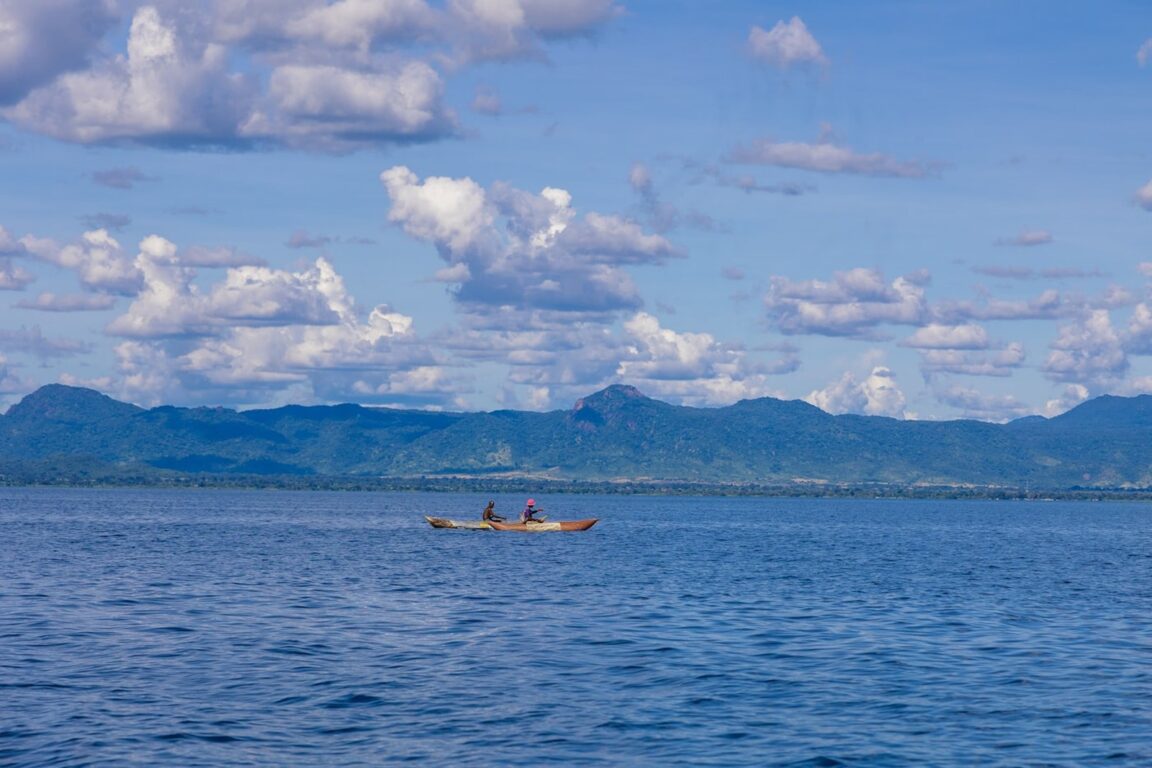
Featured image: Fishermen in dugout canoes on the open water of Lake Malawi, with the far shore hills behind. Photo: Craig Manners, via Unsplash, Malawi gallery at Famous Africa.