 Priya Nair
A woman trekking solo in Nepal is not, under the current rules, trekking unguided: since 31 March 2023 the Nepal Tourism Board has required foreign trekkers on its listed routes in protected areas, including the Annapurna and Langtang treks named in this guide, to be accompanied by a licensed trekking guide and to carry a TIMS card issued through a government registered trekking agency. Solo means travelling as the only client, with your own guide. The teahouse system then does the rest: a bed, a hot meal and a dining room full of other trekkers every night, on trails where the practical questions are about checkpoints, etiquette and altitude, not about camping alone.
That distinction, solo client versus unguided walker, is the single most misunderstood point in Nepal trekking today, and getting it right before you book changes everything downstream: which agency you hire, what the TIMS card costs, what happens at the permit checkpoints, and how a woman travelling alone is actually positioned on the trail, accompanied by a licensed professional whose job includes her safety.
Quick Facts
- The rule: Revised TIMS provision effective 31 March 2023 (Nepal Tourism Board). Listed routes in protected areas require a licensed guide and an agency issued TIMS card.
- Routes covered here: Annapurna Circuit, Poon Hill to Annapurna Base Camp, Khopra, Mardi Himal and Sikles in the Annapurna region; Langtang, Tamang Heritage and Gosaikunda in the Langtang region.
- TIMS cost (NTB): NPR 2,000 for most foreign trekkers, NPR 1,000 for SAARC nationals, arranged through a registered agency.
- Annapurna Conservation Area entry (NTB): Listed at NPR 2,000 per entry for foreigners. Langtang is a national park entry permit, bought at Kathmandu or at the Dhunche checkpoint. Always confirm current fees before you travel, as schedules change.
- Teahouse basics: Family run lodges with a communal dining room, simple twin rooms, shared bathrooms at altitude, menus in English, and charging and hot showers usually for a small fee.
- Best seasons (NTB): March to May and September to November for the Annapurna region.
What does the guide requirement mean for a woman travelling alone?
It means hiring well. Your guide must hold a government trekking guide licence and be engaged through a registered agency, which is also the channel that issues your TIMS card; independent trekkers can no longer buy that card themselves. Within that structure you have real choices, and they matter more than any other decision on the trip. Ask agencies directly about women guides: Nepal has a growing number of licensed female trekking guides, and many women travelling solo prefer one, both for comfort in teahouse settings and for the straightforward companionship of the trail. Ask, too, who your porter or porter guide will be, what insurance the agency carries for its staff, and how the agency handles an evacuation decision.
Being a solo client has practical advantages that group trekkers give up. You set the pace, which is the single best protection against altitude sickness; you choose rest days; and your guide’s attention is undivided at checkpoints, in teahouse negotiations and on the one or two genuinely exposed sections of trail. The cost is higher per head than splitting a guide across a group, and that is the honest trade: privacy, pace and a dedicated professional, at a solo price.
How do teahouses work, and what is the etiquette?
A teahouse is a family home extended into a lodge: a dining room around a stove, a menu that runs from dal bhat to noodles and pancakes, bedrooms that are simple, often twin bedded with shared bathrooms, and a nightly rhythm in which everyone eats, charges their phones and sleeps early. The standing etiquette is economic as much as cultural. Rooms are priced cheaply on the understanding that you eat your meals in the house; ordering dinner and breakfast where you sleep is the deal that keeps the system alive, and dal bhat, with its free refills, is both the best value and the fuel the guides and porters choose themselves.
For a woman travelling alone, teahouse norms work in your favour. The dining room is a social, family space where solo travellers are unremarkable, alcohol fuelled late nights are rare at altitude, and the family running the house notices its guests. Take a room with a door that bolts, as most do, mention your presence to the owners on arrival, and let your guide handle any arrangement that feels off; adjusting rooms or moving to the next lodge is a normal, unembarrassing transaction on a teahouse trail. Dress respectfully in villages, as you would in any conservative rural community: covered shoulders and knees off the trail go a long way.
Where are the permit checkpoints on the Annapurna and Langtang trails?
On the Annapurna routes, expect your conservation area permit and TIMS details to be checked at the entry points and at staffed checkpoints along the trail, including the well known posts on the approaches to the circuit and the base camp trail, where details are logged as you pass. Carry your passport, permits and TIMS card together in a waterproof pouch, and expect the same documents to be requested again at later posts; the system tracks trekkers for safety as much as for revenue. In Langtang, permits are checked at Dhunche, the trailhead town reached by road from Kathmandu, and again within the park.
Buy paperwork through your agency in Kathmandu or Pokhara before you leave, and photograph every document as a backup. Restricted areas are a separate world: regions such as Upper Mustang and Manaslu sit under Department of Immigration permits with their own agency and guide rules, and are not covered by the standard TIMS arrangements described here. If your ambitions extend there, that is a different application, made in Kathmandu, and your agency will tell you so. Walkers planning a longer Himalayan season may also want our high altitude packing logic in the safari duffel system guide, which adapts well to porter weight limits, and the long distance trail craft in our Lycian Way trekking guide for comparison with a very different lodge to lodge culture.
How should a solo woman plan safety, altitude and communication?
Altitude is the risk that does not care about confidence. The Annapurna Circuit crosses the Thorong La at 5,416 metres and base camp treks sleep above 4,000 metres; Langtang’s Kyanjin Gompa sits near 3,870 metres with higher viewpoints above it. Build acclimatisation days into the itinerary rather than treating them as spare days, climb high and sleep low where the route allows, and agree with your guide before departure that their call on turning around is final. Travel insurance that explicitly covers trekking to your maximum altitude and helicopter evacuation is not optional equipment.
Communication is patchy by design. Local SIM cards work in most trail towns, teahouses sell charging and sometimes Wi Fi, and leaving a copy of your itinerary, agency details and checkpoint dates with a contact at home closes the loop. None of this is specific to women; what is specific is that the guided structure Nepal now requires puts a licensed professional beside a solo traveller at every one of these decision points, which is precisely what the rule was designed to do.
Frequently asked questions
Can a woman trek solo in Nepal without a guide?
Not on the listed routes. Under the Nepal Tourism Board provision in force since 31 March 2023, foreign trekkers on listed routes in protected areas, including the main Annapurna and Langtang treks, must trek with a licensed guide and carry an agency issued TIMS card. You can be the guide’s only client.
How much is the TIMS card?
The Nepal Tourism Board lists NPR 2,000 for most foreign trekkers and NPR 1,000 for SAARC nationals. It is arranged through a government registered trekking agency, which also provides your guide.
Are teahouses safe for a woman travelling alone?
Teahouses are family run lodges with communal dining rooms, and solo women are a normal part of trail life. Take a room that bolts, eat where you sleep, and let your guide resolve any arrangement you dislike. Standard altitude and insurance precautions matter more than gender on these trails.
Can I request a female guide in Nepal?
Yes. A growing number of licensed women guides work the main routes, and agencies are used to the request. Ask early, especially for peak season departures in October and November.
What permits do I need for Langtang?
A Langtang National Park entry permit and, under the current TIMS provision, an agency issued TIMS card with a licensed guide, since the Langtang routes are on the board’s list. Permits are checked at Dhunche and inside the park.
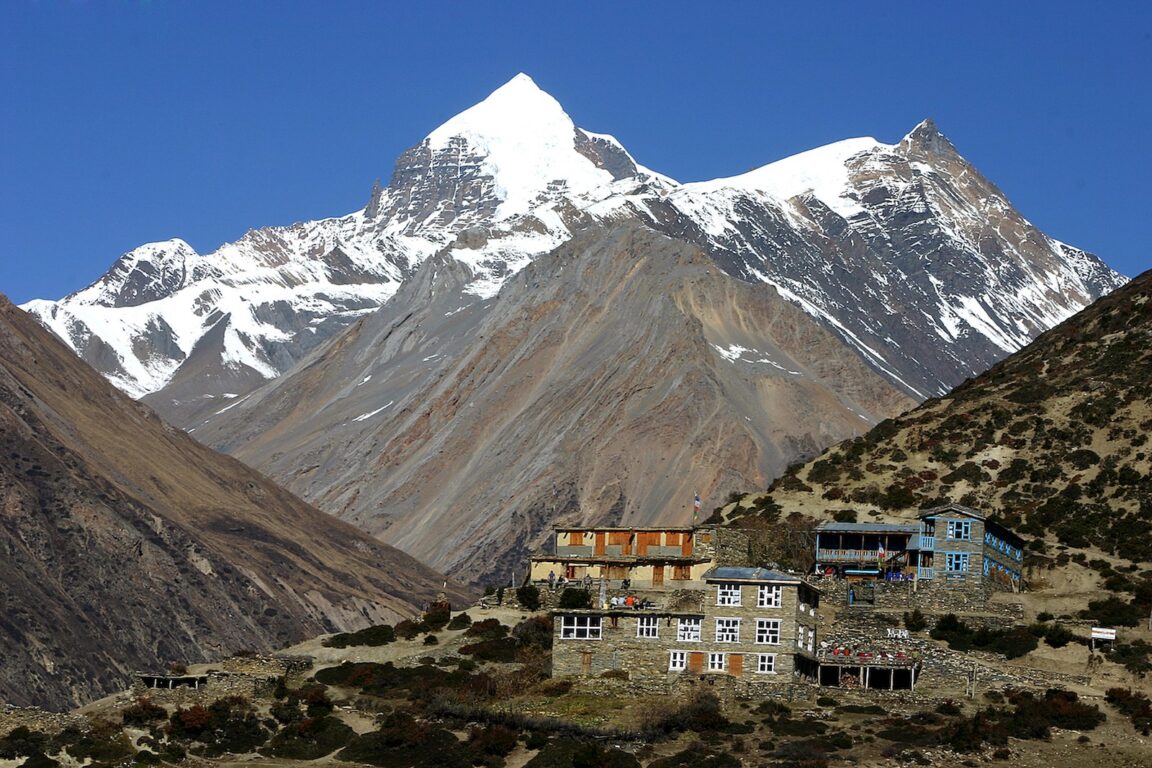
Image: Stone teahouse lodges on the Annapurna trail beneath a snow covered Himalayan peak, Nepal. Photo via the Nepal Tourism Board, ntb.gov.np, the subject country’s official tourism authority. Used with credit.