 Camille Baptiste
Read St George’s as a working spice port and the town falls into place in a single morning: walk the horseshoe of the Carenage while the harbour is still loading and unloading, cross to Market Square for the spice stalls at their busiest, then save the water for the calmest part of the day and take a boat north to the underwater sculptures in Molinere Bay. The nutmeg station at Gouyave, up the west coast, is the piece that explains everything else, because Grenada’s harbour, market and flag all run on one crop. Do the town first, the processing station second and the snorkel last, in that order, and each stop makes the next one clearer.
Quick Facts
Capital and port: St George’s, on Grenada’s southwest coast, built around the Carenage, a sheltered horseshoe shaped inner harbour set in an old volcanic crater
The walk: The Carenage waterfront, Wharf Road, is flat and walkable end to end, while the streets behind it climb steeply, so plan the hills for the cooler morning
The link through the hill: The Sendall Tunnel, built in the 1890s and named for Governor Walter Sendall, connects the Carenage side of town with the Esplanade and market side
The market moment: Market Square is liveliest on Saturday morning, with nutmeg, mace, cinnamon, cloves and cocoa among the stalls
The spice visit: The Gouyave Nutmeg Processing Station, in the fishing town of Gouyave up the west coast, is one of three Grenada Co-operative Nutmeg Association processing stations, alongside Grenville and Victoria
The snorkel: Molinere Underwater Sculpture Park, in the Molinere Beausejour Marine Protected Area, holds 75 original works over about 800 square metres at depths of 5 to 8 metres, with a major expansion added in 2023
Currency: Eastern Caribbean dollars, with small notes most useful at market stalls and for short rides
Facts checked: 25 November 2026, against the Grenada Tourism Authority, the sculptor’s official project site and Grenada Co-operative Nutmeg Association processing sources
Why does the harbour explain St George’s better than any single sight?
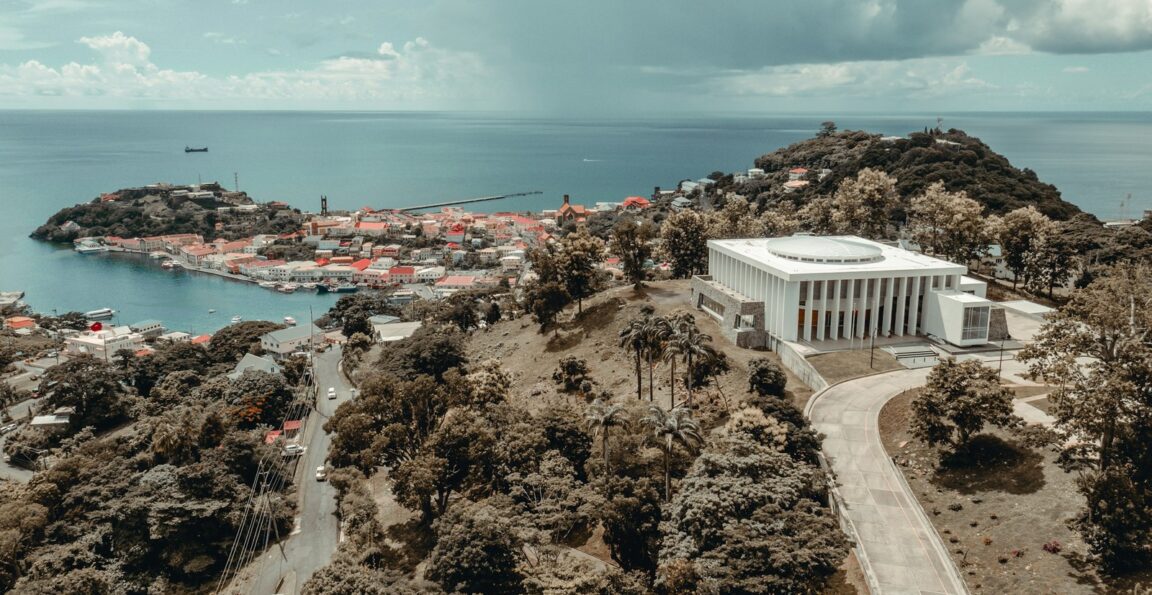
Because the Carenage is not a promenade built for visitors. It is the town’s original reason for existing, a deep and sheltered inner harbour formed in a drowned volcanic crater, which is why the water stays calm inside the horseshoe while the open Caribbean sits on the other side of the ridge. Warehouses line the curve, working boats and inter island vessels use the water, and the streets climb straight up behind the quay in steep lanes of red tiled roofs. A traveller who starts here understands the layout at once: harbour on one side, market and bus terminal on the other, forts on the headlands above both, and almost everything within walking distance if the hills are handled sensibly.
Walk Wharf Road slowly in the morning. That is when the harbour’s working life is easiest to read, with boats being loaded, deliveries moving to the warehouses and the waterfront cafes opening along the water. Look for the Christ of the Deep statue on the Carenage, a familiar harbour landmark, and keep walking the full curve rather than stopping at the first viewpoint. The shape of the town only really registers from the far end of the horseshoe, where the whole amphitheatre of houses, church towers and ridges lines up across the water.
Travellers building a wider island hopping route can set this working port against the colourful Dutch gabled waterfront in Willemstad, Curacao, and the logistics of moving between ports like these are covered in the guide to island hopping the Caribbean by ferry and short flights.
How should the Carenage walk be timed and ordered?
Start early, for three practical reasons. The light across the harbour is at its clearest before the midday glare flattens it. The heat on the exposed quay builds quickly, and the flat waterfront is far more comfortable before it does. And the town’s commercial rhythm is a morning rhythm, so an early walk shows the port working rather than resting. Allow around an hour for the waterfront itself, taken at a stroll with stops, and longer if the plan includes coffee or breakfast overlooking the water.
From the Carenage, the climb to Fort George is short and steep. The fort began as the French Fort Royal in the early 1700s and was renamed under the British, and it holds the headland at the harbour mouth, which is why its position gives the classic view back over the Carenage, the town and the coast toward Grand Anse. Access arrangements for historic sites in St George’s can change during restoration work, so check the current position on arrival rather than building the whole morning around entry. The view from the headland area is the point of the climb either way, and it is best done before the heat peaks.
The second fort, Fort Frederick, sits on Richmond Hill above the town and was built by the French in 1779, its guns famously facing inland. Between the two forts, the churches and steep lanes of the old town fill out a compact historic core that needs no vehicle, only comfortable shoes, water and a willingness to treat the hills as part of the visit.
What does the Sendall Tunnel actually save you?
A climb, every single time. St George’s is split by the ridge that separates the Carenage from the Esplanade and Market Square side of town, and the Sendall Tunnel cuts straight through that ridge. Built in the 1890s and named after Governor Walter Sendall, the tunnel is narrow, shared by vehicles and pedestrians, and very much still part of daily local movement rather than a preserved curiosity. Walk it in single file, stay alert to traffic and treat it as the practical shortcut it is.
When is Market Square worth building the morning around?
On Saturday. Market Square, at the foot of Young Street, is Grenada’s busiest open air market, and Saturday morning is when growers, spice sellers and produce stalls fill it most completely. Weekday mornings still work, but Saturday is the full version. This is the place to understand what the island grows before seeing how its most famous crop is processed: nutmeg in its shell, the lacy red mace that wraps the seed, cinnamon bark, cloves, turmeric, cocoa and bay leaves, sold loose and in small bags alongside fruit, vegetables and crafts.
Buy with a processor’s eye: a whole nutmeg should feel heavy and oily rather than light and hollow, and small Eastern Caribbean dollar notes make market buying easier. A traveller who has handled the raw spice in the market recognises every stage on the Gouyave processing floor.
What actually happens inside the Gouyave nutmeg station?
Gouyave is a fishing town on the west coast, north of St George’s, and its nutmeg processing station is run within the Grenada Co-operative Nutmeg Association system. The association receives nutmeg from farmers at receiving stations around the island and processes it at three stations: Gouyave, Grenville and Victoria. A visit to Gouyave is therefore not a museum reconstruction. It is a working floor where the island’s main export crop is dried, shelled, sorted and graded, and the smell of nutmeg sits over everything.
The sequence matters, and guides walk visitors through it in order. Fresh nutmegs arrive still in their shells, delivered green soon after harvest. The red aril around the seed is the spice mace, separated carefully and dried on its own, because mace and nutmeg are two distinct spices from the same fruit. The nutmegs themselves then dry over a period of weeks, losing moisture until the kernel rattles in its shell, which is the traditional sign that drying is complete. After drying comes shelling, then the patient hand work the station is known for: sorting and grading by size and quality, with damaged or defective kernels picked out, before the sound nutmegs are packed for export.
Two details tend to stay with visitors. The first is how much of the process is still done by hand and by eye, with experienced workers grading at a speed that only long practice produces. The second is how completely the crop shapes the island. Nutmeg appears on Grenada’s flag, the island is known worldwide as the Spice Isle, and the stations and receiving points form a network that reaches into farming communities in every parish. Practical notes for the visit are simple: Gouyave pairs naturally with a west coast drive from St George’s, visits run on working days when the station is operating, and opening arrangements should be confirmed locally on the day, since a working station follows its processing schedule rather than a visitor timetable. Ask before photographing workers, and buy spices at the station or in the market with the processing stages fresh in mind, because the grades make sense once the floor has been seen.
Why go offshore to Molinere Bay in the afternoon?
Because the sculpture park completes the story the harbour started. Molinere Bay, on the west coast a short boat ride from St George’s and Grand Anse, holds the Molinere Underwater Sculpture Park, created by British sculptor Jason deCaires Taylor and installed from 2006. The sculptor’s official project record describes it as the first of his underwater gardens and the first of its kind, now listed among National Geographic’s 25 Wonders of the World. The original 75 works cover about 800 square metres of sandy seabed in patches and gullies between natural rock formations.
The park was placed here for a working reason as well as an artistic one. Molinere Bay suffered considerable storm damage from Hurricane Ivan in 2004, and the sculptures, made from long lasting pH neutral cement with a textured surface, were designed to give marine life a stable base on which coral polyps could settle and grow. The site sits inside a Marine Protected Area, and entrance fees help fund the rangers who manage tourism and fishing in the area. In other words, the park works the way the nutmeg station works: it is a piece of Grenada’s real economy and conservation effort that visitors are allowed to watch up close.
Which sculptures should a snorkeller look for first?
The best known work is Vicissitudes, a ring of children holding hands and facing outward into the current, cast from children of diverse backgrounds and widely read as a symbol of unity and resilience. The Lost Correspondent shows a man seated at a desk with a typewriter, the desktop covered with newspaper articles dating back to the 1970s, a quiet joke about how fast communication changes. Both sit within the park’s 5 to 8 metre depth range, which is the key practical fact for snorkellers: at those depths, the larger works are visible from the surface in clear water, and divers get the closer, slower look.
In 2023 the park grew. Taylor added The Coral Carnival, a series of 25 sculptural works celebrating Grenada’s carnival masquerade traditions, along with new editions of The Lost Correspondent and Unstill Life, bringing 27 new artworks in total. A snorkel route today therefore mixes the pale, coral covered original figures with the newer carnival characters, and a good boat guide will order the swim so the signature pieces come while everyone is still fresh and the light is still strong.
How should the snorkel boat be timed for clear water?
Timing is the difference between seeing shapes and seeing sculpture. The official project site confirms the park is accessible by scuba diving, snorkelling and glass bottom boats, with departures from St George’s and Grand Anse, both a short boat ride away. For the clearest view from the surface, choose a boat that reaches Molinere while the sea is calm and the sun is high enough to light the seabed, which in practice means a late morning to early afternoon trip rather than a last light one. After rain, or on a day when the surface is choppy, visibility over the sand patches drops and the figures blur, so travellers with flexible days should ask operators honestly about conditions and be willing to swap the snorkel and Gouyave days around.
On the boat, two habits help. Keep fins up and off the sculptures, since the coral growth on them is the point of the project and is easily damaged, and surface regularly to take bearings from the guide, because the park is a series of separate groupings, not one continuous gallery. Non swimmers are not excluded: glass bottom boats run to the same site, and at 5 to 8 metres the main groupings can still be made out through the panel in good conditions.
How do the three stops fit into one or two days?
On a two day visit, keep the shape simple. Day one belongs to the town: the Carenage walk, Fort George, the Sendall Tunnel and Market Square, with the market timed for Saturday if the calendar allows. Day two pairs the west coast: drive north to Gouyave for the nutmeg station while the working day is under way, then take the snorkel boat to Molinere, which lies off the same coast, so the route back toward St George’s and Grand Anse passes the bay. On a single day, the order still holds but the town walk must start early, Gouyave becomes the midday stop and the snorkel is booked on a boat timed for the best early afternoon light and calm.
Frequently Asked Questions
Is St George’s walkable in a day?
Yes. The Carenage, Market Square, the Sendall Tunnel and the fort headlands sit within a compact area. The honest caveat is the hills: the waterfront is flat, but the streets behind it are steep, so the town suits an unhurried pace, morning sightseeing and comfortable shoes.
Do you need to dive to see the underwater sculptures?
No. The works stand at depths of 5 to 8 metres and are accessible by snorkelling and glass bottom boat as well as scuba diving, according to the sculptor’s official project site. In clear, calm water the larger groupings, including the ring of Vicissitudes, can be seen from the surface.
What is the difference between nutmeg and mace?
They come from the same fruit. Nutmeg is the dried seed kernel, while mace is the bright red aril that wraps the seed, separated and dried on its own. The Gouyave station visit shows both spices being processed through the same building by different stages.
When is the best day to visit Market Square in St George’s?
Saturday morning, when the market is at its fullest with growers and spice sellers. Weekday mornings are still worthwhile, and arriving earlier in the morning gives the widest choice and the coolest walk from the Carenage.
Can Gouyave and Molinere Bay be done on the same day?
Yes, and the pairing is efficient, since both lie on Grenada’s west coast north of St George’s. Visit the working nutmeg station during its operating day, then join a snorkel or glass bottom boat to the sculpture park, timing the water for calm conditions and strong light.
Image: St George’s and the Carenage horseshoe harbour, Grenada, seen from the hill above the town, with Fort George on the headland at left. Photo by Hugh Whyte, via Unsplash, Unsplash License.