 LeVar Thomas
A Harlem day built around music history has a natural walking order, and it runs along one street: start at the Apollo Theater on West 125th Street in the late morning, on a day when its historic tour runs, walk the 125th Street corridor east and west to read the neighbourhood that made the music, climb four blocks north to the National Jazz Museum in Harlem in the early afternoon, and let the day end where Harlem days have always ended, at a soul food counter, with the Apollo’s marquee as the walk back. Sequenced that way, the day is one argument, about how a single neighbourhood produced a century of American music, told at the places where it actually happened.
Quick Facts
- Anchor: The Apollo Theater, 253 West 125th Street, Harlem, New York
- Current status: The Historic Theater is closed for renovation, expected to reopen in late 2026, with events at the Apollo Stages at The Victoria nearby
- Apollo Experience tours: Monday and Wednesday at 11am and 1pm, Saturday at 11am, by reservation only
- Tour price: $17 per person for individuals and groups of 19 or fewer, lasting 60 to 75 minutes
- Jazz museum: The National Jazz Museum in Harlem, 58 West 129th Street, open Thursday to Saturday, 12pm to 5pm
- Walking spine: West 125th Street, between Frederick Douglass Boulevard and Lenox Avenue, with a short climb to 129th Street
- Best day for the full sequence: Saturday, the one day when an Apollo tour and the jazz museum’s opening hours overlap
- Nearest subway: 125th Street stations on the 2 and 3 trains at Lenox Avenue, and on the A, B, C and D trains at St Nicholas Avenue
Begin at the Apollo, and Begin With the Renovation Truth
The first fact of a Harlem music day in late 2026 is one many guides will not tell you plainly: the Apollo’s Historic Theater is currently closed for renovation. The theatre’s own visit page on apollotheater.org says the Historic Theater at 253 West 125th Street is expected to reopen in late 2026, and that performances continue at the Apollo Stages at The Victoria, at 233 West 125th Street, where the Victoria Theater seats 199 and the Jonelle Procope Theater seats 99. A day built around the Apollo is therefore not a day of walking into a working auditorium on impulse. It is a day built around the tour, the marquee, the street and the sister venue, and planned on the theatre’s calendar rather than on hope.
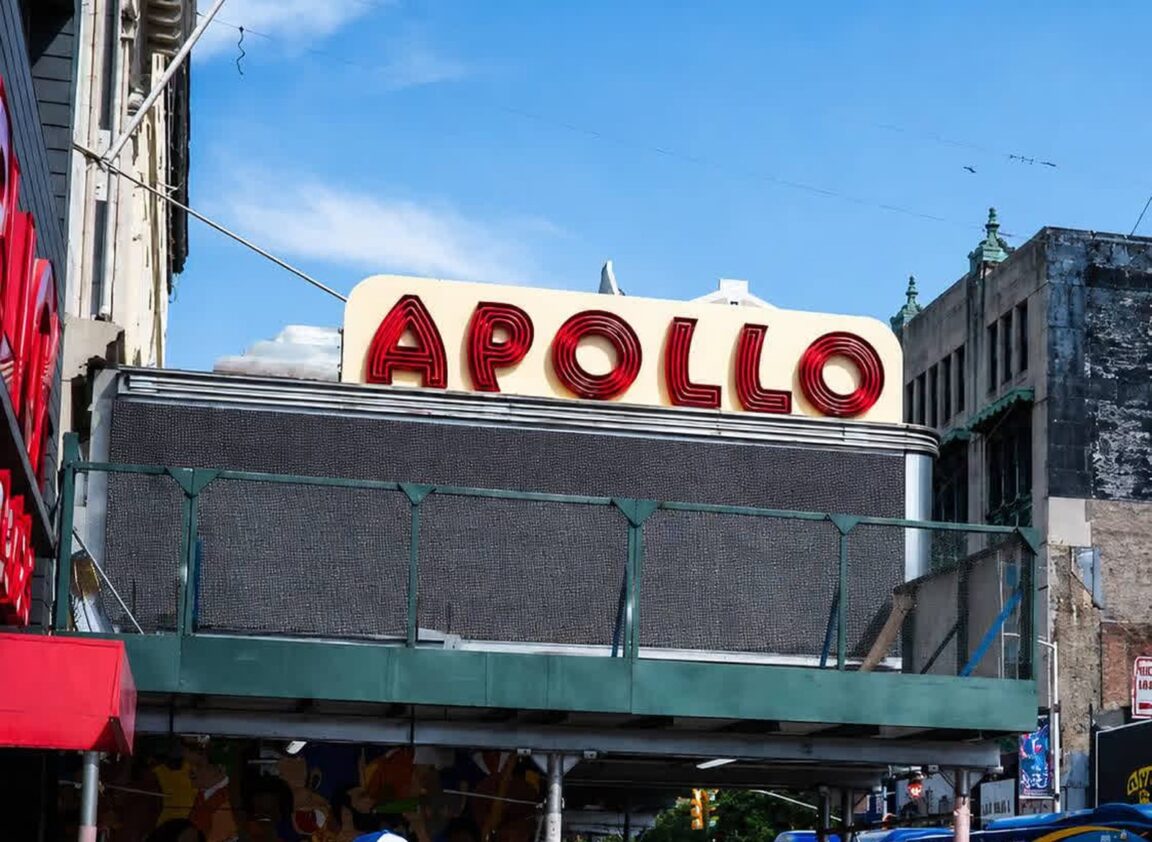
That makes the booking the day’s first task. The Apollo Experience tour, which replaced the standard historic tour during the closure, is an interactive encounter led by Billy “Mr. Apollo” Mitchell, the theatre’s longtime historian, whose backstage stories run through James Brown, Stevie Wonder and Mary J. Blige. On the Apollo’s official tours page, tours run Monday and Wednesday at 11am and 1pm and Saturday at 11am, must be scheduled in advance, are conducted in English, and cost $17 per person for individuals and small groups, with all sales final. The historic tour format is listed at 60 to 75 minutes. Book the 11am tour on a Saturday, because Saturday is the one day that unlocks the full sequence below: the Apollo tours do not run on Thursday or Friday, and the jazz museum does not open Sunday to Wednesday. and treat the marquee outside, lit again and photographable from across 125th Street, as the day’s opening image rather than a consolation.
What the Apollo Means, Read on Its Own Street
The Apollo has been Harlem’s proving ground since 1934, when it opened its doors to Black audiences and performers in a segregated city, and its Amateur Night became the most feared and coveted audition in American music: a teenage Ella Fitzgerald won there, and the theatre’s history runs from big bands through soul and funk to hip hop, with the audience’s verdict, cheers or the Executioner’s hook, deciding careers in real time. None of that history is abstract on 125th Street. The theatre sits on Harlem’s main commercial corridor, among the shops, churches, street vendors and historic buildings of a neighbourhood that was the capital of Black America through the Harlem Renaissance and remains a living community first and a destination second. Walk it slowly after the tour. The blocks between Frederick Douglass Boulevard and Lenox Avenue carry the day’s context: this is the street the music came from, not a museum district built around it afterwards.
Travellers who enjoy reading a New York neighbourhood on foot, plate by plate and corner by corner, will find the same pleasure in a Greenwich Village food walk, though the Village’s story is told in restaurants where Harlem’s is told in venues. The comparison sharpens both: downtown, the food is the archive; uptown, the music is.
The Jazz Corners: The National Jazz Museum and the Afternoon Climb
After lunch on or near 125th Street, walk north to 129th Street for the day’s second institution. The National Jazz Museum in Harlem, at 58 West 129th Street, is a Smithsonian affiliated museum in a compact ground floor space, open Thursday to Saturday from 12pm to 5pm on its published hours. It is a different kind of music stop from the Apollo: small, listening based and built around recordings, including the Savory Collection of live broadcasts from the 1930s, and around Duke Ellington’s piano, exhibits and a programme of talks and performances that runs through the year. Give it an hour to ninety minutes. Its scale is the point; after the Apollo’s big room mythology, the museum brings jazz back to the size of a room full of people listening hard, which is how the music was actually made in Harlem’s clubs and rent parties.
The walk between the two is part of the exhibit. From 125th and Lenox, the climb past Marcus Garvey Park’s edges and the brownstone blocks of the Mount Morris Park historic district shows the residential Harlem that produced the audiences: handsome, church going, politically storied streets where the musicians lived, not just performed. A gospel Sunday can extend the day in a different direction, since Harlem’s great churches welcome respectful visitors to worship, but that is a morning commitment with its own etiquette, and it should be planned from a church’s own visitor guidance rather than bolted onto this itinerary. Food travellers building a longer Black heritage route through the South will find the natural sequel in Savannah’s Lowcountry soul food squares, where the same traditions sit at the other end of the Great Migration story.
The Soul Food Counters, and How to End the Day
End the day eating, and eat on the corridor the day has walked. Harlem’s soul food tradition is served at counters and dining rooms along Lenox Avenue, Frederick Douglass Boulevard and 125th Street itself: fried chicken, smothered dishes, collard greens, macaroni and cheese, cornbread and sweet tea, in rooms where the lunch and early dinner crowds are mostly the neighbourhood. The honest guidance for a visitor is about manner rather than a ranked list, because individual kitchens open, close and change hours faster than any guide can responsibly fix in print. Choose a counter that is busy with local trade, order the plate the room is known for, expect a queue at peak times and a pace that is not rushed, and go earlier rather than later, since several Harlem kitchens keep their full menu for lunch and early evening rather than late night. A day that began with a theatre historian’s stories ends correctly in a room where the food carries the same history in a different form.
Readers planning the wider trip around this day can place it against two useful contrasts: the Delphi day trip’s sanctuary and museum order, which solves the same two institution sequencing problem at an ancient site, and the Cooperstown, New York food guide, another small place where one great institution anchors a whole town’s eating. Harlem is bigger than both, but the planning instinct, anchor first, neighbourhood second, table last, is identical. For official visitor context on the city around the day, New York City’s official tourism site carries current neighbourhood and events listings worth checking the same week.
A Timed Version of the Day
Arrive at 125th Street by 10:30am and take the marquee photograph before the tour crowds gather. Apollo Experience tour at 11am, out by about 12:15pm. Walk the 125th Street corridor in both directions for half an hour, reading the street. Lunch at a soul food counter or a Frederick Douglass Boulevard dining room by 1pm. National Jazz Museum from about 2:30pm to 4pm, noting that it closes at 5pm and does not open at all Sunday to Wednesday. Walk back south through the brownstones as the light goes, and take an early dinner on the corridor before leaving, or stay for an evening performance at the Apollo Stages at The Victoria if the calendar offers one, booked in advance through the theatre. The whole day covers barely a mile of walking. Its density, not its distance, is what makes it feel like a week of music history compressed into daylight.
Frequently Asked Questions
Is the Apollo Theater open for visits during the renovation?
The Historic Theater building is closed for renovation and expected to reopen in late 2026, but the Apollo is still visitable: the Apollo Experience tour runs by reservation, and performances continue at the Apollo Stages at The Victoria at 233 West 125th Street. Check the theatre’s own site for the current calendar before travelling.
How much does the Apollo tour cost, and when does it run?
Tours run Monday and Wednesday at 11am and 1pm and Saturday at 11am, by reservation only. Individuals and groups of 19 or fewer pay $17 per person; larger groups pay $15 per person on Monday and Wednesday and $17 on Saturday. Sales are final, and tours are conducted in English.
Which day is best for the full Harlem music day?
Saturday, and it is not close. The Apollo tours run Monday, Wednesday and Saturday, while the National Jazz Museum in Harlem opens only Thursday to Saturday, so Saturday is the single day both halves of this itinerary can be done. A weekday version must choose one institution or the other.
How long does the National Jazz Museum take?
An hour to ninety minutes covers the exhibits and listening material comfortably. It is a compact museum, and its value is depth rather than scale. It opens Thursday to Saturday, 12pm to 5pm, at 58 West 129th Street.
Is this day walkable without a car or tour bus?
Entirely. The Apollo, the 125th Street corridor, the soul food counters and the National Jazz Museum all sit within about a mile in central Harlem, served by the 125th Street subway stations. The day was designed as a walk, and driving it would make it worse.
Featured image: The Apollo Theater marquee on West 125th Street in Harlem, New York, with pedestrians on the sidewalk below, from the Apollo Theater’s own official website, apollotheater.org (cropped from the site’s Harlem media image to remove a caption overlay). Credit: The Apollo Theater / apollotheater.org, the subject’s own official website, used with credit.