 River Callahan
Badlands National Park can be done properly in one day if the day is built as a single westbound drive: enter at the Northeast Entrance early, walk the Door, Window and Notch trails before the heat, work the paved Loop Road overlooks in order through the middle of the day, and finish on the unpaved Sage Creek Rim Road in the late afternoon, when the wildlife is moving and the light is on the formations. That is the whole plan. Everything else, the visitor centre, the fossil boardwalk, the picnic stops, fits inside it, and nothing needs to be doubled back.
Quick Facts
- Park size: About 244,000 acres of eroded buttes, pinnacles and mixed grass prairie in southwest South Dakota
- Entrance fee: $30 per private vehicle, $25 per motorcycle and $15 per person on foot or by bicycle, each valid for 7 days
- Park annual pass: $55, and the park is cashless, so bring a card or buy ahead
- First trails: Door Trail 0.75 miles round trip, Window Trail 0.25 miles, Notch Trail 1.5 miles, all from one parking area
- Main drive: The Badlands Loop Road, Highway 240, the paved road linking the Northeast and Pinnacles entrances
- Wildlife road: Sage Creek Rim Road, unpaved gravel, for bison, prairie dogs and bighorn sheep in dry weather
- Visitor centre: Ben Reifel Visitor Center, near the Northeast Entrance and Cedar Pass
- One day rule: One direction, westbound, no backtracking, Sage Creek last
How This One Day Differs From a Longer Visit
This plan is written for the driver with a single day, often between the Black Hills and points east, and it makes different choices from a first visit spread over a weekend. Readers starting from zero should begin with the Badlands first timer guide, which explains what the park is and what to do first, and those with two days should use the Badlands two day itinerary, which gives Sage Creek and the west end a day of their own. The one day version is a compression, not a sampler: it accepts that the South Unit and the Sage Creek Wilderness interior belong to another trip, and it spends the saved hours on depth along one line of travel, three short trails walked properly instead of six photographed from the car.
The Morning: Door, Window and Notch Before the Heat
Be at the Northeast Entrance early, pay the fee listed on the park’s official fees page, and drive straight to the Door and Window parking area near Cedar Pass. The three trails here share one lot, and the order matters. Walk the Door Trail first: 0.75 miles round trip, beginning on an accessible boardwalk that passes through a break in the Badlands Wall, the Door itself, and continuing among the formations beyond. In early light the striped walls read at their clearest, and the trail gives a one day visitor the essential experience of being inside the formations rather than looking at them. The Window Trail is next and takes minutes: 0.25 miles to a natural window in the wall framing an eroded canyon, the park’s most efficient view. The trail lengths and the park’s open hike guidance are set out on the National Park Service hiking page for the Badlands, which is worth reading the night before, because the Badlands allows off trail exploration and a one day plan should decide in advance how much of that freedom to use. The answer for most drivers is a little, on the Door Trail’s marked extension, and no more.
Then decide on the Notch Trail with honest eyes. At 1.5 miles round trip it is the morning’s only real hike, climbing a log ladder and following a ledge to a notch overlooking the White River Valley. It is the best trail of the three and the one that costs the most time and nerve; the ladder and the exposed ledge rule it out for anyone uneasy with heights. A one day driver who walks all three trails has earned the rest of the day in the car. A driver who skips the Notch has lost nothing essential and gained an hour for the overlooks. Either way, be back at the car before the day heats up, because these formations hold and return the sun, and the park’s own advice about water, a gallon per person per day in hot conditions, is written for exactly this landscape.
The Middle of the Day: The Loop Road in Order
The Badlands Loop Road runs west from Cedar Pass toward the Pinnacles Entrance, and the one day discipline is to stop in order and never reverse. Big Badlands Overlook comes early and gives the wide establishing view back over the wall. The Fossil Exhibit Trail, a short accessible boardwalk with fossil replicas and the park’s paleontology story, is the right midday stop: flat, brief and shaded in parts, it explains the bones that make this more than a scenery park. Then the overlooks build westward, Panorama Point and the Yellow Mounds, where the geology changes colour and the formations soften into painted hills that photograph completely differently from the grey pinnacles behind. Keep each stop short. The one day mistake is to spend forty minutes at the third overlook and then drive past the last three; ten to fifteen minutes each, in order, is the rhythm that fits the road into the day.
Use the Ben Reifel Visitor Center at the start of this section or not at all. Its exhibits and film are genuinely useful, and the plan your visit hub at the park’s official plan your visit page carries the current alerts, road conditions and campground links that a driver should check the same morning, because conditions on the unpaved roads change with weather. But a visitor centre belongs before the trails or in the heat of midday, never as a late afternoon discovery. Drivers continuing to other parks on the same trip will find the pacing here familiar from the Denali three day transit bus plan, where a single road system also decides what a visit can be.
The Afternoon Decision: Pinnacles and the Sage Creek Turn
At the Pinnacles Entrance the day makes its last choice. The paved road continues out toward Wall, and the trip could end there, complete and respectable. The better ending turns onto the Sage Creek Rim Road, the unpaved gravel road that runs west along the rim above the Sage Creek Wilderness. This is the park’s wildlife road: bison range the grassland here, bighorn sheep work the rim, and Roberts Prairie Dog Town fills a flat with burrows, sentries and, often, the predators and raptors that attend them. Late afternoon is when this road pays, as the heat breaks and animals move. It is also the road with conditions attached. Gravel becomes slippery and can be impassable after rain or snow, there is no fuel and little signal, and the same official sources that describe the road warn drivers to check its status before committing. A one day driver should take Sage Creek only in dry weather, drive it out and back or through to the park boundary road with time in hand, and never let it push the exit into darkness on an unfamiliar gravel road.
Drivers who know they are prone to squeezing one more sight into a finished day should read the Black Canyon of the Gunnison mistakes to avoid before this trip, because the errors rhyme: arriving late, underestimating rim roads, and treating the last unpaved section as a small thing. In the Badlands the discipline is simpler, because the park gives the day a natural spine and asks only that the driver follow it west.
Bases, Fuel and the Exit
For a one day visit the base barely matters, and that is liberating. Wall, at the Pinnacles end on Interstate 90, is the practical overnight for drivers finishing westbound, with fuel, food and motels at the exit; Interior, near the east end, suits drivers who want to be at the Northeast Entrance at dawn. Either way, enter with a full tank and the day’s water and food in the car, because there is no fuel inside the park and services are thin along the loop. Campers extending the day into a night should know that Cedar Pass Campground takes reservations through the federal system linked from the park’s site, while Sage Creek Campground is free, primitive and first come first served; for a strict one day driver both are scenery, not logistics. The exit writes itself: out at Pinnacles to Wall and the interstate, with the formations in the mirror, having seen the park in the order it was laid out.
Frequently Asked Questions
Can Badlands National Park really be done in one day?
The North Unit’s core, yes: the Door, Window and Notch trails, the full paved Loop Road with its overlooks and the Fossil Exhibit Trail, and a late afternoon run on Sage Creek Rim Road fit one long day without rushing any single stop. The South Unit and backcountry hiking are what a one day visit gives up.
What does entry cost, and how long is the pass valid?
The National Park Service lists $30 per private vehicle, $25 per motorcycle and $15 per person entering on foot or by bicycle, each valid for 7 days, with a Badlands annual pass at $55. The park is cashless, so pay by card or buy a pass in advance.
Which trail should be skipped if time runs short?
Skip the Notch Trail. The Door and Window trails together take under an hour and deliver the essential experience; the Notch is the best hike of the three but costs the most time and involves a ladder and an exposed ledge.
Is Sage Creek Rim Road suitable for a normal car?
In dry weather, yes, driven slowly: it is a maintained gravel road. After rain or snow it can become slippery or impassable, and its status should be checked on the park’s official pages the same day before turning onto it.
Where are bison most likely to be seen in one day?
Along Sage Creek Rim Road in the late afternoon, where the herd ranges the grassland above the wilderness, and around Roberts Prairie Dog Town on the same road. Wildlife is never guaranteed, which is why the road is placed last, when viewing odds are best.
What should be carried in the car?
Water at the park’s recommended level of a gallon per person on hot days, food for the full day, a full tank of fuel, sun protection and a paper map or offline download, because signal is unreliable across much of the park.
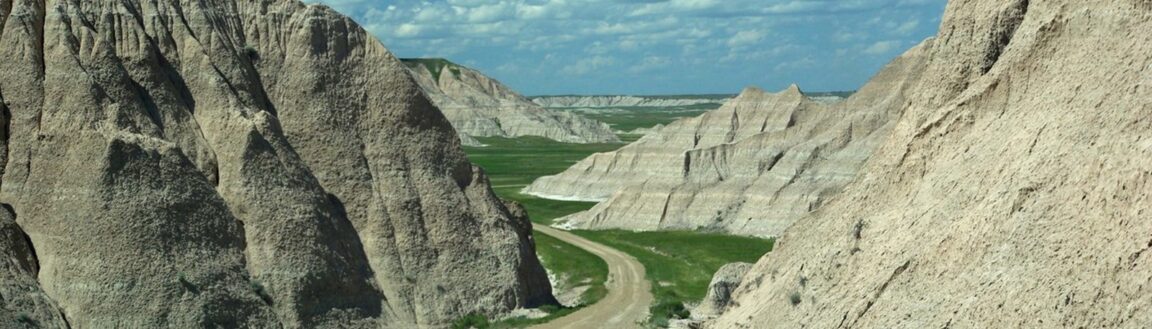
Featured image: A dirt road winds between steep badlands buttes toward green prairie in Badlands National Park, South Dakota. Photo by Larry McAfee, National Park Service, via the park’s official site at nps.gov. Credit: NPS Photo / Larry McAfee, National Park Service.