 Elena Vasquez
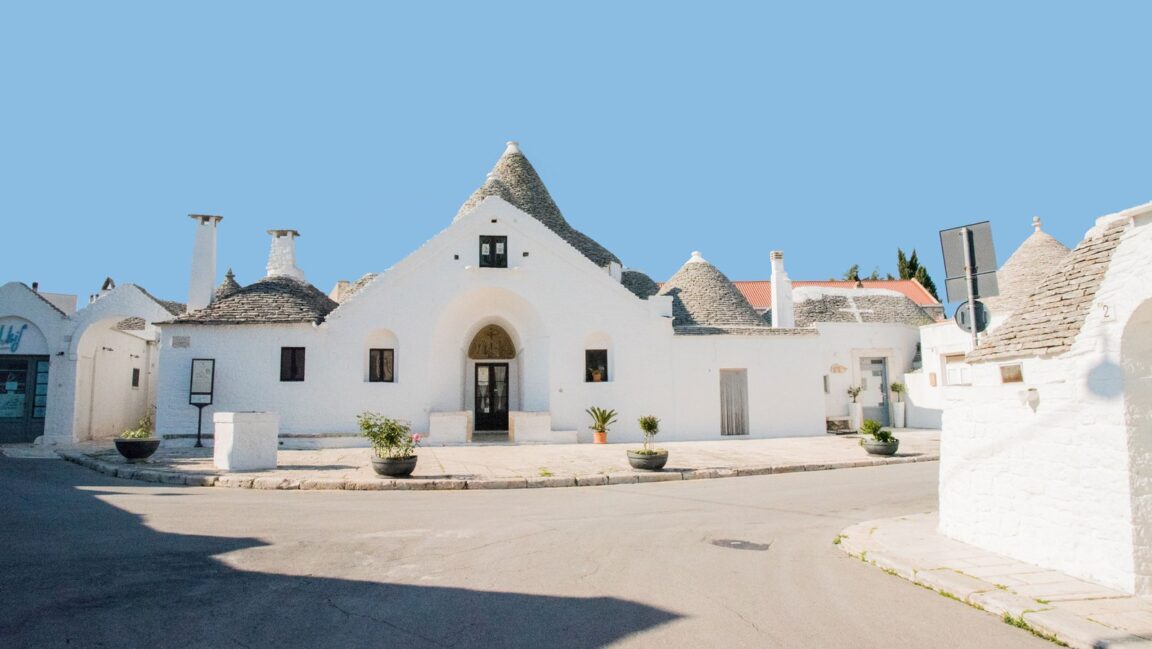
Alberobello has two historic centres, and most visitors only see one of them. Across the Largo Martellotta from the famous, shop lined slopes of Rione Monti lies Aia Piccola, a residential quarter of 590 trulli where the conical stone roofs shelter ordinary households rather than souvenir displays, and where the lanes are quiet by design. Stay overnight, walk Aia Piccola in the early morning and again after the tour buses leave, spend a day among the olive groves and masserie of the surrounding Itria Valley, and the town behind the postcard appears: a living dry stone settlement, listed by UNESCO since 1996, that happens to be beautiful rather than a beauty that happens to be listed. This guide is built around that second Alberobello.
Quick Facts
- Where: Alberobello, Puglia, on the hills of the Itria Valley between Bari and Taranto
- The two quarters: Rione Monti with 1,030 trulli; Rione Aia Piccola with 590 trulli, the residential quarter with no commercial activity in its lanes
- UNESCO status: The Trulli of Alberobello, inscribed on the World Heritage List in 1996 under criteria (iii), (iv) and (v); six land parcels over about 11 hectares
- Do not miss: Trullo Sovrano, the only two storey trullo, now a house museum on Piazza Sacramento; the trullo shaped Church of Sant’Antonio
- Construction: Dry stone, built without mortar, with conical roofs of corbelled limestone slabs called chianche
- The overnight effect: Day visitors concentrate in Rione Monti between mid morning and late afternoon; mornings and evenings belong to residents and overnight guests
Two Quarters, Two Towns
The geography is simple and decisive. Rione Monti climbs a hillside south of the modern centre in eight parallel streets of trulli, most of them given over to shops, bars, workshops and viewpoints. It is handsome, lively and, in season, crowded by late morning. Aia Piccola, on the south eastern side of town across Largo delle Fogge, is the mirror image in mood: smaller, flatter in its lanes, and, in the words of the Comune di Alberobello’s official site, the only trulli quarter untouched by commercial activity. Its streets, many closed to cars, run along Via Duca degli Abruzzi and Via Verdi past front doors, kitchen windows, small gardens and the evidence of daily life, washing lines, scooters, cats asleep on warm stone.
Walking Aia Piccola well is mostly a matter of manners. These are homes, not exhibits, so the quarter rewards the same etiquette you would want on your own street: keep to the lanes, photograph roofs and streetscapes rather than doorways and windows, and let the quiet stay quiet. The reward is the thing the postcard cannot show, the sound and rhythm of a neighbourhood that has been continuously inhabited in this building form for centuries. Readers who liked our approach to Rovinj’s old town beyond the famous sight will recognise the method: the famous view first, then the living streets behind it, given more time than the view.
What a Trullo Actually Is
The building itself deserves a slow look. A trullo is a rectangular or round structure of roughly worked limestone, gathered from the fields and from the excavation of the cistern beneath the floor, built in a double skin of stone with a rubble core and, crucially, no mortar anywhere. The walls stand directly on the limestone bedrock. The roof is a cone of corbelled limestone slabs, the chianche, laid in rings that step inward to a closing stone, often finished with a decorative pinnacle and, on some roofs, a symbol painted in white ash whose meaning ranges from the religious to the protective. Thick walls keep interiors cool in the Puglian summer and hold warmth in winter, and projecting eaves channel rainwater into the cistern below, a complete little water system hidden inside a roofline.
The UNESCO listing for the Trulli of Alberobello sets out why this matters beyond charm: the quarters represent a dry stone building tradition thousands of years old across the Mediterranean, surviving here not as scattered farm shelters, which dot the whole Itria Valley, but as entire inhabited urban districts, more than 1,600 buildings in the two quarters and the associated monuments. The listing’s six parcels include, alongside the two quarters, the Casa d’Amore, Piazza del Mercato, the Museo Storico complex and the Trullo Sovrano, and the protection rules are strict: it is illegal to demolish a trullo, add floors to one, or build a fake one. That legal backbone is a large part of why Aia Piccola still looks and functions as it does.
The Landmarks Worth Your Time
Three buildings repay deliberate visits. The Trullo Sovrano, behind the basilica on Piazza Sacramento, is the town’s only two storey trullo, preserved as a house museum with period furnishings that show how a prosperous family actually arranged life across linked cones: sleeping alcoves recessed into the thick walls, a fireplace, storage in the roof space. It is the best single place to understand the type from inside. The Church of Sant’Antonio, at the top of Rione Monti, is the only church built in trullo form, its facade and dome translating the vernacular into the sacred, and its position gives the classic view back across the Monti rooftops. The Museo del Territorio, housed in the linked trulli of Casa Pezzolla near Aia Piccola, tells the valley’s story, its agriculture, crafts and building techniques, and is the natural companion to a morning in the residential quarter.
Give Rione Monti its due as well, ideally early or late in the day. The eight streets of cones, the small workshops selling linen, olive wood and ceramics, and the rooftop viewpoints are genuinely lovely when the light is low and the lanes are breathing again. The mistake is not visiting Monti; it is visiting only Monti, at noon, in a crowd, and concluding that Alberobello is a photo stop. The town’s own information, including opening arrangements for its monuments, is carried on the Comune site linked above, and Puglia’s regional context is well covered by the official Puglia tourism pages on Alberobello.
Out to the Groves: Masserie and the Itria Valley
Alberobello’s countryside explains its architecture. The trullo began as a field building, a shelter and store raised from the stone cleared to farm the land, and the valley around town is still a working landscape of olive groves, dry stone field walls, almond and cherry orchards and white masserie, the fortified farmhouses that anchor the larger estates. Many masserie now welcome visitors for olive oil tastings, cooking classes and farm lunches, and some take overnight guests, which makes the strongest itinerary of all: sleep on a working farm outside town, walk Aia Piccola at dawn, and return to the groves for the evening. The valley’s other white towns, Locorotondo, Martina Franca, Cisternino and Ostuni, sit within easy driving distance and share the same stone grammar at different scales.
This rural dimension is what separates Alberobello from a pure old town visit, and it connects with the food first travel writing we publish elsewhere, from the Vietnamese food guide to New Orleans East to the pintxos logic of San Sebastian, where what to order in Gros and Centro is really a lesson in how a place feeds itself. In the Itria Valley the equivalent lesson is olive oil: taste it where the trees are, ask which cultivar and which harvest, and let the farm, not the gift shop, set the standard.
Staying Overnight: The Evening the Day Trippers Miss
The case for the overnight is arithmetic as much as atmosphere. The great majority of Alberobello’s visitors arrive by coach or car for a few midday hours, concentrated in Rione Monti. Sleep in town, in a trullo apartment in or near Aia Piccola, a small hotel in the modern centre, or a masseria in the groves, and the town’s two best hours become yours: the early morning, when deliveries thread the lanes and the stone is cool, and the evening, when the cones turn amber, the swallows work the rooftops, and dinner is served at local pace in restaurants the lunch crowds never find. Aperitivo on a Monti terrace at closing time, a slow walk home through a residential quarter settling for the night, and dawn in Aia Piccola before a single coach arrives: that sequence is the article’s whole argument in one day.
Practicalities are gentle. Alberobello is compact and walkable; the quarters are a restricted traffic zone, so park in the official car parks outside them and walk in, and the town is reached by Ferrovie del Sud Est trains and buses from Bari as well as by road from Bari, Taranto and the coast at Polignano a Mare and Monopoli. Two nights is the sweet spot, one for the town at its quiet hours and one for the valley. Travellers building a longer old towns itinerary will find a kindred spirit in our guide to Mostar, Bosnia, and its old town, another place where the famous view is the beginning of the visit rather than the whole of it.
Frequently Asked Questions
What is the difference between Rione Monti and Aia Piccola?
Rione Monti is the larger quarter, 1,030 trulli, with most of the shops, bars and viewpoints. Aia Piccola, with 590 trulli, is residential and free of commercial activity in its lanes, which makes it the quieter and more atmospheric walk.
How many trulli are there in Alberobello?
UNESCO counts more than 1,600 in the listed property: 1,030 in Rione Monti and 590 in Rione Aia Piccola, plus individual monuments including the Trullo Sovrano.
Why are trulli built without mortar?
They follow a dry stone tradition thousands of years old in the Mediterranean. Walls of double skinned limestone with a rubble core, and roofs of corbelled slabs, stand by weight and fit alone, and can historically be dismantled and rebuilt.
Is one day enough for Alberobello?
A day covers the quarters and main monuments, but staying overnight is strongly recommended. Mornings and evenings, when day visitors are absent, are when Aia Piccola and Rione Monti are at their best.
What else is there to do near Alberobello?
Visit working masserie and olive groves in the Itria Valley, and the nearby white towns of Locorotondo, Martina Franca, Cisternino and Ostuni, all within easy driving distance.
Image credit: The Trullo Sovrano in Alberobello, Puglia, by Phederica Mancini, via the Comune di Alberobello (comune.alberobello.ba.it), the town’s official website.