 James Wolfe
Venice has confirmed the calendar for its day-tripper entry ticket for 2027, and spring visitors are the first who need to plan around it. The city executive approved 72 charged days running from Friday 26 March to Sunday 15 August 2027, with the fee collected between 8:30 a.m. and 4:30 p.m. on each listed date and the amount capped at 10 euros per person. For spring specifically, the charged dates are 26 to 29 March, then 2 to 4, 9 to 11, 16 to 18 and 23 to 30 April, and 1 and 2, 7 to 9, 14 to 16, 21 to 23 and 28 to 31 May. The booking portal has not yet opened for the 2027 season, and the city has said the detailed acts covering exemptions, price tiers and booking rules will follow, so the correct move now is to fix your dates against the calendar and wait for the official portal to open rather than buying anything from a third party.
Quick Facts
- What: Venice access fee (contributo di accesso) for day visitors entering the historic centre on listed dates
- 2027 season: 72 charged days, 26 March to 15 August 2027, approved by the city executive on 15 October 2026
- Spring dates: 26 to 29 March; 2 to 4, 9 to 11, 16 to 18, 23 to 30 April; 1 and 2, 7 to 9, 14 to 16, 21 to 23, 28 to 31 May
- Charged hours: 8:30 a.m. to 4:30 p.m. on listed dates only
- Price ceiling: 10 euros per person per day; the tier structure for 2027 is set by a later act
- Booking: Only through the official portal, cda.ve.it; 2027 bookings had not opened at the time of writing, with detailed rules due by 31 December 2026
- Overnight guests: Exempt from the fee in every season so far because they pay the city accommodation tax, but in past seasons they still had to register for an exemption code
The Spring Calendar, Week by Week
The pattern is familiar to anyone who followed the scheme in earlier years, and readers who worked through our explainer on how the Venice day-tripper entry fee worked in 2026 will recognise the shape of it. The charge lands on Fridays, Saturdays and Sundays, plus the holiday bridges that turn a weekend into a four or five day break. Easter comes first: the season opens on Good Friday, 26 March, and runs straight through Easter Monday, 29 March. April then settles into weekend blocks of 2 to 4, 9 to 11 and 16 to 18, before the long unbroken run from 23 to 30 April that covers the Italian Liberation Day holiday period. May repeats the rhythm with 1 and 2 May, three full weekends, and a closing block from 28 to 31 May that runs into the start of June.
The practical consequence is that spring, not high summer, is where the calendar bites hardest for short trips. April and May together carry 32 of the 72 charged days, and the two ten day runs later in the season, 23 April to 2 May and 28 May to 6 June, mean there is no fee free weekend at all in late April or at the turn of June. A traveller who wants a spring day trip without the ticket should aim for a Monday to Thursday outside those blocks, or for any date before 26 March. Arriving after 4:30 p.m. on a charged day also sits outside the collection window, which suits an evening visit built around dinner rather than a full day of sightseeing.
What Is Confirmed, and What Is Still to Come
It is worth separating the fixed points from the pending ones, because the two are easy to blur. Fixed: the 72 dates, the 8:30 a.m. to 4:30 p.m. window, and the 10 euro ceiling, all set by the decision the Comune di Venezia executive took on 15 October 2026. Pending: the exact price tiers, the full exemption list, and the booking and control procedures, which the city has reserved to later acts. Reports that the familiar two tier structure carries over should be treated as unconfirmed until the city publishes the operative rules on the official access fee portal at cda.ve.it, which already displays the 2027 calendar and is the only channel that issues a valid entry code.
That distinction matters for budgeting. In 2026 the fee was 5 euros when paid at least four days ahead and 10 euros inside the final three days, a structure designed to reward early booking. Whether the same early booking discount, and the same deadline, applies in 2027 is one of the details the follow up acts will settle. Until they do, the honest planning figure is the 10 euro ceiling, per person, per charged day. There is no multi day pass and no family rate in any season so far, and nothing in the October decision creates one.
The Exemptions That Matter Most
The exemption that affects the largest number of readers is the overnight guest exemption. Visitors sleeping in registered accommodation inside the municipality do not pay the access fee, because their stay is already taxed through the accommodation tax. In every season so far, however, exempt did not mean invisible: overnight guests still had to register on the portal and obtain an exemption code to show at the checkpoints. The 2027 exemption list has not been published yet, so treat the 2026 categories as a guide rather than a promise, and recheck the portal once the detailed acts appear.
Other categories that have been exempt or excluded in past seasons include residents of the municipality, people who work or study in the historic centre, and children under 14. Just as important is what the fee never covers. It applies to the historic centre only. The lagoon islands, including Murano, Burano and the Lido, have not been charged in any year of the trial, and passing through the arrival points at Piazzale Roma, the Tronchetto or Santa Lucia station without entering the old city costs nothing. A day spent island hopping, in other words, has never needed the ticket, although the city can revise the detail for 2027 and the portal is the place to confirm it before you travel.
How Booking Has Worked, and What to Watch For
The mechanics from previous seasons are simple and are expected to carry over in outline. You choose your date on the portal, pay if a fee applies or register if you are exempt, and receive a QR code naming the visitor and the date. That code is what inspectors scan at the main entry points to the historic centre during the charged hours. Each visitor registers individually, including exempt visitors who need an exemption code. The change to watch for 2027 is the booking window itself: when bookings open, how far ahead the early tier runs if one exists, and whether the exemption registration process changes. The city has indicated the detailed arrangements will be announced by 31 December 2026, so a diary note for the New Year is the sensible planning step for a spring trip.
Venice is not the only destination tightening the paperwork around arrival, and the habit of checking the official channel before you travel transfers well. The same discipline applies to festival trips timed months ahead, such as those weighing up the Taif Rose Festival in Saudi Arabia in 2027, and to destinations where an entry form has replaced the old paper card, as with the Dominican Republic e-ticket entry form. In each case the rule is the same: the official portal is the source of truth, and screenshots of someone else’s booking are not.
Planning a Spring Day Trip Around the Fee
Start with the calendar, not the ticket. If your dates are flexible, a midweek spring visit avoids the fee entirely and usually means thinner crowds in the sestieri away from San Marco. If your dates are fixed on a charged day, build the fee into the day cost at the 10 euro ceiling and register the moment the portal opens for 2027, both to secure any early booking tier and to have the QR code settled before travel. If you are staying overnight in the city, keep your accommodation confirmation handy and complete the exemption registration as soon as the 2027 process is published, since that step, not the payment, is the one overnight guests most often forget.
Timing inside the day helps too. The charged window ends at 4:30 p.m., and the city in late afternoon, when the day groups leave, is a different place. None of this requires gaming the system: the fee exists to spread demand, and the calendar is published precisely so visitors can choose. For wider context on why the city guards its historic centre so closely, the UNESCO listing for Venice and its Lagoon sets out the pressures on the site that the access fee is meant, in part, to answer. And if your spring planning extends beyond Italy, the same choose your dates deliberately logic runs through our guide to the best time to go to Perth, where the calendar, not the headline price, decides the quality of the trip.
Frequently Asked Questions
Which spring 2027 dates require the Venice entry ticket?
The charged spring dates are 26 to 29 March; 2 to 4, 9 to 11, 16 to 18 and 23 to 30 April; and 1 and 2, 7 to 9, 14 to 16, 21 to 23 and 28 to 31 May 2027. The fee applies only between 8:30 a.m. and 4:30 p.m. on those dates.
How much will the ticket cost in 2027?
The city has set a ceiling of 10 euros per person per day. The tier structure, including whether an early booking discount applies, will be set by a later act and published on the official portal.
When does booking open for 2027?
Bookings had not opened when the calendar was confirmed. The city has indicated the detailed arrangements, including booking, will be announced by 31 December 2026, and the only official sales channel is cda.ve.it.
Do overnight guests in Venice have to pay?
No. Guests sleeping in registered accommodation in the municipality are exempt because they pay the accommodation tax. In past seasons they still had to register on the portal for an exemption code, and the 2027 procedure will be confirmed in the detailed acts.
Does the fee cover Murano, Burano or the Lido?
It has not in any season so far. The charge applies to the historic centre only, and transit through Piazzale Roma, the Tronchetto and Santa Lucia station without entering the old city is not charged.
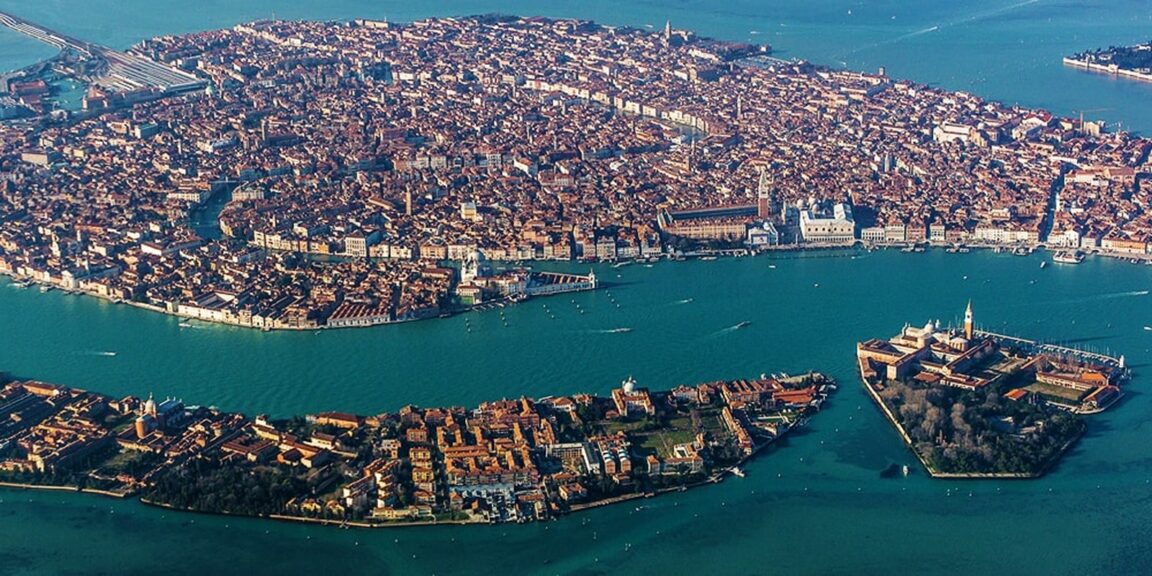
Image credit: Aerial view of the Venice historic centre and the Giudecca Canal, via Visit Venezia (visitvenezia.eu), the official tourism portal of Venice.