 Jordan Ellis
Two days in the Badlands work best as a split decision: give Day 1 to the paved Badlands Loop Road, Highway 240, starting with sunrise at the Door Trail and the short trails around the Ben Reifel Visitor Center, and give Day 2 to the gravel Sage Creek Rim Road on the west side for wildlife, using the town of Wall as the working base. The paved loop delivers the formations in a reliable order; the gravel road delivers bison, prairie dogs and quiet, but only in dry weather. Wall Drug, minutes from the Pinnacles Entrance, earns a short stop and no more. That order, loop first and gravel second, is what this itinerary is built on.
Quick Facts
- Park: Badlands National Park, southwestern South Dakota, about 244,000 acres of eroded buttes, pinnacles and mixed grass prairie, 75 miles east of Rapid City
- Entrance fee: $30 per private vehicle, $25 per motorcycle, $15 per person on foot or by bike, each valid for 7 days, park annual pass $55, park is cashless, per the National Park Service fee schedule checked on November 20, 2026
- Main drive: Badlands Loop Road, Highway 240, paved, linking the Northeast Entrance at Interstate 90 Exit 131 with the Pinnacles Entrance at Exit 110 near Wall
- Wildlife road: Sage Creek Rim Road, Highway 590, gravel, along the north rim of the Badlands Wilderness Area; may close after heavy rain or snow
- First trails: Door Trail and Window Trail, short boardwalks sharing one parking area near the Ben Reifel Visitor Center
- Base: Wall, at the park’s northwest door, with Interior as the quiet alternative near the visitor center
- Water rule: Carry water on every trail; the park recommends two quarts per person per two hour hike
- Prices checked: November 20, 2026, against National Park Service sources
How should Day 1 on the Loop Road be ordered?
Start before the heat, at the Door and Window parking area near the Ben Reifel Visitor Center, and walk the Door Trail first. The trail begins as an accessible boardwalk of about a quarter mile that passes through a break in the Badlands Wall known as the Door; beyond the boardwalk, numbered posts mark a route across the eroded surface for a full round trip of about 0.75 miles, per the National Park Service Badlands hiking page. Early light is the practical reason to start here: the formations face the morning, the boardwalk is empty, and standing inside the formations before driving past them changes how every later overlook reads. The Window Trail, a 0.25 mile accessible boardwalk to a natural window in the wall framing an eroded canyon, takes about 20 minutes from the same parking area and belongs in the same first hour.
From the trailhead, work west along the Loop Road with the visitor center as the hinge. Stop at the Ben Reifel Visitor Center for the exhibits and the working fossil preparation lab, where visitors can watch fossils being cleaned, then continue to the Fossil Exhibit Trail, a 0.34 mile accessible boardwalk loop with fossil replicas and interpretation. Drivers new to the park can compare this two day split with our Badlands first timer guide, which concentrates on a single first day. Add the Notch Trail on Day 1 only if the ground is dry and nobody in the group minds heights: 1.25 to 1.5 miles round trip from the south end of the Door and Window parking area, through a canyon, up a log ladder and along a ledge to a view over the White River Valley. The park warns that the Notch is treacherous during and after rain and is not recommended for anyone with a fear of heights. Finish Day 1 driving the western overlooks toward the Pinnacles Entrance and out to Wall for the night, which sets up Day 2 without backtracking.
Sage Creek Rim Road or a second loop day: which belongs on Day 2?
Sage Creek Rim Road, provided the weather is dry. The road is gravel, signed as Highway 590, and runs along the north rim of the Badlands Wilderness Area on the park’s west side, reached from the Pinnacles Entrance side near Wall. It is the park’s wildlife road: the open prairie along it is where bison, bighorn sheep and prairie dog towns are most reliably part of the drive, and the Sage Creek Campground area at its far end is the park’s quieter, first come side. The National Park Service directions page states the condition plainly: the road may be temporarily closed after heavy rain or snow, and gravel Badlands clay is not a surface to argue with when wet. Check the road status at the entrance or visitor center on the morning of Day 2, and if the road is closed or the clay is wet, take the fallback without regret: a slower second pass on the paved loop, walking the Castle Trail’s eastern section or the Medicine Root Loop, a 4.18 mile prairie loop, in the cool of the morning.
The decision matters because the two roads show different parks. The Loop Road is geology at windshield scale, one eroded overlook after another, and it can be done well in a single day. Sage Creek is the prairie park, grass, sky and animals, with the formations as a rim rather than the main event. A two day trip that spends both days on the loop repeats itself; a two day trip that splits them does not. Allow a half day for Sage Creek rather than a full day, which leaves Day 2 afternoon for the drive out, whether that is back to Rapid City, 75 miles west, or onward. Keep the park’s distance rule on every wildlife stop: stay at least 100 feet from all wildlife, and if an animal reacts to your presence, you are too close.
How much time does Wall Drug actually deserve?
About half an hour, treated as a supply stop with entertainment attached. Wall is the practical base for this itinerary because it sits about seven miles north of the Pinnacles Entrance on Interstate 90, with fuel, food and beds in one small grid, and Wall Drug is its famous roadside store, advertised on billboards for hundreds of miles. The honest proportion is this: stop for fuel, water, a meal and a walk through the store because it is part of the road trip record, then leave. Every hour spent there in the morning is an hour taken from the Door Trail’s best light or the Sage Creek wildlife hours, and the park, not the store, is why the trip exists. The same logic applies at the other end of the park: Interior, near the visitor center entrance, is the quieter overnight choice for visitors who want a dawn start at the Door Trail without a morning drive, at the cost of Wall’s wider choice of rooms and restaurants.
What should be reserved, carried and checked before the two days?
Reserve the room in Wall or Interior first, because park entry itself needs no reservation: passes are bought at the entrance stations by card, since the park is cashless, or in advance as a digital pass. Nothing inside the two days requires booking, which makes weather the main variable. Carry water as the park directs, two quarts per person for a two hour hike, plus hats, sunscreen and sturdy shoes, because the hiking page warns about cactus spines, snakes and rapidly changing weather, and because there is no shade worth the name on the exposed trails. Badlands also operates an open hike policy, meaning visitors may walk off trail, but the marked short trails in this itinerary are the right scope for a two day first trip. Check two things on the park’s site the week before: Sage Creek Rim Road status after any rain, and any trail notices, including repair closures that can affect the Notch Trail. Visitors stringing the Dakota parks together can extend the same layered rock logic south and west with our Petrified Forest road trip guide, a useful comparison for how a single park drive can carry a full day.
Frequently Asked Questions
How much does Badlands National Park cost to enter?
A private vehicle pass costs $30, a motorcycle pass $25 and a per person pass for visitors on foot or by bike $15, each valid for 7 days. The park annual pass costs $55. The park is cashless, so pay by card at the entrance station or buy a digital pass in advance. Fees were checked against the National Park Service on November 20, 2026.
Is Sage Creek Rim Road worth it on a two day trip?
Yes, in dry weather. The gravel road along the north rim of the Badlands Wilderness Area is the park’s best wildlife drive, with bison, bighorn sheep and prairie dog towns along open prairie. It may close after heavy rain or snow, so check its status on the morning of the visit and use a second paved loop day as the fallback.
How long are the Door and Window trails?
Short. The Window Trail is about 0.25 miles round trip on an accessible boardwalk. The Door Trail boardwalk is about a quarter mile, and the full marked route beyond the boardwalk brings it to about 0.75 miles round trip. Together they take under an hour at an easy pace and share one parking area near the Ben Reifel Visitor Center.
Where is the best base for two days in the Badlands?
Wall, about seven miles north of the Pinnacles Entrance, offers the widest choice of lodging, fuel and food and the easiest access to Sage Creek Rim Road. Interior, near the Ben Reifel Visitor Center, is quieter and better for a sunrise start at the Door Trail. Rapid City, 75 miles away, works as a regional base but adds a long drive to each day.
Can the Badlands be seen in one day instead of two?
The paved Loop Road and the Door, Window and Fossil Exhibit trails can be done well in one long day. What a single day usually loses is Sage Creek Rim Road and any unhurried trail time. Two days is the shortest visit that covers both the formation country and the prairie wildlife side of the park.
Is the Notch Trail suitable for children and nervous hikers?
The park advises caution. The Notch Trail climbs a log ladder and follows an exposed ledge with drop offs and loose gravel, is not recommended for anyone with a fear of heights, and becomes treacherous during and after rain. The Door, Window, Cliff Shelf and Fossil Exhibit trails are the safer short alternatives from the same area.
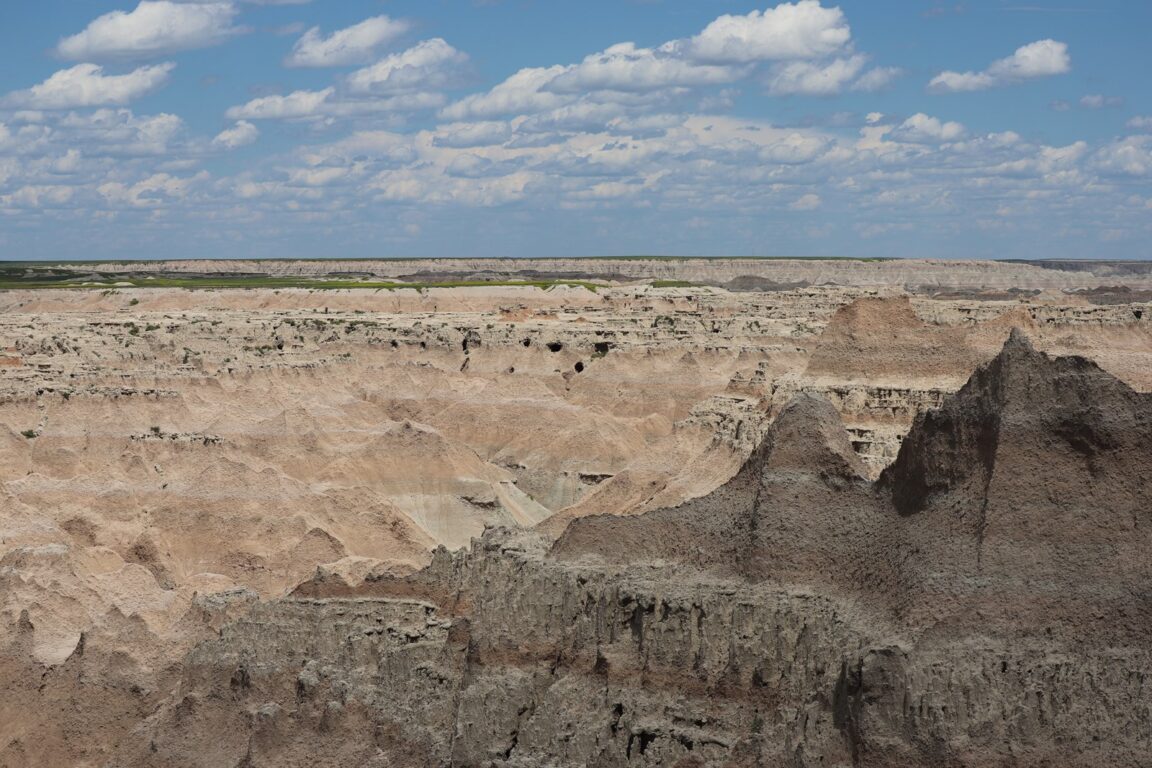
Featured image: Layered Badlands formations and eroded ridges seen from the end of the Window Trail, Badlands National Park. Photo from the National Park Service official site (nps.gov), NPS Photo, US Government work, used with credit.