 Sofia Rossi
Casa San Agustín is the right Cartagena splurge if the courtyard matters more to you than a sea view, and the honest version of the choice is this: book a room that faces inward. The hotel is three colonial houses joined together inside the walled city, with 20 rooms and 11 suites arranged around a courtyard pool that runs beneath a weathered stone aqueduct wall. Rooms that face the street, including the Prestige Suites, which the hotel lists with a balcony and street view, put you closer to the Old Town’s evening life and its noise. Rooms that face the courtyard trade the street scene for the pool, the palms and a quieter outlook. Everything else about the hotel, the Alma restaurant, the Aurum Spa and the private beach arrangement on Barú, supports that central decision rather than replacing it.
Quick Facts
What it is: A boutique hotel made of three houses inspired by Cartagena’s colonial heritage, inside the walled historic centre.
Rooms: 20 rooms and 11 suites, in five categories listed on the hotel’s own site.
Address: Centro, Calle de la Universidad No. 36 to 44, Cartagena de Indias, Colombia.
Pool: A courtyard pool set beneath an old aqueduct wall, photographed extensively in the hotel’s own gallery.
Restaurant: Alma, presented by the hotel as a cultural experience built on the flavours and colours of Cartagena, plus the Alma Bar.
Spa: Aurum Spa, on site.
Beach: Acasí Beach on Barú Island, described by the hotel as a private beach, with a restaurant and six rustic bungalows.
Recognition stated by the hotel: Two Michelin Keys for 2026, and membership of The Leading Hotels of the World.
Airport: The hotel states a 20 minute drive from Cartagena’s international airport.
Prices checked: 25 November 2026. This guide deliberately gives no rates, because the hotel sells through its own booking engine and rates move by date and category.
What Are the Three Colonial Houses, Exactly?
The hotel’s own description is unusually plain about its structure, and that plainness is the appeal. Casa San Agustín calls itself a boutique hotel made of three houses, redesigned as an ode to the past, with 20 rooms and 11 suites that evoke its heritage in every detail. On its Our House page it dates its beginnings to the 17th century and points to the features that carry that date: wooden beamed ceilings, wall frescoes, whitewashed walls and simple but sophisticated traditional decoration. Nothing about that list is generic luxury language. Beamed ceilings and frescoes are either in the building or they are not, and the hotel publishes photographs of both, alongside stone walls, heavy studded wooden doors, ironwork gates, terracotta floors and interior balconies in dark wood.
Because the hotel follows the plan of three houses rather than one purpose built block, the rooms are not copies of each other. The hotel itself markets the Deluxe Rooms as each chic and unique, which is a fair summary of what happens when bedrooms are fitted into historic houses of different shapes. For a traveller, the practical consequence is that the category you book sets the size and the extras, but the orientation, meaning courtyard or street, is the detail worth confirming directly with the hotel before you arrive. Two rooms in the same category can feel quite different in an old house, and the hotel’s published material makes that easy to understand rather than hiding it.
Courtyard Rooms or Street Rooms: Which Should You Book?
This is the decision the whole stay turns on, so it deserves a direct answer. If sleep quality is your priority, ask for a courtyard facing room. The courtyard is the hotel’s interior world: pool, palms, loungers and the aqueduct wall, enclosed by the houses themselves. A room looking into it looks into the quietest space the property has. If you want to watch the Old Town go by, the street facing options are the ones the hotel itself identifies. Its rooms page describes the Prestige Suite, a 161 square metre duplex, with a balcony and street view, and the Suite Del Virrey, a 170 square metre duplex, with two private terraces and a jacuzzi. Street view is sold there as a feature, and in the daytime it is one. Cartagena’s Centro is handsome, busy and worth watching.
The honest caveat is that a street view in the walled city is also a street soundtrack. The Old Town stays lively late, with restaurants, bars, music and carriage and foot traffic on stone streets that carry sound. The hotel does not publish noise guarantees, and no traveller should expect a 17th century house in the middle of the Centro to behave like a sealed modern tower. Thick historic walls help, and an inward facing room helps more. Light sleepers should say so when booking, ask which side of the house the room sits on, and treat a high category street suite as a choice for space and terraces rather than for silence. Travellers who plan to be out late themselves will mind far less, and for them the Prestige and Del Virrey layouts, with living rooms and terraces, are the strongest rooms in the house on paper.
How Do the Five Room Categories Compare?
The hotel lists five categories, and the sizes it publishes are generous by Old Town standards. The Deluxe Rooms are the entry point: 20 of them, sized at 48 to 68 square metres, presented for couples with colonial decoration. The Junior Suites add a living room and a sofa bed across 70 to 90 square metres, in a run of five suites, which makes them the natural pick for a parent and child or for friends who want a sitting space that is not a bed. The Premium Suites, three of them at 90 square metres, are aimed at honeymooners, with a private terrace, a jacuzzi and a garden view. That garden view wording matters: it places these suites on the inward, green side of the house rather than the street.
At the top sit the two duplexes. The Prestige Suite sleeps its guests over two levels at 161 square metres, with a living room and the street facing balcony already discussed. The Suite Del Virrey is the largest at 170 square metres, also a duplex, with two private terraces and a jacuzzi, described by the hotel as one of a kind. Families and small groups comparing Cartagena hotels should note the shape of this range: the step from a Deluxe Room to a Junior Suite buys a living room, and the step to the duplexes buys a small apartment. Anyone pricing a stay should do it in the hotel’s own booking engine for their exact dates, because this guide does not quote rates and the difference between categories is a decision about space and orientation, not about a fixed number.
What Is the Courtyard Pool Actually Like?
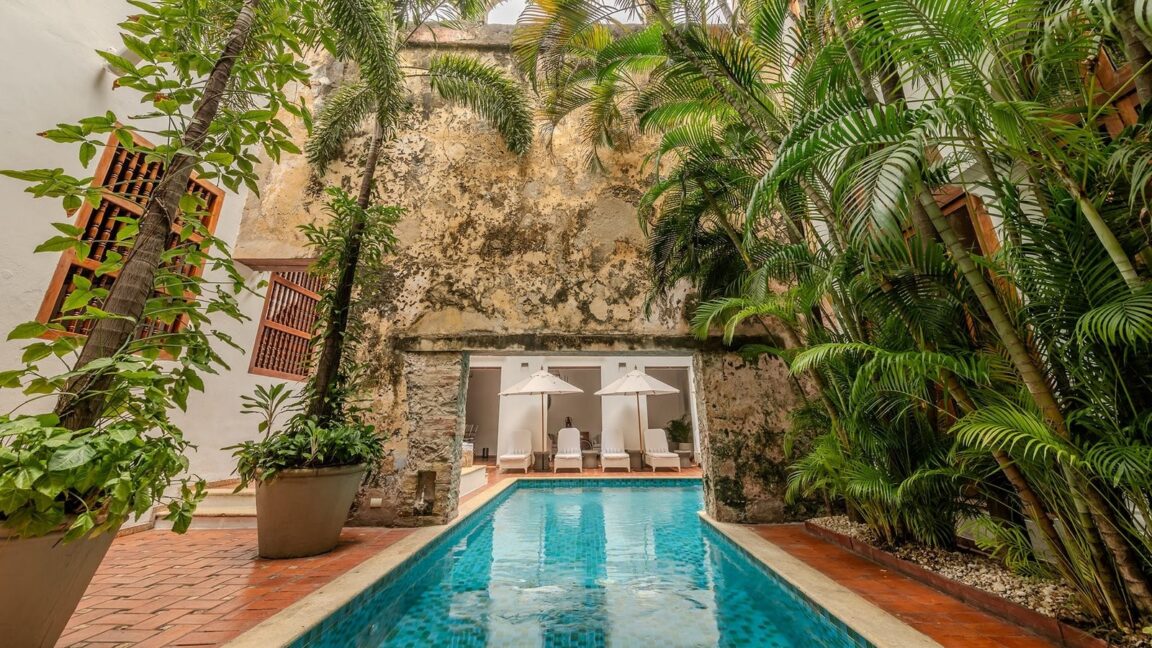
The pool is the hotel’s centrepiece and its best argument. In the hotel’s own gallery photographs, a long, narrow, mosaic tiled pool runs through the courtyard towards a weathered stone wall, and the water passes beneath an opening in that wall to loungers and umbrellas on the far side. Palms and dense tropical planting close in on both sides, and shuttered wooden windows look down from the white walls. Forbes Travel Guide, describing the same feature, calls it a 300 year old untouched aqueduct that cuts through the pool, and the hotel’s imagery supports the essential point without any embellishment: this is a pool built around a piece of the old city’s fabric, not a pool decorated to look old.
Read the scene honestly, though. This is a courtyard pool in a 31 key hotel, made for a morning swim, a hot afternoon hour and a quiet drink beside the water. It is not a resort pool deck, there is no beach in front of it, and at busy times its loungers will be shared with the rest of a small house. Travellers who want long lap swimming or a big pool scene should choose a Bocagrande resort instead. Travellers who want to swim under a stone aqueduct wall, then sit in the shade of palms inside a colonial courtyard, are exactly who this pool was made for. Cartagena’s heat makes the arrangement more than decorative: a shaded courtyard with water at its centre is the part of the hotel you will use in the middle of the day, when the streets outside are at their hottest.
What Does Alma Add to a Stay?
More than most hotel restaurants do. The hotel presents its gastronomy as a cultural experience, with each dish in the Alma Restaurant echoing the flavours and colours of Cartagena. Its gastronomy page pairs Alma with the Alma Bar, described as Cartagena by the glass, and notes that Alma works with local ingredients given innovative twists. For a guest, that means the best dinner of the trip is available without a walk, a reservation across town or a taxi back, which in the Old Town’s evening heat is a real convenience rather than a slogan. It also means the courtyard has a second life at night as a dining room, one more reason the inward facing side of the house stays animated in the evening even as it stays enclosed.
The same page carries a useful footnote for longer stays: Animare, at the sister property Hotel Casa Pestagua, is part of the same small family. Guests who like to vary their dining without leaving a trusted kitchen’s orbit have a second address. None of this requires a stay, since Alma is a Cartagena restaurant in its own right, but staying guests get the simplest version of it, downstairs.
How Does the Beach Work, If the Hotel Is Inside the Walls?
By boat, and by arrangement, which is the standard Cartagena pattern and one the hotel states openly. Its Acasí Beach page describes a private beach on Barú Island, presented as just for a few guests, with a restaurant serving authentic Colombian cuisine and a fresh take on tropical flavours, plus six rustic bungalows where it is possible to wake up overlooking the Caribbean Sea. So a Casa San Agustín stay is really two stays in one booking: the walled city base, and a beach day, or even a beach night, on Barú. Ask the concierge how transfers run on your dates before you plan the day, because the hotel presents Acasí as its own place rather than as a public beach club with a timetable printed on the hotel homepage.
That split is worth weighing against the alternatives. A beachfront resort gives you the sea every morning and the Old Town by taxi. Casa San Agustín gives you the Old Town at your door and the sea as an excursion. For a first Cartagena trip built around the walled city, its food and its evenings, the second pattern usually fits better, and it is the pattern this hotel is designed around. Our 2 days in Cartagena itinerary shows how a walled city base sequences the Centro and a Getsemaní night, and it pairs naturally with a Barú beach day in a longer stay.
What About the Walk to the Clock Tower at Night?
Short, central and on the busiest streets in the city. The hotel stands on Calle de la Universidad in the Centro, inside the walls, and the clock tower, the Torre del Reloj at the main gate of the old city, is a few blocks away through the Centro’s plazas and restaurant streets. At night those streets are the most populated in Cartagena: diners, street performers, horse drawn carriages and other travellers fill them well into the evening, and the route from the hotel stays inside that lit, busy core the whole way. There is no dark or isolated stretch to plan around, and no taxi needed for the distance.
The sensible cautions are the ordinary Old Town ones. Stone streets and heat argue for flat shoes and a slow pace. Late at night, as anywhere, keep to the busy streets rather than quiet side lanes, keep valuables low key, and agree any carriage price before you climb in. Travellers heading further south into Colombia after Cartagena will find a different rhythm in the coffee country, covered in our Salento and Cocora Valley guide, but within the walls the clock tower walk is one of the easiest evening strolls in the city, and staying on Calle de la Universidad puts it on your doorstep.
Who Should Book Casa San Agustín, and Who Should Not?
Book it if you are a couple or a small group who came for the walled city itself, who value a small house of 31 keys over a resort’s scale, and who will actually use a courtyard, a serious restaurant and a spa, the hotel’s Aurum Spa, between walks. Book it, specifically in a courtyard facing room or a Premium Suite with its garden view, if you are celebrating something and want the setting to do the work. The hotel’s stated honours, two Michelin Keys for 2026 and membership of The Leading Hotels of the World, are consistent with that positioning, and its own site leads with heritage rather than with facilities lists, which tells you what it thinks it is selling.
Look elsewhere if you need a beach outside your door every day, a large pool deck, or guaranteed silence on a street facing room in the liveliest part of town. Look elsewhere, too, if you are travelling with a big group that needs many identical rooms, because a hotel built from three historic houses does not have them. Those are not flaws. They are the terms of a small colonial house hotel, stated plainly enough on its own pages that a traveller can decide before booking rather than after arriving.
Frequently Asked Questions
How many rooms does Casa San Agustín have?
The hotel states 20 rooms and 11 suites, 31 keys in total, across five categories: Deluxe Rooms, Junior Suites, Premium Suites, Prestige Suites and the Suite Del Virrey.
Which rooms are quietest at Casa San Agustín?
The hotel does not publish a noise ranking. On its own descriptions, the Premium Suites face the garden and the courtyard side is enclosed by the houses, while the Prestige Suite is sold with a balcony and street view. Light sleepers should request a courtyard facing room and confirm the orientation with the hotel when booking.
What is the aqueduct in the pool?
The courtyard pool runs beneath a weathered stone aqueduct wall, clearly visible in the hotel’s own gallery. Forbes Travel Guide describes that aqueduct as 300 years old and untouched, cutting through the pool.
Does Casa San Agustín have a beach?
The hotel presents Acasí Beach on Barú Island as its private beach, with a restaurant and six rustic bungalows. It is reached as a beach excursion from the walled city, arranged through the hotel, rather than sitting in front of the hotel.
What is Alma at Casa San Agustín?
Alma is the hotel’s restaurant, presented as a cultural experience built on the flavours and colours of Cartagena, using local ingredients with innovative twists. The Alma Bar sits alongside it.
How far is Casa San Agustín from Cartagena airport?
The hotel states that it is a 20 minute drive from Cartagena’s international airport. Its address is Centro, Calle de la Universidad No. 36 to 44, inside the walled city, a few blocks from the clock tower.
Image credit: The courtyard pool at Hotel Casa San Agustín, running beneath the old aqueduct wall, photographed for the hotel and published on its official website, hotelcasasanagustin.com. Hotel Casa San Agustín, via its official website.
Facts in this guide were checked against the hotel’s own official website on 25 November 2026. Room sizes, category counts and arrangements such as Acasí Beach can change, so confirm the details that matter to your stay with the hotel when you book.