 Sofia Rossi
The short answer is that the Henry Jones Art Hotel earns its premium in exactly two places, the harbour facing rooms of the old IXL jam factory and an art programme that runs through every corridor, and it asks one compromise in return: the harbour outside those windows is a working port, not a painted backdrop. Book a Deluxe Spa Harbour View Room or better and the stay delivers the thing no newer Hobart hotel can copy, a bed inside a 19th century sandstone warehouse, original Tasmanian art on the wall, and the docks of Sullivan’s Cove framed by the window. Book it expecting silence and a generic luxury finish, and the same building will test you. This assessment is drawn from the hotel’s own published facts, its room descriptions, its art and history pages and its dining pages, checked on 25 November 2026.
Quick Facts
Address: 25 Hunter Street, Hobart, Tasmania 7000, in the Hunter Street precinct on the Hobart waterfront
The building: A row of Hobart’s oldest waterfront warehouses, with origins the hotel dates from 1804, converted from the IXL jam factory and opened as a hotel in 2004
The claim: Australia’s first dedicated art hotel, with nearly 500 original artworks displayed through rooms, corridors and gallery spaces
Rooms and suites: Eight published categories, from Corporate Studios and Standard Rooms to the H. Jones Suite and Peacock Terrace, all individually designed, with rooms refurbished in 2018
Published starting rates: From $290 AUD for a Corporate Studio and $340 AUD for a Standard Room, rising to $1,180 AUD for Peacock Terrace, as listed on the hotel’s own rooms page when checked
Check in and out: Check in from 2:00pm, check out at 10:00am
Parking: Valet parking operates 24 hours, complimentary with suite bookings and $35 per day for other room types
Dining on site: Landscape Restaurant & Grill, IXL Long Bar and Jam Packed Café, plus in-room dining
Art tour: Art and History Tours run at 4:00pm most days, complimentary for in-house guests and $35 per person for the public
A jam factory first, a hotel second
The history is the product here, and the hotel’s own account of it is specific enough to judge. The warehouses on Hunter Street began as part of Hobart’s earliest waterfront, and the site became the factory and headquarters of IXL Jams, the company founded by George and Margaret Peacock. Henry Jones started work in Peacock’s jam factory at the age of 12, became foreman at 20, and bought a controlling interest with two partners when Peacock retired in 1891, renaming the business IXL Jams after his personal motto, “I excel in everything I do.” The factory worked on the Hunter Street site until the early 1970s, canning and exporting Tasmanian fruit, and the buildings then sat largely derelict for decades, used informally by students from the neighbouring Tasmanian School of Creative Arts.
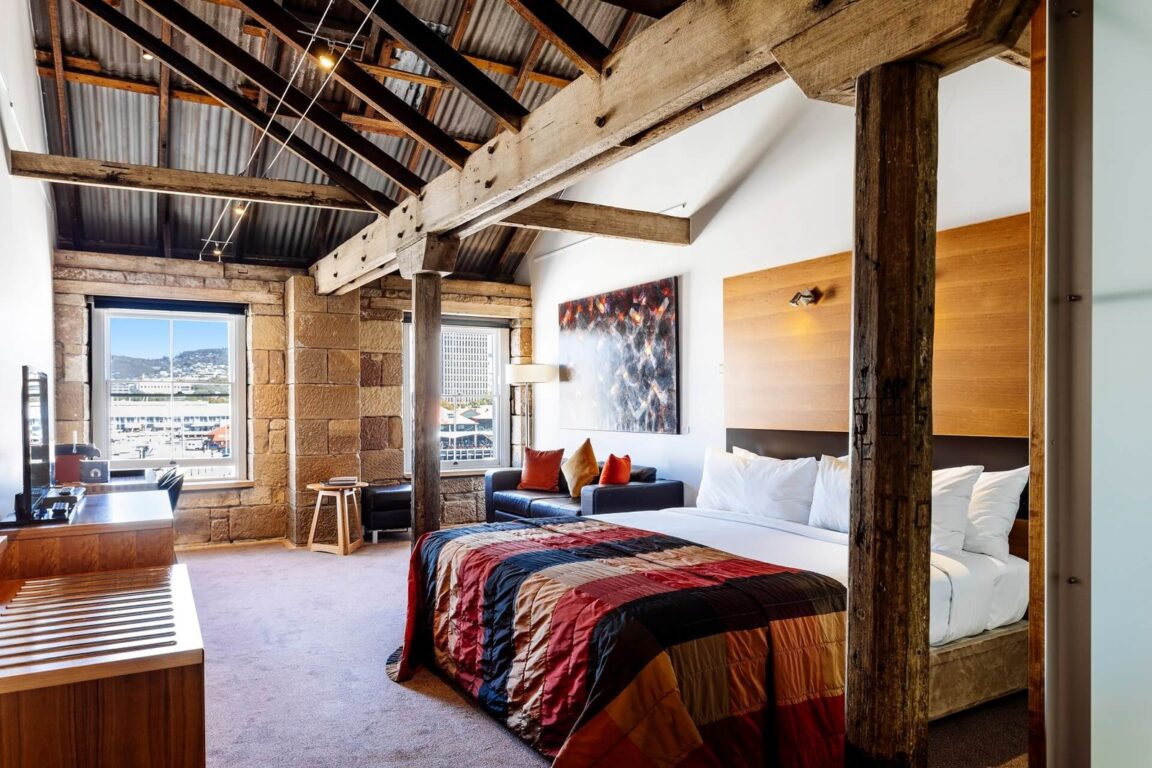
Planning for the hotel began in 2000 and it opened in 2004, designed by architect Robert Morris-Nunn to preserve as much of the surviving factory as possible. The hotel states that only four beams were replaced for safety during construction, that new structural elements are painted the signature Henry Jones red so old and new can be told apart, and that on hot days a scent of sugar and berries can still be caught from the sandstone. Whether or not the scent performs on a given afternoon, the fabric is genuinely the point: hand cut stone walls, rough hewn timber trusses and arched warehouse openings run through the public spaces and many of the rooms, and no two rooms are laid out alike, because a factory floor plate does not divide into identical boxes.
The rooms, category by category
The hotel publishes eight room and suite categories, and the ladder is unusually legible, because each step up buys a named thing rather than a vaguer promise of luxury. At the base, Corporate Studios, from $290 AUD, are dual level lofts set above the IXL Atrium, bright and airy with original art, aimed at travellers who want the building without paying for a view. Standard Rooms, from $340 AUD, sit inside the former factory complex itself, with original art and heritage stone and timber, but no guaranteed outlook, since the hotel is frank that not all room types include one.
The middle of the range is where most guests will land. Deluxe Spa Rooms, from $440 AUD, add the hotel’s signature bathroom format, a translucent glass bathroom built around an ultra deep Kohler elliptical spa bath, and they sit in either the original factory or the modern building, a distinction worth asking about when booking, since the heritage fabric is the reason to be here. Standard Harbour View Rooms also start from $440 AUD and trade the spa for the view, with wide harbour and city views from timber framed windows and interiors that vary room to room, some in exposed stone, others lined with the blackwood panelling of the old IXL administration offices.
Deluxe Spa Harbour View Rooms, from $490 AUD, combine the two, harbour frontage plus the Kohler spa, and are the category this hotel will be judged by for most couples: the published premium over a Standard Room is modest next to the gap between this hotel and an ordinary waterfront chain property. Above them, the Oriental Suites, from $930 AUD, sit in the original Henry Jones Ice House, with Asian design accents against raw Tasmanian materials and views to the harbour or to kunanyi, Mount Wellington. The H. Jones Suite, from $1,030 AUD, occupies the former IXL boardroom at the top of the grand staircase, lined in Tasmanian blackwood, with a Kohler SOK overflowing spa and harbour views. Peacock Terrace, from $1,180 AUD, is the 1823 home of George and Margaret Peacock, described by the hotel as the oldest standing building on the Old Wharf, arranged over two levels with two separate bedrooms, a sitting room with fireplace, a kitchenette and harbour views, which makes it the natural pick for families and small groups who want the deepest layer of the site’s history.
Is the harbour view premium worth paying?
On the hotel’s own numbers, yes, with one condition. The step from a Standard Room at $340 AUD to a harbour view at $440 AUD, or to the spa and view combination at $490 AUD, is small in percentage terms against the total cost of a Tasmanian trip, and the view is the hotel’s defining asset: a working harbour, the city behind it, and the mountain beyond, seen through the warehouse’s original window openings. The condition is that the view and the building’s character are the same purchase. A traveller who values a silent, sealed, identical room will find better value in a modern tower. A traveller who wants to wake inside the port’s history, and to look at original art rather than reproduction prints, is paying for something that cannot be replicated down the street. The hotel also publishes two standing offers worth factoring into the maths, up to 15 percent off for booking 30 days ahead, and 20 percent off stays of three nights or more in its rooms and suites.
The harbour noise question, stated plainly
No honest assessment of this hotel can skip the docks. The Henry Jones stands on Hunter Street at the edge of a working port, and the hotel itself describes the outlook from its harbour rooms as a bustling harbour. That is the correct frame for the noise question: this is a judgment about fit, not a defect to be uncovered. A working waterfront means vessel movements, port activity and the ordinary sound of a small city harbour doing its job, and the Hunter Street precinct adds restaurant and bar life in the evenings, with waterfront events in season drawing crowds to the docks. None of that is hidden, and none of it should surprise anyone who books a room chosen precisely for its front row seat over the water.
Light sleepers should therefore choose their category with the trade in mind. The harbour facing rooms put the port on the other side of heritage windows in a converted warehouse, a very different acoustic proposition from a sealed modern tower, and the hotel’s room range offers the obvious alternative in its own list: rooms without a harbour outlook, facing into the site or its historic courtyard, keep the stone, the timber and the art while stepping back from the dock edge. Anyone for whom sleep is fragile should say so when booking and ask which side of the building a room sits on, rather than paying the harbour premium and then fighting it. Travellers who sleep through city sound, or who actively enjoy a port waking up below the window, will read the same facts as atmosphere.
The art programme, judged as a guest experience
Many hotels hang art; this one is organised around it, and the published programme is substantial enough to plan time for. The hotel displays nearly 500 original artworks, paintings, prints, sculpture, photography and design objects, mostly by Tasmanian artists, across rooms, corridors and dedicated gallery spaces including the Packing Room Gallery and the IXL Atrium, with the collection evolving as works are introduced through the year. Crucially for guests, the majority of the works are for sale, with a full digital catalogue on the hotel’s website listing artists, background stories and prices, so a corridor browse can turn into a purchase with the paperwork already done.
The structured experiences are the strongest part of the offer. The Art and History Tour leaves reception at 4:00pm most days, runs one to one and a half hours, is led by the hotel’s Art Curator alongside storytellers from neighbouring MACq 01, includes a glass of Tasmanian sparkling, and is complimentary for in-house guests. A second tour, Sticky Stones and Secrets, runs daily at 12:30pm and goes behind the scenes into the 19th and 20th century lives of the Hunter Street buildings. The Artist in Residence programme places emerging Tasmanian artists at work in the reception area, where guests can watch the process and talk with the artist. Beyond the building, the hotel runs the Henry Jones Art Prize for early career Tasmanian artists, with two $20,000 prizes across painting and mixed media plus a $1,000 People’s Choice Prize and a $750 Packing Room Prize, and it is the principal partner of the John Glover Prize, the $75,000 landscape prize for art depicting Tasmania. Eleven original works by John Glover himself hang in the hotel’s Landscape Restaurant & Grill, which means dinner comes with a small, serious collection of colonial landscape painting. For a Hobart trip built around MONA, Salamanca and the city’s gallery scene, the Henry Jones is the rare hotel that continues the theme after the gallery doors close.
Eating and drinking without leaving the building
The in-house food and drink offer covers the full day, which matters on a waterfront where the weather can turn a dinner walk into a negotiation. Landscape Restaurant & Grill is the flagship, serving dinner only, from 5:45pm seven nights, built around premium Tasmanian produce cooked over an Asado grill fired with seasoned local timber, with aged Wagyu, Tasmanian lamb and seafood among its signatures, and the Glover paintings on the walls; the restaurant was awarded a Chef Hat in 2022 by the Australian Good Food Guide. IXL Long Bar opens daily from 4:00pm until late, pouring cocktails, Tasmanian spirits, wines, craft beers and ciders with a small plates menu, and live music features in the hotel’s description of the room. Jam Packed Café handles breakfast and lunch daily, with breakfast served from 6:30am, barista coffee and a walk in format that also welcomes non-guests. In-room dining runs from breakfast through a Night Owl menu in the small hours, useful insurance for late arrivals off the Spirit of Tasmania or a delayed flight.
Who should book it, and who should think twice
Book the Henry Jones if the trip is about Hobart itself: a first visit built on the waterfront, Salamanca and the MONA ferry, which leaves from the Brooke Street Pier a short walk from the hotel’s door, an art focused weekend, or a couple’s stay where the room is part of the experience rather than a place to sleep between experiences. The hotel’s position, at 25 Hunter Street with the city centre behind it, also suits the sequencing in a three day Hobart plan of market, ferry and mountain, since almost everything in it starts within walking distance. Think twice if unbroken quiet is the top priority, if a guaranteed identical room layout matters, or if the budget only stretches to the entry categories while the heart is set on the harbour, because the gap between the base rooms and the harbour spa rooms is where this hotel’s reputation is actually made. Judged on its own published facts, the Henry Jones is not Hobart’s most luxurious hotel in the abstract. It is the most Hobart hotel in Hobart, and for the right traveller that is the better thing to be.
Frequently asked questions
Is the Henry Jones Art Hotel really a former jam factory?
Yes. The hotel occupies the Hunter Street warehouses that housed the IXL jam factory and headquarters. Henry Jones joined founder George Peacock’s factory at 12, became foreman at 20 and bought a controlling interest in 1891, renaming it IXL Jams. The factory operated on the site until the early 1970s, and the hotel conversion, opened in 2004, preserved the sandstone, timber trusses and warehouse openings, replacing only four beams.
Which rooms at the Henry Jones have harbour views?
The Standard Harbour View Rooms and Deluxe Spa Harbour View Rooms face the harbour directly, and the H. Jones Suite, the Oriental Suites and Peacock Terrace also offer harbour views among their outlooks. Standard Rooms, Deluxe Spa Rooms and Corporate Studios do not guarantee a view, and the hotel notes that not all room types include an outlook.
Can guests buy the art on the walls?
Yes. The hotel states that the majority of its nearly 500 displayed artworks are for sale, and its online art catalogue lists each work with the artist, background information and pricing. The collection focuses on contemporary Tasmanian artists, and exhibitions in spaces such as the Packing Room Gallery and the Atrium change through the year.
Are the art and history tours free for guests?
The Art and History Tour, departing at 4:00pm most days and lasting one to one and a half hours, is complimentary for in-house guests and $35 per person for the public, with bookings essential. A second tour, Sticky Stones and Secrets, runs daily at 12:30pm and explores the buildings’ earlier lives. Private tours can also be arranged in advance.
Is the Henry Jones Art Hotel noisy?
It stands on a working harbour, and the hotel itself describes the harbour below its view rooms as bustling, so harbour facing rooms come with the sound of a functioning port and a lively waterfront precinct. That is a fit question rather than a fault: light sleepers should consider the rooms without a harbour outlook and confirm a room’s position with the hotel when booking, while travellers who enjoy port atmosphere will count the same setting as a feature.
Where is the hotel, and how close is the MONA ferry?
The hotel is at 25 Hunter Street, in Hobart’s oldest waterfront precinct, a short walk from Salamanca Place and the city centre. The hotel notes that the ferry terminal for MONA is nearby, making the run up the Derwent to the museum an easy start from the front door. Check in is from 2:00pm and check out is at 10:00am.
Image: A Deluxe Spa Harbour View Room at The Henry Jones Art Hotel, Hobart, with original sandstone walls, timber trusses and artwork, looking over the harbour. Photo from The Henry Jones Art Hotel, the hotel’s own official website (thehenryjones.com), used with credit.