 Jonas Lindqvist
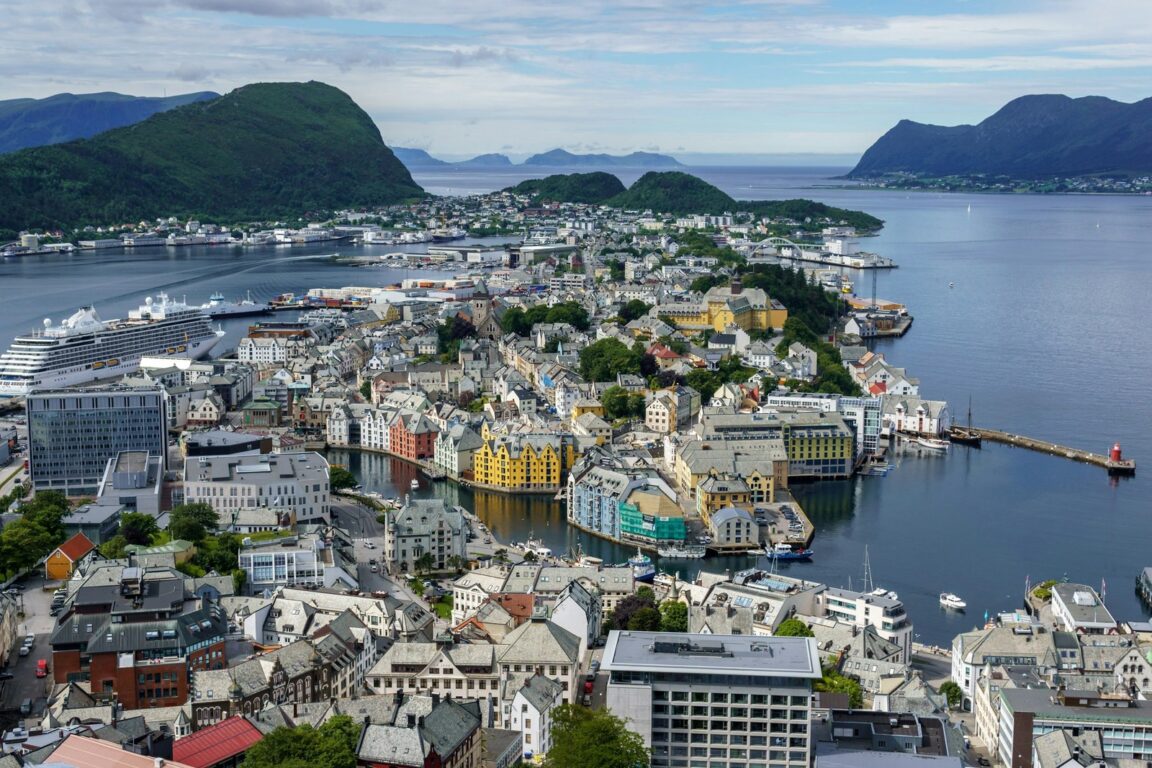
Alesund is the western Norwegian port town that burned almost to the ground on the night of 23 January 1904 and was rebuilt within about three years in stone and brick, in the Art Nouveau style the Norwegians call Jugendstil, which is why its centre looks like one coherent architectural idea rather than a jumble of centuries. Spread across several islands at the entrance to the fjord country, it works on two levels at once: as a town worth a full day in its own right, walking the Brosundet canal and climbing the 418 steps to the Aksla viewpoint, and as the practical gateway for day trips to the UNESCO listed Geirangerfjord. This guide explains the fire and the rebuild, how to read the streets, and how to use the town as a fjord base without treating it as a mere overnight stop.
Quick Facts
- Location: Islands on the west coast of Norway, in More og Romsdal county, at the entrance to the Geirangerfjord
- The fire: Night of 23 January 1904. More than 850 houses burned and about 10,000 people were left homeless, with only one death recorded
- The rebuild: Rebuilt in stone and brick in Art Nouveau, or Jugendstil, style, with more than 300 buildings rising in the years immediately after the fire
- Key museum: Jugendstilsenteret, the Art Nouveau Centre, housed in the former Swan Pharmacy building from 1907 on Apotekergata
- The viewpoint: Fjellstua on Mount Aksla, about 130 metres above sea level, reached by 418 steps from the town park, Byparken
- Fjord role: Gateway town for the Geirangerfjord, a UNESCO World Heritage Site since 2005 as part of the West Norwegian Fjords
- Currency and language: Norwegian krone. Norwegian is official, English is widely spoken
- Best season: May to September for fjord sailings, long daylight and open mountain roads. Winter brings short days, storms and the chance of northern lights
What happened in the fire of 1904?
The fire began on the night of 23 January 1904 and, driven by a storm, moved through a town built almost entirely of wood. By the time it burned out, more than 850 houses were gone and around 10,000 people, most of the town, were homeless. That only one person died was considered remarkable at the time and still shapes how the story is told locally: as catastrophe, certainly, but also as the founding event of the modern town.
Help arrived quickly and conspicuously. Kaiser Wilhelm II of Germany, who holidayed regularly in the Norwegian fjords, sent ships with supplies, building materials and personnel, and relief came from across Norway and Europe. The rebuilding decision that matters for visitors is the one taken locally: the new centre would be built in stone and brick, not wood, and it would be built fast, largely between 1904 and 1907. Because one generation of architects and craftsmen rebuilt one town in one short period, and because the fashionable style of that exact moment was Art Nouveau, Alesund acquired the most concentrated Jugendstil centre in Norway, with turrets, spires, carved stone ornament, dragon and floral motifs, and soft, rounded corners on street after street.
How should you read the Art Nouveau streets?
Start at the Jugendstilsenteret, the national Art Nouveau Centre, which occupies the former Swan Pharmacy, completed in 1907, one of the finest of the rebuilt buildings. Its exhibitions cover the fire, the reconstruction and the style itself, and half an hour there turns the walk that follows from pretty to legible: you begin to spot the difference between the Norwegian national romantic touches, with their hints of stave church carving and Viking ornament, and the cleaner continental Jugendstil lines.
Then walk slowly. The Brosundet canal, the narrow waterway that cuts through the centre and is lined with former warehouses now used as hotels and restaurants, gives the classic reflections on a calm morning. Kongens gata, the main street, and the parallel streets around Apotekergata and Lovenvolddgata carry the densest facades. Look up rather than at shopfronts: the investment after the fire went into gables, oriel windows, towers and carved doorways. The town rewards the same unhurried facade reading that our guide to two days in Reykjavik applies to a very different northern townscape, where one landmark church organises everything around it.
Is Alesund a museum town or a working port?
Both, and the second half matters. Alesund is one of Norway’s major fishing ports, built historically on cod and the klippfisk trade, salted and dried cod exported to Spain, Portugal and Brazil, which is why the town’s signature dish is bacalao, a tomato, potato and olive oil stew that travelled back along the same trade route. Cruise ships berth close to the centre at berths including Storneskaia and Prestebrygga, expedition ships use the town as a fjord gateway, and the harbour traffic is real. Expect working boats in the Brosundet photographs and a town that empties of day visitors in the evening, which is when residents get their streets back.
Why climb the 418 steps to Aksla?
Mount Aksla rises directly behind the centre, and its viewpoint, Fjellstua, at about 130 metres, is the single orientation device for the whole visit. The 418 steps begin in Byparken, the town park at the foot of the hill, and climb in flights with landings and benches, so the ascent is a steady 15 to 30 minutes for most walkers rather than an athletic event. There is also road access and a cafe at the top in season for anyone who prefers to ride up and walk down.
From the top, the geography that is confusing at street level becomes obvious: the islands running west to the open sea, the two halves of the centre divided by the Brosundet, the harbour, and inland the first ridges of the Sunnmore Alps. Go twice if the weather allows, once early for clear air and empty platforms, and once in the long summer evening, when the light rakes across the rooftops. In winter the same platform is a northern lights vantage on clear nights, with the town lights below as the trade off. Travellers building a wider Norwegian winter around aurora odds and glass cabins, as in our Rovaniemi aurora guide, should treat Alesund as the milder, coastal counterpoint: less reliably clear, far less cold, and with a real town attached.
How does Alesund work as the Geiranger gateway?
The Geirangerfjord, about 15 kilometres long and inscribed by UNESCO in 2005 as part of the West Norwegian Fjords listing together with the Naeroyfjord, is the headline day trip. In season, boats sail from Alesund into the fjord, and road trips run through Hellesylt or via the Eagle Road above Geiranger village, passing the Seven Sisters and Suitor waterfalls and the abandoned fjord farms that give the landscape its particular melancholy. It is a full day in any format, roughly two and a half to three hours of travel each way by the common boat and bus combinations, and it should be booked as a full day rather than squeezed.
Two honest cautions belong here. First, mountain roads in this region, including the famous Trollstigen further north, are seasonal and weather dependent, and closures for maintenance or rockfall risk have affected routes in recent summers, so check the status of any specific road on the day rather than trusting a guidebook. Second, Geiranger in peak season receives very large cruise volumes for a very small village. An early sailing from Alesund, or a shoulder season visit in May or September, changes the experience materially. The Hjorundfjord, closer and far quieter, is the connoisseur alternative that local operators increasingly suggest, and the bird island of Runde, linked by bridges west of Alesund, adds a completely different day: cliffs, seabird colonies in season and open Atlantic weather.
How long should you stay, and when should you come?
One full day covers the town properly: museum, street walk, Brosundet, Aksla and a harbour side dinner. Two nights is the sensible minimum if Geiranger is the point of the trip, because it gives a weather margin for the fjord day. Three nights lets the Hjorundfjord or Runde join the plan without rushing. Many visitors arrive on the Hurtigruten or Havila coastal voyage, which in summer detours into the Geirangerfjord from Alesund, or by air through Alesund Airport at Vigra, or by road on a fjord itinerary linking Bergen, Flam and Trondheim.
Season shapes everything. From May to September come long days, open roads, fjord sailings and the cruise crowds. Late autumn and winter bring storms, a handful of daylight hours and a quiet, atmospheric town that suits the Art Nouveau interiors and the Atlantic Sea Park aquarium at Tueneset, one of the largest saltwater aquariums in northern Europe, about three kilometres from the centre. Neither season is the wrong answer. They are simply different towns wearing the same beautiful facades.
Frequently Asked Questions
How many steps are there to the Aksla viewpoint?
There are 418 steps from Byparken, the town park, to Fjellstua, the viewpoint on Mount Aksla at about 130 metres above sea level. Most walkers take 15 to 30 minutes up, with landings to rest on. Road access and a seasonal cafe at the top provide an alternative to climbing both ways.
When did Alesund burn down, and why does it look Art Nouveau?
The fire struck on the night of 23 January 1904, destroying more than 850 houses and leaving about 10,000 people homeless. The centre was rebuilt quickly, in stone and brick, at the moment when Art Nouveau, called Jugendstil in Norway, was the fashionable style, producing more than 300 buildings in a coherent decorative manner.
What is the Jugendstilsenteret?
It is the Art Nouveau Centre, Norway’s national centre for the style, housed in the former Swan Pharmacy building completed in 1907 on Apotekergata. Its exhibitions explain the fire, the rebuilding and how to read the facades, and it is the best first stop in town.
Can you visit the Geirangerfjord as a day trip from Alesund?
Yes, in season, by boat or by road combinations via Hellesylt and the Eagle Road. Allow a full day, roughly two and a half to three hours of travel each way depending on the format, and check current sailings and road status, because mountain roads in the region are seasonal and can close.
How many nights do you need in Alesund?
One full day covers the town itself. Stay at least two nights if a Geirangerfjord day trip is planned, to allow a weather margin, and three nights to add the Hjorundfjord or the bird island of Runde without rushing.
What food is Alesund known for?
Bacalao, the tomato, potato and olive oil stew made with klippfisk, the salted dried cod that built the town’s trade with Spain, Portugal and Brazil. Fresh cod, halibut and shellfish are widely served around the Brosundet, and svele, a thick pancake with butter and brown cheese, is the standard cafe and ferry snack.