 Priya Nair
Two days in Kochi belong almost entirely to two small, walkable neighbourhoods: Fort Kochi, with its Chinese fishing nets, churches and cafe lined lanes, and Mattancherry, a few kilometres east, with the Dutch Palace, the Paradesi Synagogue and the spice warehouses of Jew Town. The itinerary that works is day one in Fort Kochi, ending with the Kathakali make up and performance in the early evening, and day two in Mattancherry, sequenced to dodge the closures that catch visitors out: the palace shuts on Fridays and the synagogue shuts on Fridays, Saturdays and Jewish holidays. Base in Fort Kochi, walk everywhere, and let the harbour set the pace.
Quick Facts
- Base: Fort Kochi, the historic peninsula neighbourhood of heritage hotels, homestays and cafes, about 42 kilometres and roughly 90 minutes by road from Cochin International Airport
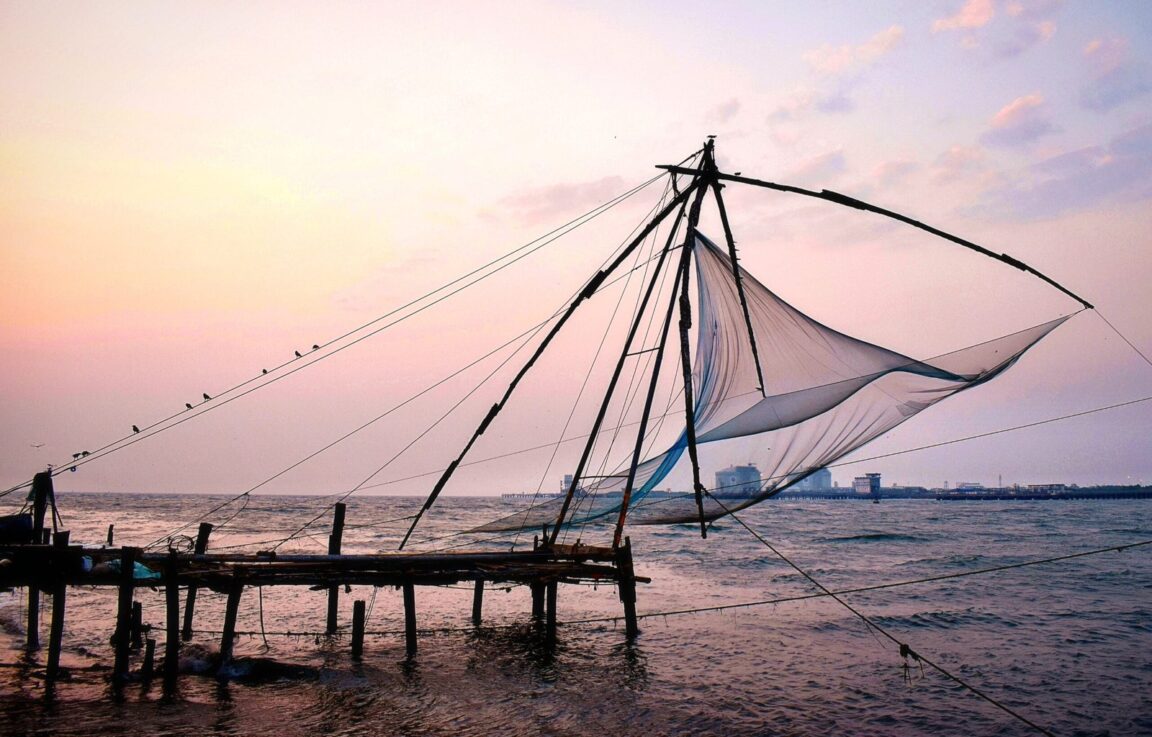
- Signature sight: The Chinese fishing nets, Cheena Vala, cantilevered shore operated nets along the Vasco da Gama Square waterfront, free to watch and best at early morning and sunset
- Mattancherry Palace: The Dutch Palace, built by the Portuguese around 1555 for the Raja of Kochi and later renovated by the Dutch, famous for its Kerala murals of the Ramayana; closed on Fridays
- Paradesi Synagogue: Built in 1568 in Jew Town, the oldest active synagogue in the Commonwealth; closed on Fridays, Saturdays and Jewish holidays, modest dress required
- Kathakali evening: At the Kerala Kathakali Centre in Fort Kochi, make up application runs from about 5pm and the performance from about 6pm; arrive for the make up, not just the show
- Best season: October to March, with November to February the driest and most comfortable for walking
- The Friday trap: A Friday in Mattancherry loses both the palace and the synagogue; put Mattancherry on a Sunday to Thursday if the trip allows
Day 1 morning: the nets and the Fort Kochi waterfront
Start early at Vasco da Gama Square, the promenade at the tip of Fort Kochi, where the Chinese fishing nets stand in a row over the harbour entrance. Each net is a great cantilevered structure of teak and bamboo poles, its wide mesh suspended from a horizontal boom and balanced by stone counterweights on ropes. A crew of several men works each net as a team, walking the ropes to dip the net into the channel and hauling it up minutes later with whatever the tide has delivered. The nets are believed to have arrived with traders from China centuries ago, and around a dozen still work this shore. Their catch today is modest, sold from the stalls behind the promenade, but as working machinery and as a silhouette against the harbour they remain Kochi’s defining image.
Early morning is the working hour, when crews are active and the light is soft; sunset is the beautiful hour, when the nets stand black against the sky and the whole promenade gathers. A two day stay can have both, and should. Between those bookends, walk the fort slowly. St. Francis Church, a short stroll inland, was built by the Portuguese in 1503 and is among the oldest European churches in India; Vasco da Gama, who died in Kochi in 1524, was first buried here before his remains were returned to Portugal, and his tombstone remains in the floor. The Santa Cruz Basilica, with its frescoed interior, and the quiet Dutch Cemetery, consecrated in 1724, complete a compact circuit of the fort’s layered colonial history, Portuguese first, then Dutch, then British, each leaving buildings the next adapted.
Day 1 afternoon: lanes, galleries and the slow hours
Fort Kochi’s streets around Princess Street and the Parade Ground repay unplanned wandering: rain trees, old merchant houses, spice shops, bookshops and a cafe culture built on the art crowd that the Kochi-Muziris Biennale brings to the fort in its editions. One honesty note matters for planning: the Biennale is an event, not a permanent attraction, and its sixth edition ended on 31 March 2026, so do not build a visit around Biennale venues being open unless a new edition has been announced for your dates. What remains year round is the fabric the Biennale chose, warehouses, courtyards and waterfront godowns that make even an ordinary afternoon walk feel curated.
Use the hot middle of the day as Kochi does, with a long lunch and a rest, because the evening programme starts early. Eat where the harbour points: fresh fish bought by weight near the nets and cooked at the stalls, or a Kerala meal of rice, fish curry, thoran and appam in one of the fort’s courtyard restaurants. Travellers continuing through Kerala afterwards will find the natural companion read in our Ayurveda in Kerala retreat guide, which covers the state’s other great tradition of deliberate slowness.
Day 1 evening: the Kathakali sequence, make up first
The Kathakali evening is the appointment the whole day should be built around, and its essential detail is timing. At the Kerala Kathakali Centre on KB Jacob Road, the evening opens at about 5pm with the make up session, when performers sit before the audience and build their characters in public: the green pacha vesha faces of noble heroes, layer by layer, the chutti beard of white paste and paper, the towering headgear and skirts assembled piece by piece. Watching this transformation is not a preliminary. For many visitors it is the most memorable hour in Kochi, because it turns the performance that follows from spectacle into craft.
The performance itself, from about 6pm, presents scenes from the great epics in the classical Kathakali form, dance drama told through codified hand gestures, the mudras, through the nine facial expressions, the navarasas, and through music and percussion, with an introduction that teaches the audience how to read what it is seeing. A short demonstration format suits first time viewers perfectly; the full traditional form runs all night, and no two day itinerary needs to apologise for taking the distilled version. The centre’s evenings also commonly include a Kalaripayattu martial arts demonstration, Kerala’s ancient fighting form, all leaps, spins and sword work, which pairs with Kathakali as the physical other half of the same performance culture. Book ahead in the busy season, arrive for the 5pm make up, and sit close enough to see the actors’ eyes, because in Kathakali the eyes do half the acting.
Day 2: Mattancherry, the palace, Jew Town and the spice warehouses
Take the short ride east to Mattancherry on the second morning, and start at the palace before the day heats up. The Mattancherry Palace, universally called the Dutch Palace, was built by the Portuguese around 1555 as a gift for the Raja of Kochi and later renovated by the Dutch, a naming confusion that is itself a short history of the port. Inside, the palace’s glory is its murals: whole rooms of Kerala tempera painting narrating the Ramayana in dense, glowing detail, alongside scenes from the Mahabharata and other epics, portraits of the Rajas of Cochin and displays of royal dress, weapons and palanquins. Photography is not permitted in the mural rooms, which enforces the right kind of looking. Allow an hour to ninety minutes, and remember the closure rule: the palace shuts on Fridays.
From the palace, walk into Jew Town, the quarter that grew around the Paradesi Synagogue and the spice trade. The synagogue, built in 1568 by the Jewish community that traded in Kochi for centuries, is the oldest active synagogue in the Commonwealth, its floor paved with hand painted blue and white Chinese tiles, each one different, and its interior hung with glass lamps and centred on a brass railed bimah. It keeps strict visiting discipline: closed Fridays, Saturdays and Jewish holidays, modest dress, no photography inside. Check your day against that list before setting out, because Jew Town without the synagogue is a pleasure but a diminished one.
The streets between palace and synagogue are the other half of Mattancherry’s story. This was, and in part remains, a working spice port: warehouses and godowns stacked with black pepper, ginger, cardamom and turmeric, the air itself seasoned, with antique and curio shops filling the old trading houses along Jew Town Road. The antiques trade here ranges from genuine architectural salvage to cheerful reproduction, and the correct approach is to buy what you love at a price you accept, after unhurried bargaining, rather than to hunt for certified treasure. The spice, by contrast, is exactly what it claims to be; buy pepper and ginger here, vacuum packed for the flight home.
Day 2 afternoon: the harbour from the water, and Ernakulam if time allows
Kochi is a port before it is anything else, and the second afternoon is the moment to see it from the water. Public ferries cross between Fort Kochi, Mattancherry, Vypeen and Ernakulam for a few rupees, functioning as both transport and the cheapest harbour tour in India, and the newer Kochi Water Metro electric ferries run modern, air conditioned services on key routes including Fort Kochi connections. A simple crossing at golden hour, past the nets, the naval base, the port cranes and the fishing fleet, gathers the whole geography of the city into one ride.
If energy remains, Ernakulam, the mainland commercial city across the harbour, offers the contrast that completes Kochi: Marine Drive’s promenade, modern malls and the working city that Fort Kochi’s heritage calm exists in counterpoint to. Most two day visitors will rightly choose a second sunset at the nets instead. Either ending is correct; what would be wrong is a dash to the backwaters. Alleppey and the houseboat country deserve their own day or overnight, and bolting a rushed backwater cruise onto a Kochi stay short changes both places. Travellers building a wider India route can pair this coast with the capital using our first time Delhi three day itinerary.
Where to stay and how to get around
Stay in Fort Kochi. The heritage hotels and homestays in converted merchant houses put the nets, the churches and the Kathakali centre inside a ten minute walk, and the neighbourhood’s evenings, quiet lanes and cafe dinners, are half the experience. Mattancherry has fewer options and Ernakulam’s business hotels suit only travellers who need the mainland. Within the fort and Mattancherry, walking and short auto rickshaw rides cover everything; agree the fare or insist on the meter before moving. From the airport, prebook a transfer or use the official taxi desk, and allow the full ninety minutes the 42 kilometre road can take in traffic.
Frequently Asked Questions
What day should I avoid for Mattancherry?
Friday, when both the Dutch Palace and the Paradesi Synagogue are closed. Saturday loses the synagogue as well. A Sunday to Thursday visit keeps every door in Mattancherry open, subject to Jewish holidays, which also close the synagogue.
Do the Chinese fishing nets still work?
Yes. Around a dozen nets still operate along the Fort Kochi shore, worked by crews using the original counterweight system. Catches are small today, and the nets function partly as living heritage, but the early morning routine of dipping and hauling is genuine work, not a performance.
Why should I arrive at 5pm for Kathakali if the show starts at 6pm?
Because the make up application, from about 5pm at the Kerala Kathakali Centre, is an essential part of the art. Performers build their painted faces and costumes in front of the audience, and watching a character assemble makes the gestures and expressions of the performance itself far easier to read and enjoy.
Is Fort Kochi or Ernakulam the better base?
Fort Kochi, decisively, for a leisure trip. Every sight in this itinerary is in Fort Kochi or Mattancherry, the heritage accommodation is there, and the atmosphere is the reason to come. Ernakulam is the commercial mainland city, useful for transport connections and modern hotels.
How long does the airport journey take?
Cochin International Airport is about 42 kilometres from Fort Kochi, and the road journey takes roughly 90 minutes, longer in heavy traffic. Prebook the transfer, and on departure day leave with genuine margin rather than trusting a quiet road.
Can I add a backwater houseboat trip to the two days?
Not without damaging both experiences. The houseboat country around Alleppey is a separate destination needing at least a full day, ideally an overnight on the water. Two days in Kochi are fully and properly used by Fort Kochi and Mattancherry alone.
Closure days, performance timings and visitor details checked 14 November 2026 against venue and Kerala tourism information. Synagogue and palace hours can change for holidays and maintenance, so reconfirm Mattancherry timings before setting out.