 River Callahan
Tarifa runs on two winds, and a first kitesurfing week here succeeds or fails on reading them correctly. The Levante blows from the east, warm, strong and gusty, often between 20 and 40 knots, and on the main Atlantic beaches it blows offshore, which makes it water for experienced riders with rescue cover, not for lessons. The Poniente blows from the west off the Atlantic, cooler and far steadier, typically 12 to 22 knots, side-onshore at the main beaches, and it is the wind beginners should pray for. Tarifa sits at the southernmost point of mainland Europe, where the Strait of Gibraltar funnels air between the Atlantic and the Mediterranean, and local schools count usable wind on more than 300 days a year. This guide sets out an honest first week: which beach suits which level in which wind, how lessons are actually sequenced, when to sit a day out, and what to do when the wind refuses to cooperate.
Quick Facts
- The two winds: Levante from the east, warm, gusty and strong at roughly 20 to 40 knots; Poniente from the west, cooler, steadier and lighter at roughly 12 to 22 knots
- Beginner wind: Poniente. It blows onshore or side-onshore at the main beaches, so a drifting learner drifts back toward the sand
- Expert wind: Levante. It blows offshore at Los Lances, flattens the water and demands a rescue boat plan
- Main beaches: Los Lances, a long Atlantic beach running about 10 kilometres northwest of town; Valdevaqueros, the bay beneath the Punta Paloma dune about 8 kilometres out; Balneario, the town beach, for advanced riders in Levante
- Summer zoning: From mid June to mid September, marked swimming zones close parts of Los Lances to kites, and kitesurfing is banned on Balneario in daytime hours; schools work the designated zones at Los Lances Norte and Valdevaqueros
- Wind season: The main season runs roughly March to October, busiest from May to September; winter is quieter and less consistent
- Lesson shape: Courses build from land based kite control to body dragging to board starts over several days, almost never on day one in strong wind
- Forecast habit: Check the forecast every evening and plan the next day around the wind direction first and the strength second
Why does Tarifa get this wind at all?
The geography is the whole story. Tarifa occupies the narrowest stretch of the Strait of Gibraltar, about 14 kilometres from Morocco at the closest point, and the strait acts as a nozzle between two seas. When pressure differences build between the Atlantic and the Mediterranean, air accelerates through the gap, and the result is a wind machine that works in both directions. An easterly flow becomes the Levante, arriving warm after crossing land, often holding for days at a time and gusting hard. A westerly flow becomes the Poniente, arriving off the ocean cooler, cleaner and more evenly, and frequently strengthening in the afternoon as the land heats and a thermal effect adds to it.
That two direction system is why Tarifa can host a kitesurfing industry rather than a kitesurfing season. If one direction fails, the other often delivers, and the beaches are arranged so that each wind has a correct address. It is also why a single forecast number means little here. Twenty knots of Poniente and twenty knots of Levante are different sports on the same beach, and the first skill a Tarifa week teaches is asking which wind it is before asking how strong it is.
Levante and Poniente, honestly compared
The Levante: strong, gusty and offshore
The Levante is the famous wind and the dangerous one for learners. It blows from the east, off the land, so at Los Lances it pushes riders away from the beach toward open water and the shipping lanes of the strait. It is gusty by nature, with lulls and spikes that punish beginners who cannot yet edge against the kite or relaunch quickly. Its compensations are real: it flattens the Atlantic swell into fast, smooth water, and strong Levante days produce the big air sessions Tarifa is photographed for. Schools adapt rather than cancel. Teaching moves to Valdevaqueros, where the bay shape gives more side shore angles, and licensed schools run rescue boats on Levante days at the main spots. The honest rule is simple. If you cannot yet ride upwind reliably and relaunch in deep water, a strong Levante day is a watching day, a theory day or a land lesson day, not a water day.
The Poniente: the learning wind
The Poniente is less glamorous and far more useful. Blowing from the west off the Atlantic, it arrives side-onshore to onshore at Los Lances and Valdevaqueros, so mistakes drift you back to the beach instead of out to sea. It is steadier, with fewer violent gusts, and its typical 12 to 22 knot range is exactly the band in which training kites behave and first board starts happen. It also builds waves rather than flattening them, which makes the water choppier and the learning slightly harder in one respect, but the safety geometry outweighs everything. A first week built around Poniente days will put more hours of real progress into a learner than a week spent waiting out Levante heroics.
Which beach for which rider?
Los Lances and Los Lances Norte
Los Lances is the long beach, roughly 10 kilometres of wide Atlantic sand running northwest from the edge of town, backed by dunes and marsh. Its northern section, Los Lances Norte around the Rio Jara mouth, is the school heartland: a designated year round kitesurfing and school zone with room to launch, land and spread lessons out. In Poniente this is the default teaching beach for good reason. In summer, from about 15 June to 15 September, the stretch nearest town is zoned for swimmers and kiting is restricted to the marked corridors further out, so follow the flags and your school, not the empty sand that looks convenient. On strong Levante days the blown sand alone makes the town end of this beach unpleasant, and the offshore wind makes it the wrong choice on the water.
Valdevaqueros and Punta Paloma
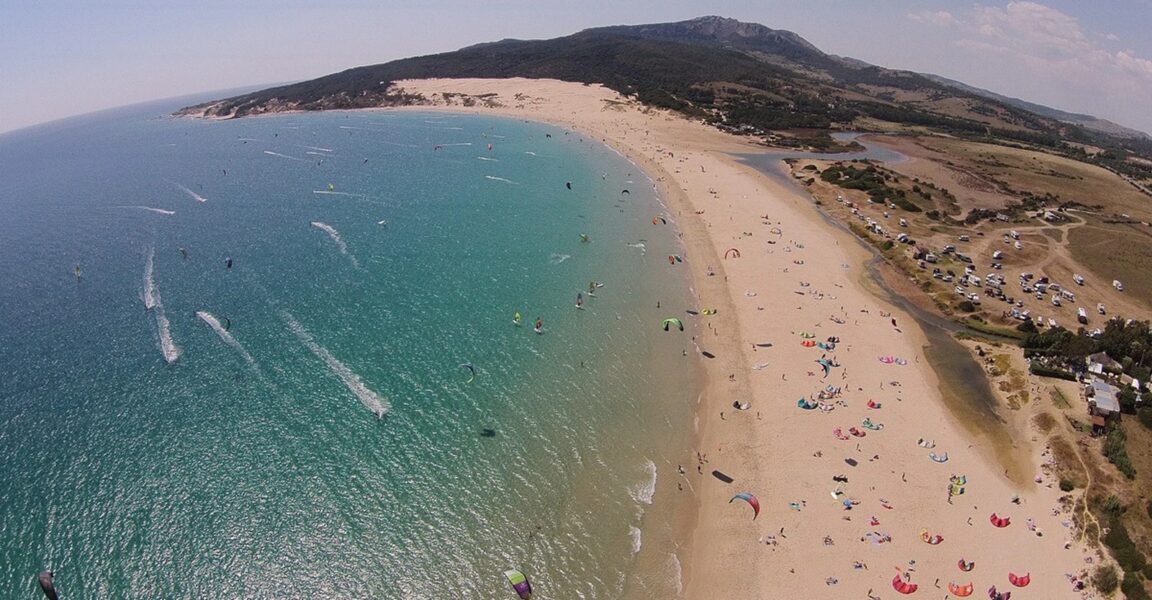
Valdevaqueros, about 8 kilometres northwest of town beneath the great Punta Paloma dune, is the bay most schools treat as the all winds fallback. The curved bay softens the Levante problem compared with Los Lances, the beach is wide enough for school zones and independent riders to coexist, and on a good afternoon hundreds of kites can be up at once. It works in both wind directions and for most levels, which is why it gets busy. Arrive early in high season, respect the school zones marked on the sand, and walk your kite out to the water rather than launching through the crowd.
Balneario: the advanced Levante option
Balneario, the beach on the town side by the island causeway, is the flat water Levante spot, and it is for advanced riders only. The same wind that is a hazard at Los Lances produces butter flat water here, close to town, and experienced locals use it accordingly. Kitesurfing is prohibited on Balneario during summer daytime hours, roughly mid June to mid September until the evening, so even advanced visitors should treat it as an out of season or evening option and check the current local rules before rigging. Beginners should not be on this beach in any month.
How a first week actually runs
Book lessons with a licensed school and expect a sequence, not a single heroic day. Day one is mostly on land: wind theory, the wind window, setting up, and flying a trainer or small kite on the beach until steering is automatic. The next stage is body dragging in the water, learning to use the kite to pull you without the board, including dragging upwind to recover a board you have not yet been given. Only then come board starts, combining kite control and board handling in short, often frustrating bursts, and finally short rides in both directions. Realistic progress across a week of mixed wind is reaching independent water starts and brief rides, not riding upwind all day, and any school promising more in three days is selling, not teaching.
Structure the week around the forecast rather than the calendar. Put lesson blocks on the Poniente days and the moderate days, use strong Levante days for theory, equipment briefings, or supervised watching from the beach with an instructor explaining what the experienced riders are doing, and keep one genuine rest day, because shoulders, forearms and concentration all fail before enthusiasm does. Spring and autumn weeks suit learners well: the wind is plentiful, the beaches and schools are quieter than in July and August, and accommodation costs less. Riders who want a second wind sport base on the same trip often compare Tarifa with the winter surf scene in Taghazout in Morocco, where the honest expectations lesson is the same one Tarifa teaches: match the spot to your level on the day, not to the poster.
Safety rules that are not optional
Never learn, or ride beyond your level, in offshore wind without rescue cover, and confirm before booking that your school runs rescue boats on Levante days. Rig one size smaller than the average wind suggests in Levante, because the gusts, not the average, are what will hurt you. Stay inside the marked zones in summer and give swimmers absolute priority. Wear the harness, helmet and impact protection your school issues during lessons, use a kite leash every session, and learn the self rescue procedure before you need it, in the body dragging stage, not after your first crash far out. If the wind picks up beyond your lesson plan, come in. Tarifa will be windy again tomorrow; that is the entire point of the place.
What to do on a no wind or too much wind day
Even Tarifa has flat days, and strong Levante spells can close the water to learners for two or three days at a stretch. The town fills the gaps well. The old town inside the walls, the castle of Guzman el Bueno above the port, and the ferry across to Tangier for a day trip all work without wind. The beaches themselves become walking territory, birdwatching on the strait migration route is serious here in season, and the chiringuitos at Valdevaqueros and Los Lances serve long lunches built for exactly these afternoons. Food planning helps too: Andalusian eating runs late, and a kite week pairs naturally with a wider Spanish food trip such as the one mapped in our guide to what to eat in Valencia, where lunch is the main event and dinner starts after your evening forecast check, not before.
Frequently Asked Questions
Can a complete beginner learn to kitesurf in Tarifa?
Yes, and it is one of Europe’s best places to learn, provided the lessons run in Poniente or moderate conditions at Los Lances Norte or Valdevaqueros with a licensed school. Expect land based kite control first, then body dragging, then board starts across several days. A beginner should not be on the water in strong Levante at any point in the first week.
Which wind is better, Levante or Poniente?
For learning and for most intermediate riding, Poniente: steadier, lighter and onshore, so errors drift you back to the beach. Levante is the advanced wind: stronger, gustier, offshore at the main beaches, producing flat water and big air for riders who can already ride upwind and relaunch reliably, with rescue cover on the water.
When is the best time of year for a first kitesurfing week?
Spring and autumn balance wind, space and price best, inside a main season that runs roughly March to October. Summer from May to September is the busiest and windiest period, with summer beach zoning in force from mid June to mid September. Winter brings wind too, but less consistently, and with colder water.
How many days of lessons does a beginner need?
Plan on a course spread across at least three to five windy days to move from kite control through body dragging to first board starts and short rides. Wind direction will decide which days those are, so book a week and let the school place the lessons on the suitable days rather than fixing them in advance.
Is kitesurfing allowed everywhere on Los Lances in summer?
No. From about 15 June to 15 September, swimming zones close the town stretch of Los Lances to kites and kiting concentrates in the designated areas at Los Lances Norte and at Valdevaqueros. Balneario is also closed to kitesurfing in summer daytime hours. Follow the flags, the school zones and local instructions on the day.
What happens if the Levante is too strong for lessons?
A good school moves the teaching to Valdevaqueros, runs land based and theory sessions, or rests the day, and rescue boats operate at the main spots on Levante days for the experienced riders who do go out. Treat a blown out day as part of the course design, not a lost day, and use it for the old town, the castle or a Tangier ferry day trip.
Wind patterns, beach zones and seasonal restrictions checked on 14 November 2026 against Tarifa tourism and kitesurf spot sources, including the destination guide at tarifa.travel and local spot guidance. Zones, school arrangements and rescue provision change by season and operator, so confirm the current rules with your school and the flags on the beach before rigging.