 Priya Nair
Every Gjirokaster journey has the same shape: a bus or car journey into the Drino valley, a drop at the bus station on the flat edge of the new town, and then a climb, on foot, by city bus or by taxi, into the steep cobbled bazaar quarter under the castle. There is no railway, and the old town lanes themselves are effectively pedestrian, too steep and too narrow for anything but feet. Plan for roughly 3.5 to 4 hours by road from Tirana, about 1 to 1.5 hours from Saranda and its Corfu ferry, and about 2.5 to 3 hours from Berat, then give the last kilometre, station to bazaar, the same respect as the long leg, because that is where first time visitors lose time and temper. This guide covers each leg in order, with the fares most recently reported and the points where you should confirm them locally.
Quick Facts
- Bus station: The regional bus and furgon station at the entrance to town, where the main boulevard meets the National Road, northwest of the centre
- From Tirana: Buses and minibuses most recently listed at 1,000 lek, running hourly from about 7am to 1pm, then a bus at 2:30pm and a night bus; journey roughly 3.5 to 4 hours by road
- From Saranda: Buses most recently listed at 300 lek, hourly until early afternoon, stopping at the bottom of the old town hill; about 1 to 1.5 hours
- From Berat: About 2.5 to 3 hours by road, buses and furgons via the station
- Greece connection: A shuttle runs several times a day to the Kakavije border crossing; many visitors also arrive via the Corfu to Saranda ferry, then the Saranda bus
- Station to old town: A flat, easy walk of about 10 minutes along the boulevard to the centre roundabout, then uphill into the bazaar; taxis most recently listed at about 200 lek for the trip
- City bus: A local circuit links old town and new town for about 30 lek
- In the bazaar: On foot only in practice; steep, polished cobbles, so footwear with grip is not optional
- Tourist information: The information centre near the Old Bazaar, listed as open daily 9am to 5pm from March to November and 9am to 3pm from December to February
How do you reach Gjirokaster from Tirana, Saranda and Berat?
Albania runs on buses and furgons, shared minibuses, and Gjirokaster is a main stop on the north to south road, so the choice is about departure time, not availability. From Tirana, current listings show buses and minibuses leaving through the morning, roughly hourly from 7am to 1pm at a fare most recently reported at 1,000 lek, with an afternoon departure at 2:30pm and a night bus that arrives near Skanderbeg Square in the small hours. The road journey runs south past Fier and Tepelene and into the Drino valley; allow roughly 3.5 to 4 hours and treat timetable precision loosely, because furgons in particular leave when they are reasonably full. From Saranda, the coastal town and ferry port for Corfu, buses most recently listed at 300 lek run hourly until early afternoon and stop at the bottom of the old town hill as well as at the station, which can save you the cross town leg entirely if your stay is in the old town; ask the driver to call the bazaar stop. From Berat, the partner town in Gjirokasters shared UNESCO listing, the road takes about 2.5 to 3 hours, and the pairing is covered in our Berat guide.
Drivers have it simplest: the national road delivers you to the same station junction, and the real decision is parking, because the bazaar quarter has almost none. Stay in the old town and ask your accommodation, before you arrive, where exactly to leave the car; several guesthouses direct guests to specific small plots or streets at the quarters edge. Arriving from Greece, the Kakavije border crossing south of town has a shuttle several times a day, and the Corfu route, flight to Corfu, ferry to Saranda, bus up to Gjirokaster, is a legitimate and often cheaper alternative to flying into Tirana for travellers starting in Europe.
The last kilometre: station to bazaar quarter
The bus station is less a terminal building than a recognised stretch of road at the towns entrance, where the boulevard meets the National Road, with several nearby points where different buses stop. That informality is the main trap: on departure day, ask your accommodation or the tourist information centre exactly where your bus loads, and be there early, because a furgon leaving from the wrong corner is a furgon missed. From the station, the centre roundabout is a flat, easy walk of about 10 minutes along the main boulevard, and from the roundabout the town divides: the new town stays level, while the old town, the bazaar and the castle climb the hill to your right.
Three ways up cover every traveller. Walking the whole way, station to bazaar, takes roughly 25 to 35 minutes with luggage and ends in a steep cobbled climb, fine for the pack light and the fit, miserable with a rolling case on wet stone. The city bus circuit links the new town and the old town for about 30 lek and drops you at the bazaars lower edge, the best value option if the timing lines up. A taxi, most recently listed at around 200 lek from the station area into town, is the sensible default with bags, and taxis also solve the castle problem: the castles entrance is a further steep climb above the bazaar, and riding up to it and walking down through the quarter reverses the days effort in your favour. Agree the fare before you set off, and carry lek in cash throughout; card payment cannot be assumed on buses, in taxis or at sight entrances.
Moving around the bazaar quarter once you arrive
The bazaar, Pazari i Vjeter, is a knot of cobbled lanes meeting at the Qafa e Pazarit junction below the castle, and it is walked, not ridden. The lanes are steep, the cobbles are polished smooth by centuries of feet, and in rain they are genuinely slippery, so the single most useful piece of transport advice for Gjirokaster is about shoes: grip, closed toes, no smooth soles. Everything in the quarter is close: the Bazaar Mosque, which survived the communist era by being turned into a circus training school and now serves as a Muslim school, stands in the bazaar itself; the tower houses, Skenduli House most reliably open and presented by the family that built it, are minutes uphill; and the castle gate is reached by the stall lined cobbled street climbing from the bazaars top edge.
Distances deceive on the hill, so plan the quarter as two half days rather than one march: bazaar lanes, mosque and a tower house in one, the castle in the other, ideally late afternoon for the light over the Drino. Opening patterns here are by arrangement and season more than by fixed museum hours, the castle being the exception, most recently listed at 400 lek entry with high season hours of 9am to 7pm and shorter winter hours, museum ticketed separately; confirm at the gate and at the tourist information centre near the bazaar, whose listed hours are 9am to 5pm from March to November and 9am to 3pm in winter. For what to see once you are standing in the quarter, our Gjirokaster castle and old town guide walks the sights themselves. The National Folklore Festival, held on the castles festival stage, transforms the towns transport when it runs: buses fill days ahead and the quarter is at its most crowded, so festival visits need accommodation and onward buses booked well in advance.
Leaving Gjirokaster: onward routes that actually connect
Onward travel rewards the same early start as arrival. Northbound buses from the station serve Tepelene, Fier, Vlore, Berat and Tirana, and the morning departures are the reliable ones; by mid afternoon the pattern thins, and a missed bus can mean a night you did not plan. Southbound, the Saranda buses connect with Corfu ferries, but the last useful connection leaves earlier than visitors expect, so check the ferry time first and work backwards. The Blue Eye spring, a vivid karst spring on the Saranda road, is the standard stop en route and many furgons will drop you at its turn off, from which it is a walk in; agree the drop before boarding and know your onward plan, because flagging a passing bus from the turn off takes patience. Permet and the Benja thermal baths lie the other way, up the Vjosa valley, served from the same station. In every direction the method is the same: confirm the departure point and time the day before, at the station or through your accommodation, carry cash in lek, and build slack into any same day flight or ferry connection, because Albanian road times are honest averages, not guarantees.
Frequently Asked Questions
How do you get to Gjirokaster from Tirana?
By bus or furgon from Tirana, most recently listed at 1,000 lek, hourly through the morning from about 7am to 1pm with an afternoon and a night departure, arriving at the station at the entrance to Gjirokaster after roughly 3.5 to 4 hours on the road. There is no train. Confirm the Tirana departure point and time the day before.
Can you visit Gjirokaster as a day trip from Saranda?
Yes. Buses most recently listed at 300 lek run hourly until early afternoon and take about 1 to 1.5 hours, and some stop at the bottom of the old town hill. Take the earliest bus up, do the bazaar and one tower house, climb to the castle, and be disciplined about the return, because afternoon departures thin out.
How far is the bus station from the Old Bazaar?
About 10 flat minutes on foot along the boulevard to the centre roundabout, then uphill into the old town, roughly 25 to 35 minutes in total with luggage. The city bus circuit costs about 30 lek, and a taxi has been listed at around 200 lek.
Do you need a car in Gjirokaster?
No. The bazaar quarter is effectively pedestrian, the city bus links old and new town, and taxis are cheap for the station and castle climbs. A car only helps for regional day trips such as the Blue Eye spring, Antigonea or the Benja baths, and it brings a parking problem in the old town that you must solve with your accommodation in advance.
What is the best way to reach the castle?
Walk up through the bazaar if you are fresh, it is the scenic route, or take a taxi to the castle entrance and walk down through the quarter afterwards. The climb is steep cobbles either way. Castle entry was most recently reported at 400 lek with the museum ticketed separately; confirm prices and hours at the gate.
Is there an airport near Gjirokaster?
No. The practical airports are Tirana, roughly 3.5 to 4 hours by road, and Corfu in Greece, reached by ferry to Saranda and then about 1 to 1.5 hours by bus. Build generous slack into any same day flight connection, especially from Corfu, where a ferry crossing sits in the chain.
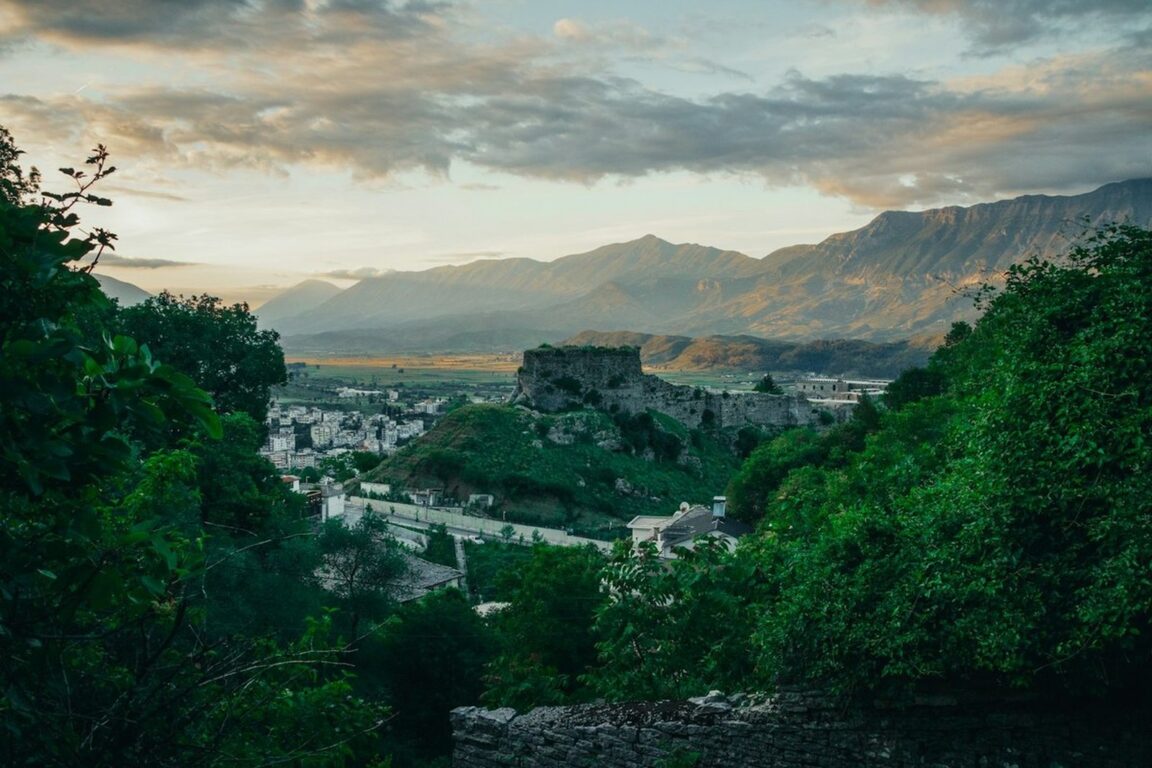
Facts checked 16 November 2026 against Wikivoyage and Wikitravel Gjirokaster transport listings, UNESCOs Historic Centres of Berat and Gjirokastra listing and current visitor guides. Fares are the most recently reported and should be confirmed locally. Featured image: Gjirokaster Castle above the old town and the Drino valley at dusk, the bazaar quarter at its foot. Photo by Shana Van Roosbroek on Unsplash, Unsplash License, via a captioned hosted copy on Honge.