 Maya Chen
Eating in Luang Namtha runs on a market clock. The day starts at the morning market, where noodle stalls steam before the trekking groups have finished breakfast, and it ends at the night market, where the provincial tourism office promises broths, noodles and chicken on spits under a haze of grill smoke from 4 pm to 10 pm every day. Between those two markets sits one of the most ethnically diverse food landscapes in Laos: more than 20 ethnic groups live in and around the Nam Ha National Protected Area, and their ingredients, textiles and cooking show up on the stalls. This guide sequences the eating around the other reasons people come, the Nam Ha ecotourism treks, the handicraft villages and the onward routes north and east, so a food traveller can plan meals, treks and departure days together.
Quick Facts
- Where: Luang Namtha town, capital of Luang Namtha Province in northwestern Laos, near the borders with China and Myanmar
- Morning market: The town market is the breakfast anchor, with noodle soups, fresh produce, tea, coffee and textiles; arrive early for the fullest stalls
- Night market: Open every evening, listed by the provincial tourism office at 4 pm to 10 pm, with grilled meats, broths, noodles and sticky rice
- Signature bowl: Khao soi, the Tai Nuea noodle soup also famous at Muang Sing market, where Tai Nuea women serve it from 6 am to 8 am at peak market time
- The trekking base: Nam Ha National Protected Area covers 244,000 hectares, about 24 percent of the province, and was designated an ASEAN Heritage Site in 2003
- Museum: The Luang Namtha Museum opens 8:30 am to 4 pm, Monday to Friday, with ethnic clothing, textiles and household collections
- Best season: The cool, dry months from November to February are the comfortable window for markets, trekking and river trips
- Onward by rail: The Laos China Railway serves Nateuy station, about 37 km and 40 minutes from town, per the provincial tourism office
What should you eat first at the morning market?
Start with noodles. The morning market is where Luang Namtha eats breakfast, and the noodle stalls are the social centre of the building: bowls of broth, fresh rice noodles, herbs and chilli, eaten quickly at shared tables before the working day begins. Alongside the cooked food, the produce sections carry the raw material of the provincial kitchen, seasonal fruit and vegetables, forest products gathered from the hills, tea leaves and coffee beans, and the woven textiles and ethnic clothing that make the market as much a craft fair as a food hall.
The bowl to hunt down is khao soi. In this corner of Laos, khao soi is a Tai Nuea specialty, a rice noodle soup topped with a fermented soybean and tomato based sauce, quite different from the coconut curry version known in northern Thailand. The provincial tourism office singles out the Tai Nuea women of Muang Sing market, about a two hour drive northwest, whose khao soi draws retailers and shoppers from across the region between 6 am and 8 am. In Luang Namtha town the same tradition anchors the morning stalls, and ordering it first gives a traveller the reference flavour for the whole province.
Practical timing matters. The market is at its best early, when hill tribe vendors from surrounding villages have their fullest displays and the noodle stalls are turning over quickly. By late morning the cooked food winds down and the market becomes mostly produce and dry goods. Travellers heading out on a day trek should eat here rather than at a guesthouse: the food is fresher, the choice is wider and the cost is a fraction of a cafe breakfast.
How does the night market work?
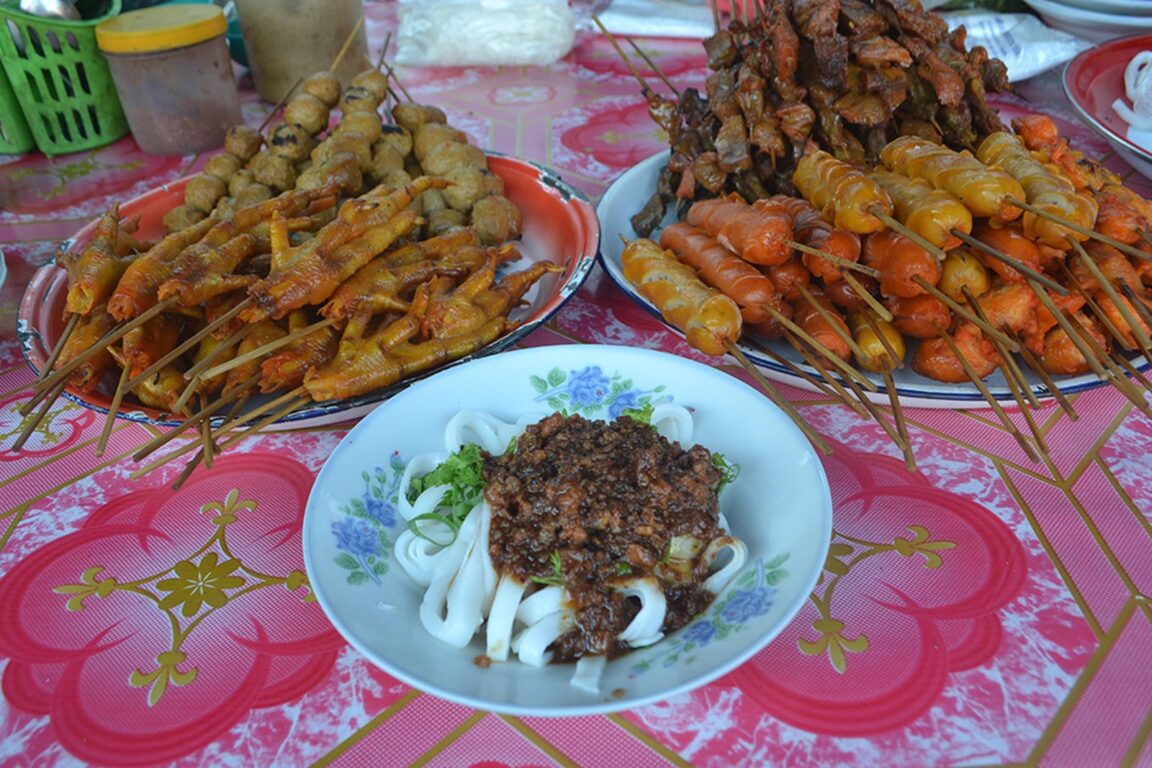
The night market is the town’s evening living room, and the provincial tourism office describes it plainly: freshly made broths, noodles and chicken on spits, tightly packed with local shoppers and veiled in smoke, open every single day from 4 pm to 10 pm. The format is a food court of grills and pots. Roast duck, barbecued pork and chicken sold by weight, fresh spring rolls, papaya salad and sticky rice are the reliable core, and cold Beerlao is the standard accompaniment.
The adventurous end of the market is genuinely adventurous. The tourism office itself lists rhinoceros beetles, grilled intestines and bile soup among the things on offer for the brave. Nobody is obliged to try them, but their presence is a useful reminder that this market feeds the town first and visitors second, which is exactly why the mainstream dishes taste right. Prices are local prices, and a full evening of grazing across several stalls still costs less than a single restaurant main in Luang Prabang.
Sequencing tip: the night market is also the natural debrief for a trek day. Guides and trekking agencies cluster along the main street nearby, so a group can eat, compare notes on the day’s walk and book the next outing in the same hour. In the rainy season the market still opens but runs quieter, with fewer stalls; in the cool season it is the busiest room in town.
What food will you meet on a Nam Ha trek?
The Nam Ha National Protected Area is the reason most visitors reach Luang Namtha at all, and its food culture is part of the trek. The protected area covers 244,000 hectares of forest and hill country, designated an ASEAN Heritage Site in 2003, and its ecotourism model, which has collected the ASEAN Community Based Tourism Award and an Equator Prize for its eco guide service, routes trekking income to the ethnic villages inside and around the forest.
On the trail, guides cook. The tourism office describes trek lunches assembled with a knife in the forest, banana leaf presentations of rice, vegetables and whatever the village or the forest provides that day. Overnight treks stay in jungle camps, eco lodges or village homestays, and the evening meal in a Khmu, Akha, Lanten or Tai village is the cultural centre of the trip: home cooking eaten with the host family, built on sticky rice, seasonal greens, river fish where available and fermented staples that rarely appear in restaurants.
The Nalan Trail, which received an ASEAN tourism award, is the signature overnight route, walking through forest to a remote Khmu village on the banks of the Nam Ha River, and it can be combined with a day of kayaking back down the river. Day treks, multi day treks, kayaking on the Nam Ha and Nam Tha rivers, rafting and mountain biking are all bookable through the qualified agencies on the main street in town. One honest caveat from the tourism office: low water from December to June can make some river sections difficult, so kayak plans are seasonal even when trekking is at its best.
Which village stops add food and craft to a rest day?
Not every day needs a trek. The Luang Namtha Valley Route, an approximately 35 km self guided loop the tourism office maps at two to four hours, strings together eight ethnic villages and five cultural and religious sites, and several of its stops are food and craft stops in disguise.
Nam Dee village, about 5.5 km out of town, is a Lanten community known for bamboo paper making and indigo dyeing, with a waterfall beyond the houses and an entrance ticket at the village. The Phieng Ngam Handicraft Centre, about 6 km from town, is where the valley’s weavers demonstrate the loom work behind the textiles sold in the morning market, with pieces for sale and snacks and coffee on site. The Luang Namtha Museum, open weekday hours in town, gives the context that makes the market intelligible, with its collections of indigenous clothing, agricultural tools, bronze drums, ceramics and textiles from the province’s many communities.
Two stupas punctuate the northern half of the route: the golden Luang Namtha Stupa above the north end of town, built in 2004 with a viewpoint gazebo over the valley, and Poum Pouk Stupa, whose original was constructed in 1628 to mark neutral territory between the Lane Xang and Lane Na kingdoms and which was rebuilt in 2003 after wartime damage. Neither is a food stop, but both are natural pauses on a cycling day built around eating and villages.
How do you continue onward, including toward Mu Cang Chai?
Luang Namtha is a crossroads town, and food travellers often pass through it on longer northern itineraries. The provincial tourism office lists the practical links. The Laos China Railway station at Nateuy is about 37 km away, roughly 40 minutes by minivan or taxi, with trains taking around three to five hours to Vientiane and tickets bookable at the station or on the LCR app. Regular flights link the town with Vientiane on Lao Airlines and Lao Skyway, and buses run to Huay Xai on the Thai border, to Luang Prabang and to the province’s other districts.
The overland route east toward Vietnam and the rice terraces of Mu Cang Chai is a different kind of journey: a multi leg road trip through the northern mountains toward the Tay Trang border crossing near Dien Bien Phu, then on through Son La province toward Yen Bai and Mu Cang Chai. There is no single through ticket and no direct bus for the whole arc, so plan it as separate legs, confirm each one locally a day ahead, and carry the same market habit with you: eat where the morning market is busiest, because in these mountain towns the market is still the best restaurant in the district. Travellers coming the other way, from Mu Cang Chai toward Luang Namtha, should expect the same legs in reverse and the same need for buffer days in the wet season.
For a regional comparison of Cambodia’s great market and river town eating, see our guide to Battambang, Cambodia’s river town, and for Vietnam’s imperial food city, our Hue imperial citadel and tombs guide pairs naturally with the northern Vietnam leg of this route.
When should you come, and what does a day cost?
The cool dry season from November to February is the consensus best window: trekking trails are dry, mornings are fresh, the markets are full and river levels still allow most activities early in the season. March to May turns hot, and the wet season from roughly May to October brings heavy rain, mud on the trails and a quieter night market, balanced by the greenest landscapes of the year.
Costs stay low by regional standards. Market meals are priced for local shoppers, a night of grazing at the night market costs a few dollars, and the main expenses of a Luang Namtha stay are the guided treks themselves, which vary by group size and length and are quoted by the agencies in town. The honest budgeting advice is to spend on the trek and eat at the markets: that is both the cheapest and the best tasting version of this town.
Frequently Asked Questions
What is the one dish to try in Luang Namtha?
Khao soi, the Tai Nuea style rice noodle soup with a fermented soybean and tomato topping. It is the morning market signature here and at Muang Sing, and it tastes nothing like the coconut curry khao soi of northern Thailand.
What time does the Luang Namtha night market open?
The provincial tourism office lists the night market as open every day from 4 pm to 10 pm. Go between 6 pm and 8 pm for the fullest range of grills and stalls.
Do I need a guide for Nam Ha treks?
Yes. Treks in the Nam Ha National Protected Area run through qualified local agencies with trained eco guides, which is the model that funds village participation. Book on the main street in town and confirm what meals are included.
How long should I stay in Luang Namtha?
Three days is the working minimum the tourism office itself suggests: a market and museum day, a day or overnight trek, and a valley route day for the villages and waterfalls. Add a day if kayaking is on the list.
How do I leave Luang Namtha by train?
Travel about 37 km to Nateuy station on the Laos China Railway, roughly 40 minutes by road, and book at the station or through the LCR app. Trains connect south toward Luang Prabang and Vientiane.
Is Luang Namtha a practical stop on the way to Mu Cang Chai?
Yes, as a staged overland journey rather than a single ride. Route east through the northern mountains to the Tay Trang crossing near Dien Bien Phu, then continue through Son La toward Mu Cang Chai, confirming each leg locally.