 Lucas Meyer
Ninh Binh has the clearest food identity in northern Vietnam, and it starts with goat. The provinces limestone hills are grazing land for free ranging mountain goats, and the meat, lean, firm and sweet, is cooked a dozen ways in restaurants that exist for no other purpose. The second dish is com chay, slabs of rice crust fried until crisp and served under a savoury topping or carried home by the bag. Add eel vermicelli, seasonal mountain snails and the rice wines of Kim Son and Nho Quan, and a two day food trip writes itself: a full goat banquet on day one, market breakfasts and the lighter dishes on day two, with the boat trips at Tam Coc and Trang An in between.
Quick Facts
- Where: Ninh Binh, northern Vietnam, about 90 km south of Hanoi, a landscape of limestone karsts, rivers and rice fields around Tam Coc and Trang An
- The signature: De nui, mountain goat. Ninh Binh goat was named among Vietnams top 50 specialities by the Vietnam Records organisation in 2012, a status the goat restaurants of the province still cite
- Where to eat it: Nha Hang De Nui Thanh Long, 04 Ngo Quyen Street, Dong Thanh, Ninh Binh City, by the Non Nuoc bridge with views over the Day River. Listed hours 9 am to 10 pm daily. The restaurant seats up to 500 and runs set menus from 150,000 VND per person per its own site
- Order there: De tai chanh, goat cured in lime; de xao lan, rolled and stir fried goat; de nuong, grilled goat; doi de, goat sausage; lau de, goat hotpot; and com chay on the side
- The goat itself: Thanh Longs own site specifies free ranging mountain goats of 15 to 25 kg, chosen because the meat stays aromatic, firm and low in fat
- Drink: Kim Son rice wine and ruou can, the communal jar wine of Nho Quan, are the traditional pairings named by the goat restaurants
Why does goat define Ninh Binh?
Geography. The goats climb and graze on the limestone hills around Hoa Lu, the ancient capital, feeding on wild leaves and herbs on the rock, and the result is meat unlike farmed goat anywhere else: lean rather than fatty, firm rather than soft, and sweet rather than gamey, provided it is cooked by people who understand it. Ninh Binh has cooked it for generations, and the provinces goat restaurants are not a tourist invention. They are where Vietnamese families and tour groups from Hanoi eat on weekends, in dining rooms built for banquets, with the goat courses arriving in sequence until the table is covered.
The full order, for a group, is the set menu, and Thanh Long, one of the best known houses, lists sets for six and for ten alongside a menu of more than 200 dishes, with per person set prices starting at 150,000 VND on its own site. The courses to insist on are the signatures. De tai chanh comes first: raw goat sliced thin and cured in lime juice, wrapped with herbs and fig leaves, the dish every Ninh Binh meal is judged by. Then the cooked courses in rising richness: steamed goat, de xao lan rolled in its own skin and stir fried with lemongrass, grilled goat over charcoal, crisp goat sausage, and a goat hotpot to finish if the table still has room. Com chay belongs on the table from the start, as the crisp, edible plate under everything.
What exactly is com chay?
Rice, cooked, pressed and dried, then deep fried until it puffs into a golden, shattering crust. In a restaurant it arrives as a slab under a hot topping of meat and gravy, eaten with a spoon and chopsticks as it softens at the edges and stays crisp in the middle. As a snack it is sold in bags, topped with pork floss or dried shrimp, in shops and market stalls across the province, and it is the standard Ninh Binh gift to bring home. Local telling credits its invention to an accident in a Ninh Binh kitchen in the 1890s, when scorched rice from the bottom of the pot turned out to be the best part. Whether or not the story is precise, the logic is: this is a rice growing province making a delicacy out of the rice crust every pot produces. Order it in a restaurant first, where it is served hot and sauced, then buy the bagged version with that benchmark in mind.
What comes after goat?
The supporting cast, which is where day two lives. Mien luon, glass vermicelli with eel, is the provinces other named speciality: crisp fried eel and soft eel in a rich broth with the noodles, banana flower and herbs, served in the city and around Tam Coc as a breakfast or lunch bowl. Oc nui, mountain snails gathered from the limestone hills, are seasonal, appearing in warm months, steamed with lemongrass and ginger and picked from the shell with a pin. Around Bai Dinh, the vast pagoda complex west of the city, vegetarian com chay sets and pagoda kitchens serve the meat free version of the local table. And in Tam Coc itself, the restaurant strip by the boat pier cooks goat, com chay and river fish for the boat trip crowd, convenient rather than definitive: eat the banquet in the city, and use Tam Coc for breakfasts, coffee and the lighter bowls between boats. For the boat routes themselves, see our Trang An grottoes visit guide, and for another single ingredient food town in Southeast Asia, our Kep and Kampot crab guide takes the same approach with pepper crab.
How do market mornings fit the plan?
Early, and in the city rather than at the sights. Ninh Binh Citys markets and breakfast stalls serve the working day: noodle soups, eel vermicelli, sticky rice and coffee, eaten fast and standing close to the action. Go before the Tam Coc or Trang An boats, not after, because the morning is when the stalls are stocked and the broth is fresh, and because a market breakfast sets up the days rhythm properly: light at dawn, banquet at midday, boats in the soft afternoon, and a smaller goat or hotpot dinner if the group is still ambitious. Cash is the system in the markets and the smaller restaurants. Carry small dong notes, and do not expect card machines outside the hotels and the big banquet houses.
Two days, sequenced
Day one: arrive from Hanoi, market breakfast in the city, the Trang An boat trip in the morning, then the full goat set menu at a banquet house such as Thanh Long for lunch, ordered as de tai chanh, de xao lan, grilled goat and com chay at minimum. Rest in the heat of the afternoon, climb Hang Mua toward evening for the Tam Coc valley view, and eat lightly in Tam Coc at night. Day two: eel vermicelli for breakfast, the Tam Coc boats early, mountain snails if they are in season, a com chay slab served hot as the last lunch, and bags of com chay and a bottle of Kim Son wine for the road. The goat is the headline, but the trip is the sequence: crust, lime cured goat, eel, snails, wine, in that order.
Frequently Asked Questions
What is the one dish I must order in Ninh Binh?
De tai chanh, mountain goat cured in lime juice and wrapped with herbs. It is the signature of the provinces goat restaurants and the dish the whole local food culture is judged by, with com chay, the fried rice crust, as the essential second order.
How much does a goat meal cost?
At Thanh Long, a featured banquet house, set menus start from 150,000 VND per person per its own site, with sets built for groups of six and ten. Smaller restaurants and Tam Coc strip kitchens price individual goat dishes by the plate.
What is com chay made from?
Rice. Cooked rice is pressed, dried and deep fried into a crisp golden crust, served hot under a savoury topping in restaurants and sold bagged with pork floss as the provinces take home snack. Note the near identical name of the vegetarian set meals served near Bai Dinh pagoda, a different thing entirely.
When are mountain snails available?
Oc nui are seasonal, gathered from the limestone hills and served mainly in the warm months. Ask at the restaurant rather than assuming, and treat them as a bonus course, not the plan.
Is Ninh Binh food spicy?
Not especially by Vietnamese standards. The goat table leans on lemongrass, lime, ginger and fresh herbs, with chilli served as a condiment. The heat is optional and added at the table.
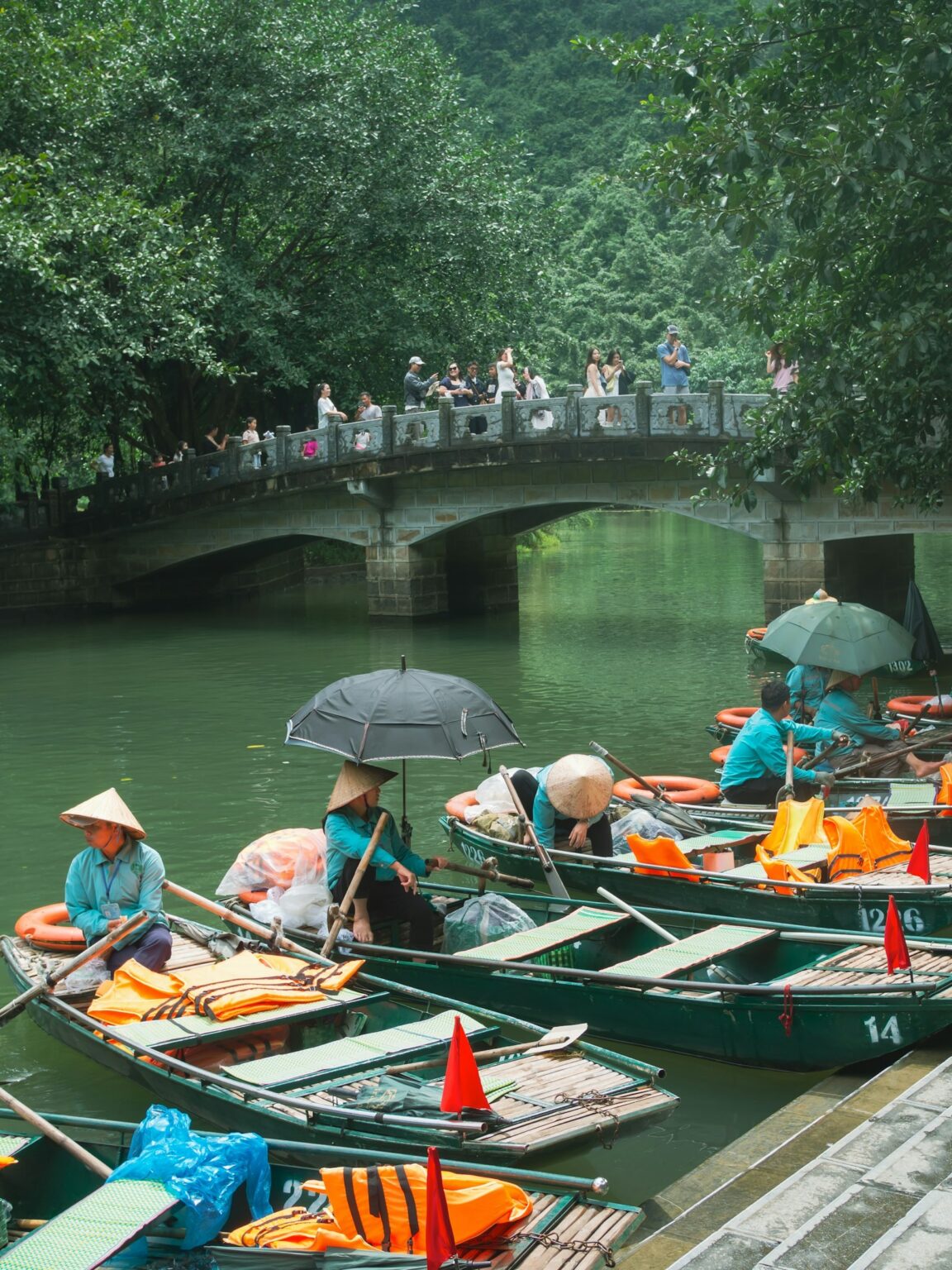
Photo: Rowing boats waiting at Tam Coc, Ninh Binh, where the restaurant strip serves the boat trip crowd. Photo by Yoav Aziz on Unsplash, Unsplash License.